Sunday, 30 October 2011

Beachy Head Marathon – Illustration of the Race Focus Energy Fatigue Model

Hi, be prepared for a marathon post tonight!

Last weekend I raced the 10th Beachy HeadMarathon (previously known as the Seven Sisters Marathon for 21 years).  It was my tenth time, having raced it every year since moving to East Sussex in 2002.  Starting and finishing in Eastbourne, this is my local marathon, so along with the great views as we run across the South Downs completing a 26 mile loop, there is a great atmosphere from the 1750 runners and walkers involved, in addition to the tremendous support along the course from the many spectators, many who give me personalised encouragement due to recognising me from previous years.  Over the previous nine years my finish times have been reasonably consistent, ranging from my fastest of 2:57 in 2007, to my slowest finishing time of 3:11.  In both of these years I finished second, whereas I won the race on all of the other seven occasions.


The graph above shows my finish time plotted alongside my average weekly mileage each year for my 16 week build-up.  There are many aspects that account for the variation in finish time, which as the graph illustrates; the finish time is not directly determined by average weekly mileage.  Therefore within this year’s Beachy Head Marathon race report, I will attempt to provide an explanation into the many factors that influence trail marathon race performance, through an illustration of my newly released Race Focus Energy Fatigue Model.  Hopefully my fatigue model will find some agreement with your experiences of race fatigue, and hopefully lead to a greater understanding of things to consider in order to improve trail marathon and ultra running performances.

Before I describe my TOTAL preparation for this year’s Beachy Head Marathon, first a little background into what causes fatigue during endurance running.  Well as I have highlighted within previous blog posts, very little is actually known in terms of what causes fatigue.  Over recent years, the simple homeostatic failure model of fatigue, (homeostasis refers to remaining stable, or specific to the human body, functioning within a normal range) i.e. fatigue at the periphery within the muscles due to lactic acid, glycogen depletion or muscular damage/fatigue, has been clearly shown to be too simplistic!  Many observations such as: the finishing spurt, different pacing strategies for different race durations, lack of glycogen depletion/lactic acid within muscles when fatigued, and how interventions that solely act on the brain affect performance, all confirm that the simple homeostatic failure model (either peripheral fatigue or catastrophic central/brain failure) , is flawed.  Therefore the need for a new model!

Probably the most significant change over recent years is the increased acceptance that the brain needs to play an extremely important role within any endurance fatigue model.  The Central Governor Model proposed by Professor Tim Noakes, author of the Lore of Running, is probably the most commonly known alternative fatigue model.  The key feature of this model, shown above, is that it is an anticipatory-regulatory model, where the brain anticipates a future failure and so modifies behaviour specifically to ensure homeostasis is protected.  This modified behaviour is a decrease in the number of motor units recruited in the exercising muscles, or what I refer to as a change in the level of muscle activation.  Noakes and others have demonstrated that there is a decrease in muscle activation initiated by the brain when fatigued, They have identified some of the factors that lead to this reduced muscle activation, but haven't really explained how.  My Race Focus Energy Fatigue Model introduces a novel way to look at endurance fatigue and proposes a number of factors that influence the rate at which fatigue develops.

Race Focus Energy (RFE) could be thought of as concentration or mental effort.  It relates to the concept that it requires mental effort/concentration in order to remain focused whilst racing, in order to keep on running hard, out beyond one’s comfort zone.  (The term 'race' doesn't have to mean racing other competitors, it simply means that the run is a special occasion, where you are extending yourself, trying to run to achieve a certain goal.) Fatigue will occur when your supply of Race Focus Energy is depleted so it is no longer able to recruit exercising muscles above a ‘threshold’ level.  Or when the brain anticipates that at your current rate of RFE usage, depletion of RFE is imminent so alters the level of muscle activation to preserve the limited supplies of RFE.  The basis of the RFE fatigue model is that RFE is required in order to activate the exercise muscles above a threshold level.  At low levels of intensity, e.g. at a slow jog when 'fresh', it does not take any RFE to maintain the easy pace.  A slow jog when fresh is below the RFE threshold.  However as the race progress, as the body physiologically becomes less efficient, e.g. muscles fatigues, glycogen levels decrease, heart rate increases due to cardiac drift, to maintain a slow jog now may require RFE as the intensity, albeit rather low is now above the RFE threshold.

At the start of an endurance race, each runner has a limited supply of RFE, although this limited supply can be added to/topped up slightly during the race, however, the greater the supply of RFE at the start, the better the performance.  This therefore leads directly onto Training Principle No. 1 – Maximise the size of the RFE tank prior to race start.
The size of the RFE tank is determined by a number of factors including: Research on the Race, Research on Oneself, and the Surrounding Environment leading up to and immediately prior to the race.  Or to put it simply, the size of the tank is determined by one’s attitude to and expectations of the race; expectations to what will be encountered during the race and an expectation of how one will respond to these challenges. My TOTAL preparation in order to maximise the size of my RFE tank on the start line is to spend many hours researching the race.  What are the demands of the race?:  Total Time, Distance, Profile, Terrain, Daylight/ Darkness, Navigation, Possible Weather, Temperature, Clothing, Feed Stations, Food, Dehydration, Backpack, Fellow Runners, Loneliness, Support, Family/Friends.  I also spend many hours researching myself: WHAT do I WANT?  WHY do I WANT IT?  HOW MUCH do I WANT IT?  Are these WANTS realistic, based on what evidence?

Leading up to the Beachy Head marathon this year, because I had previously raced it nine times, I didn’t need to do any research on the race, as I already knew everything there was to know about the race.  I think the lack of time I spent researching the race also resulted in me spending less time than usual researching myself.  What were my aims/goals for this year’s race?  Having a DNF at Ultra Trail Mont Blanc, where I focused too much of the performance, and forgot about enjoying the journey, I feel I experienced an over-reaction to UTMB, by there being a minimal performance goal for this year’s Beachy Head Marathon.  Yes, it would be nice to win the race for an eighth time, and yes it would be good to run it in under 3 hours again, but there wasn’t really any thought in my preparation into WHY do I want this, and HOW MUCH do I want this.  There wasn’t the usual excitement of looking forward to the race, the real buzz associated with getting ready to really test myself as I strive to respond positively to the expected challenges that the race will create.  So my RFE tank on the start line was not as full as possible.

I suggest above that the amount of RFE one has on the start line is influenced by one’s confidence in that they will respond positively to the expected challenges that the race will create.  Yes, self confidence leading up to the race has a large effect on the level of RFE within the tank, and also the rate at which RFE is being consumed during the race.  One factor that largely determines one’s self confidence is their recent physical training.  If the physical training has been going well, then confidence is usually increased.  How one determines whether physical training has been going well is an important issue, which I will return to, as are a number of other benefits from physical training.

The size of the RFE tank is also determined by the Surrounding Environment leading up to and immediately prior to the race.  What I mean here are things like other stresses within you life, whether work related, family related, stress, tiredness, feeling drained, worn-out, stale etc.  All of these factors will have a negative effect and reduce the amount of RFE at race start.  For the last three years leading up to the Beachy Head Marathon I still felt drained from previous ultra trail races, 56mile London to Brighton (2008), UTMB (2009) and Pumlumon Challenge/High Peak 40 Ultra Trail races (2010).  Therefore my RFE was lower than usual, and hence why even though physically I was extremely fit, with the increase in my weekly mileage during these years, the performance didn’t directly reflect to the physical fitness due to the decreased RFE as a result of being worn-out/tired. 

Finally your surrounding environment prior to the race can, even at the last minute, reduce or increase the level of RFE within the tank.  If you are surrounded my highly motivated people and there is a real buzz then this can add that little bit extra to your tank.  Similarly if there is negativity, conflict, prior to the race, e.g. an argument with your partner, or having to listen to whinging and moaning from runners about injuries, or how tough it will be etc.  Then this can have a decreasing effect on the level of RFE.  Fortunately I didn’t have any of these negative experiences prior to last weekend race, in fact I had many positive experiences, especially from the successful Beachy Head Marathon Science Symposium that took place the night before.

Maybe you are beginning to think, nothing really novel above.  Apart from the term Race Focus Energy, there isn’t really anything to get excited about.  Possibly true, but I think the real revolutionary feature of my RFE fatigue model is what happens DURING the race.  Hopefully I can explain with the use of the following three figures, which include three important concepts; Rating of Perceived Exertion (RPE), Race Focus Energy (RFE), and Muscle Activation.

Rating of Perceived Exertion (RPE) is a common measure used within Sports Science research.  While doing physical activity, subjects are asked to rate their perception of exertion.  This feeling should reflect how heavy and strenuous the exercise feels to them, combining all sensations and feelings of physical stress, effort, and fatigue.  They are then asked to look at the rating scale while they are engaging in an activity, and to choose the number, between 6 - 20, that matches the description that best describes their level of exertion.  Research on running to exhaustion has shown that RPE is a better predictor of the time to exhaustion than any physiology measures.  RPE is influence by many factors, not just physical, and involves the integration and processing of multiple signals – feedback and feed-forward!  There is an increase in RPE when there is a mismatch of expectations to what’s encountered.

One can therefore interpret that not only does extensive research of the race and oneself within the TOTAL preparation increases the level of RFE on the start line, but if their is poor preparation in terms of visualising what one is likely to encounter during the race, then this increased likelihood of there being a mismatch of expectations to what’s encountered will increase RPE.


Looking at the figure above, you see that the level of RPE determines the about of Race Focus Energy that is required in order to provide the muscle activation to run at the demanded race pace.  A higher RPE will increase the amount of RFE required to activate the muscles.  The greater the RFE usage, the sooner it will be before your RFE tank is emptied, which results in decreased muscle activation, and hence a decrease in running pace.  The key to endurance running performance is therefore to reduce the rate at which RFE is being consumed!

The first obvious way to decrease the rate or RFE usage is to getting physically fitter.  Everyone knows that as you get physically fitter, it feels easier to run at the same pace as before, and therefore there is a decrease in RPE.  This concept matches most previous models, and is why there is such a massive emphasis on physical training.  However the novel aspect of the RFE fatigue model is that there is not a DIRECT link between RPE and RFE, as shown in the above figure.  The level of RFE being consumed for a set level of RPE can vary, and is dependent upon the amount of positivity or negativity that is being experienced at that moment of time.  The two figures below illustrate this; if you are experiencing positivity, this will cause the arrow relating RPE to RFE to rotate downwards, resulting is a lower RFE consumption for the same RPE.  So even though you know you are working really hard, i.e. at a high RPE, it doesn’t take much mental effort, it just feels easy, i.e. it is using less than normal RFE. Similarly in experiencing negativity, the RPE – RFE linking arrow will rotate upwards, causing an increase in the rate at which you use the RFE.  In this situation, even though you know that the intensity isn’t very high, i.e. a low RPE, it just feels harder than usual, a real struggle!


The key to TOTAL preparation in order to maximise endurance performance is recognising that receiving positivity and ignoring/rejecting negativity whilst racing can have a large effect on overall performance.  It is not just the final 1- 2 %, e.g. the icing on the cake.  This positivity/negativity has a SUBSTANTIAL effect on endurance performance.  Realising this, accepting that your race performance isn’t preset by your level of physical fitness is essential.  The next step is then to identify what factors can contribute to positivity and negativity, and be prepared to accept/reject these.  Listed below are a number of factors that affect me, but factors that affect you may be different.  This is where race reflection is so important.  Where you reflect back, to learn from what went well, what factors seemed to be related to running well, or related to achieving less than the ideal performance.

LIKELY sources of POSITIVITY - Racing / the competition, overtaking others; Internal feeling of satisfaction, i.e. running well, positive time splits, perception of speed, running non-stop to top of hill; Puffing and blowing hard; Feeling proud, support, family, friends, others; Being excited, unique experience; Feeling refreshed, sponge, water, food, break; Feeling easy yet running well, relaxed, ‘flying by’; Scenery, sunshine, warmth, dry feet, tail wind.

LIKELY sources of NEGATIVITY - Anxiety, doubt, lack of confidence/self belief; Getting tired, finding it hard/tough - counting down the miles; Muscle soreness, blisters - focus of attention!; Going slower than expected - a ‘bad day’!; Going faster than expected - will ‘pay’ for it!; Going off course - frustration, angry; Difficulty in taking on fluid/fuel; Being overtaken, slowing at a great rate; Conditions: rain, cold, heat, mud, wind, scenery.

So back to last weekend’s Beachy Head marathon.  I start the race with a reduced level of RFE due to poor preparation in terms of research on myself, although my surrounding environment leading up to the race was beneficial this year with there not being the tiredness/staleness of the previous three years.  The race starts and as usual it is an exciting feeling as I attack the significant climb at the very start resulting in extensive puffing and blowing.  After around three miles I am joined by Tom Morris a local runner from Lewes Athletic Club.  We run together up the short sharp climb before a lengthy descent down into Jevington.  This point during the race always results in my highest heart rate during the race, as I am able to really attack the short climb knowing that I have 5 minutes recovery on the descent.   Looking at my heart rate trace it shows I reached 179 bpm.  Although quite close to my maximum of around 186 bpm, it is less than previous maximum heart rates of 182 and 184 bpm achieved during 2009 and 2008 at the same point.  We reach Jevington, one of my time checks in 27:10.  I had planned a race schedule for 2 hours 59 minutes, and my target time at Jevington was 27:30, so I was 20 seconds up on schedule.


During the last year or so, although I still plan race split times prior to the race as part of my TOTAL preparation, I now tend to not pay attention to them during ultra races, as it can often lead to negativity, if ahead or behind schedule, which results in the RPE - RFE link arrow rotating upwards.  However, since I have extensive race split time data over nine years I decide that for the marathon I would look at the split times, as a measure of how I was going.  I think this needing to look at split times was mainly a result of my poor research on myself.  I hadn’t determined what I wanted from the race.  When I saw that I was 20 seconds up, it just confirmed that I was going okay, and hence no rotation of the arrow in either direction, as the time up was most likely due to the strong tail wind this year.  For the first time in 10 years, the wind was a tail wind on the way out!

Climbing out of Jevington, I could sense Tom giving me a ‘hurry-up’ as he ran immediately behind me on my shoulder.  Usually this wouldn’t bother me, but as one of my main aims of the day was to simple enjoy the journey, following this not occurring during UTMB, I decide I would get more enjoyment my easing of the pace and to let Tom take the lead.  So as we started the climb up to the top of the Long Man of Wilmington Tom gradually eases away to around 50 – 70 metres lead at the top, and I am happy that I can run at my own pace without distractions.  There is then a lengthy descent to checkpoint 2 (previously checkpoint 1 but an additional checkpoint/feed station was added this year at Jevington).  This is another of my time checks at around 8.8 miles reached in 57:30, so now 30 seconds up on my planned arrival time of 58:00.  Again, no rotation of the RPE - RFE arrow, as although there was an increased positive feeling of enjoying the journey, there was also some negativity in that I was running ‘within myself’ and I should be really ‘pushing harder’ as after all it is a race!  Being in second place wasn’t any cause of negativity as during the last three years, on all occasions I had been in second place till the later stages of the race.

There is a steep climb as we leave Alfriston towards the next checkpoint at BoPeep carpark.  To my surprise I am overtaken by a chap (Steve Nimmo from Orpington Road Runners) wearing a bright multi-coloured, extremely large/baggy t-shirt, (see photo lower down the blog post).  He looks like he is a fun runner on a gentle stroll.  There is an immediate rotation up of the RPE - RFE arrow due to the immediate negativity of dropping down to third, but probably more due to his t-shirt!  How can a fun runner, which I perceived him as, due to his nearly fancy dress costume runner simply stroll past me.  The immediate increase in Race Focus Energy actually ‘snaps’ me back into action.  I am back into race mode, and I am able to up the race intensity, there is an increase in RPE, but no further increase in RFE due to the satisfaction of ‘pushing hard’ again.  I get increased positivity from working hard again!

For the next seven miles or so, the three of us maintain an equal distance of around 50 metres between Tom and Steve, and 50 metres between Steve and me.  I passed my time check at BoPeep carpark in 1:22, exactly on my 2hour 59 race schedule, although again no rotation of the arrow, as although pleasing to be ‘bang on’ schedule, due to the tail wind I am well aware that it is unlikely that I will maintain the 2:59 pace.  Here you can see a clear demonstration of how time splits can limit your performance.  This calculation due to the perceived future slowing down, causes an upward rotation of the arrow, and hence results in an increased ‘drain ‘on the RFE.

As the three of us leave the feed station at Litlington (reached in 1:51, now one minute down on my schedule) and reach the top of the short but steep climb. Tom begins to significantly struggle, although his pace had been slowing for the last mile or so, but with Steve seeming hesitant to take the lead.  At 17 miles into the race all three of us for a brief moment are running side by side.  It isn’t for long as Tom soon drops off, and as I try not to look behind whilst racing, it is the last I see of him.  He later comments to me that shortly after we overtook him he really began to struggle.  He ends up finishing over 17 minutes behind Steve and I, in sixth place.  He attributes his extensive fatigue due to lack of nutrition/energy, however, I would imagine that going from leading such a prestigious marathon as Beachy Head, down to third place within seconds, probably resulted in a massive swing in his RPE - RFE arrow in the upwards direction.  I can only speculate, but perhaps this lack of energy he suffered from, was energy not in the form of glycogen/glucose, but Race Focus Energy; the key ingredient that enables us to run fast, as without the RFE there is not the required muscle activation.
With nine miles to go, it is down to a race between the two of us.  Steve sits immediately on my shoulder as we make our way to Cuckmere and cross the A road, before climbing up the extra hill that was added in 2003, which probably adds an extra two minutes to the race time.  (Hence why the weekly mileage/finish time graph above shows a race time of 3:01 for 2002, even though I actually ran the shorter course in 2:59).  We take our time going up the climb and it becomes apparent that Steve is quite happy to simply follow my pace.  On the descent back down to the Cuckmere valley before we start the first and longest climb of the seven sisters, I decide to put in an attack and see whether Steve is staying behind me by tactical choice, or hopefully as he is not capable of quicker. 

I immediately gain around 20 – 30 metres, and with the downward rotation of the RPE - RFE arrow I attack the next climb extremely hard making the most of the positivity of running hard and leaving him behind.  The climb I guess takes around 4 – 5 minutes and I am really ‘buzzing’.  I am running hard, receiving satisfaction from the extensive ‘puffing and blowing’, and the added joy of leading and possibly heading towards win number eight.  I am working hard into the strong headwind, the first time there has been a headwind on this last portion of the course in all ten times of my running the Beachy Head marathon, which causes a slight upward rotation of the RPE - RFE arrow as I reach the finger post at the top of the climb in 2:17, still only one minute down on my 2hour 59 min schedule, but with an immediately realisation and an increase in negativity ‘knowing’ that I will not run sub 3 hours!  Yes, I am now a strong believer that paying too much attention to race split times more often than not leads to a upward rotation of the RPE - RFE arrow.

 I then take a quick glimpse behind, expecting to see Steve a good 50 metres plus behind, but no. he is less than 20 metres behind.  All of that massive increase in pace has resulted in an actual lose of a few metres!  There is an immediate large swing of the RPE - RFE arrow upwards, as if instantly it feels like I am really struggling.  I therefore ease of the pace substantially in an effort to recover from the massive drain on my Race Focus Energy.  Within a few moments I go from high RPE but a low RFE, where it felt easy, to an immediate need to reduce the RPE in order to lower the level of RFE usage!
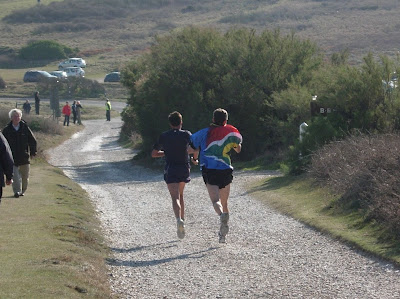
For the next 3 – 4 miles I set the pace at a reasonably comfortable level, with Steve happy to follow.  I am getting ready for a big effort to respond to a likely attack from Steve, because I have a feeling that we both know that if we are still together at the top of Beachy Head, with there being a little over a mile of descending to the finish, then due to the evidence from the previous race descents I would most likely result in being the first to cross the finish line.  It is at moments like these where extensive preparation in terms of research on oneself, i.e. race goals/aims, e.g. what do I want, why do I want it, and how much to a want it comes into play.  If one has these goals/aims clearly ingrained within one’s subconscious and conscious, the fact that one is so close to achieving their clear goals results in the RPE - RFE arrow to rotate downwards, which allows for an increase in running pace, causing an increase in RPE, but yet for the same level of Race Focus Energy.  Looking back now, if I had established a clear race goal of either sub 3 hours, and/or, winning the race, I feel that instead of ‘having’ to ease of the pace at the finger post when discovering that Steve was still close to me, I would have been able to maintain the increased high intensity of running without the actual high rate of RFE usage than actually occurred, that led to a substantial reduction in race pace.

With a little over two miles to go, as we start the final lengthy climb up to the top of Beachy Head, the expected attack from Steve occurs.  The increase in pace is dramatic, I immediately increase by pace in response but the massive increase in Race Focus Energy in order to increase my running pace is huge, and although there is the desire to stay with him, the brain senses that my rate of RFE usage is excessive, and even with there being less than 15 minute of running till the finish, the level of muscle activation being output from my brain is insufficient, and Steve pulls away, gaining a lead of 30 – 40 seconds in a very short space of time. 
One thing I have noticed is that the brain’s subconscious anticipation of exhaustion of ones’ Race Focus Energy appears to not only be influenced by the actual RFE usage rate at the present moment, but also the extent of the recent increase in RFE usage.  I think the fact that I was running at a reasonably comfortable pace, with this being not at too a higher level of RFE, to then immediately to go to extremely high levels of RFE led to the insufficient muscle activation needed to stay in contact with Steve.  I’m sure that if I had maintained a semi-uncomfortable pace, rather that a semi-comfortable pace during the proceeding 3 -4 miles, then I would have been able to run faster up the final climb.  It wasn’t physiological reasons that prevented me from keeping up with Steve, as my heart rate trace shows that even with maximal effort; my heart rate did not go higher than 167 bpm!

At the top of the climb I am probably around 40 seconds behind Steve, I run hard all the way to the finish, running the last 0.76 miles at an average mile pace of 5:19, albeit losing 79 metres in elevation, reducing the lead slightly, and finish 27 seconds behind in an official time of 3 hours 2 minutes and 55 seconds.  The photo below shows be running downhill to the finish with my two boys Robert and Chris trying o keep up with me!  Yes, another immediate rotation down of the RPE - RFE arrow as I run past my family.


Interestingly as I finish there isn’t any disappointment at running 30 seconds slower than last year, or in not winning, as I did enjoy the journey, this being a big improvement upon UTMB. However, within a race, I always try to extend myself, to run to my limits, to totally exhaust my Race Focus Energy, and I feel that I didn’t really do that during last weekend’s race, probably largely a result of the lack of research on myself during my TOTAL preparation, not as total as usual. The physical preparation had gone well, as evidenced by the physiological ease at which I completed a 3:02 Beachy Head Marathon time, with my average heart rate of only 163 bpm, with this being significantly lower than the average heart rates of 167 - 171 bpm during previous year's Beachy Head marathons.
Well another marathon effort of a blog post.  Hopefully you have managed to maintain focus throughout, and are not totally blog fatigued!  It is difficult attempting to explain my Race Focus Energy Fatigue Model within a blog post.  The best bet, if you want to find out more is to get to one of my upcoming talks.  Yes, talks!  Not only have I got my talk up in Cheshire on Saturday 19th of November, which I have previously mentioned, but on Saturday 3rd of December I am doing a talk down in Dorset as part of the Endurancelife Live More Lectures Series.  My focus of my talk in Dorset is on UTMB, however, I will have a few slides to do with the Race Focus Energy Fatigue Model, as it plays such an important part during endurance trail running.  In addition, if you buy me a beer, I will talk to you all night about it.  And as evidenced by the length of my blog posts, all night could in fact mean all night!

Time to sign off with some words related to tonight’s post;
“Often it is too easy to accept a less than satisfying performance due to an acceptance that physically you are not capable of better, however, as soon as there is the realisation that simply the way you think and respond to the challenges that you encounter during the race can alter one’s performance, one is capable of achieving so much more!”  Stuart Mills, 2011.
All the best with your interpretation of my model,

Stuart

Saturday, 22 October 2011

Beachy Head Marathon - Quick Update

Hi,

Just a quick update on today's Beachy Head marathon.  Since moving down to East Sussex in 2002 I have run the Beachy Head Marathon every year, so today was my tenth time.  My personal best for the course was set in 2007 with a time of 2:57, when I finished second to Tim Short, a fellow inov-8 athlete..  As the time of 2:57 indicates, the course isn't really flat.  My times for the last three years, all being winning times, have been 3:02, 3:03, 3:02.  So going into today's race, I was hoping to try to run quicker than last year, but a PB time wasn't really on the cards.

For the first time in ten years of running I had a real race on my hands.  At CP2 at BoPeep car park, shortly before half way, I was in third place, I guess around 45 seconds behind the leader.  It was then head wind pretty well from there all the way back to Eastbourne.  At around 17 miles, the leader from local club Lewes started fading and the three of us were for a few seconds running side by side.  The chap, Steve Nimmo from Orpington, but originally from South Africa didn't want to lead.  I also wasn't to keen to lead so, it was a bit of 'cat and mouse' with the occasional attack for the next 7 miles, as the chap from Lewes, (sorry I didn't get his name!) faded to eventually finish in sixth place.

Then at the 24 mile mark, Steve from South Africa, took off up the start of the last climb up to the top of Beachy Head.  He looked like he was doing a 5K.  He quickly gained around 30 - 40 seconds, and then we ran this distance apart to the finish.  I think his official time was 3:02:28, and mine being 3:02:58 was only 33 seconds slower than my 2010 time.

Overall a really enjoyable and exciting race.  A true race, with the pace fluctuating substantially over the last nine miles.  It would have been nice to clock up my eighth win, but it wasn't to be today.  I felt I ran well, but just didn't have that 'extra gear' when Steve attacked.  A great run by Steve Nimmo.  Hopefully he will be back next year, when I will be ready for him.  Maybe I might even go back to doing some rep work again in preparation!

So another great Beachy Head marathon.  Trail marathons really don't come any better.  A great atmosphere with around 1700 starters, a great course, a beautiful sunny day, and a superbly organised event.

Full race report to follow in a few days, although, quite a lot already highlighted above, as the quick update wasn't that quick!  However, the race report will include 'snippets' of my new 'Race Focus Energy' fatigue model, that was launched at the Beachy Head Marathon Science Symposium last night, which was a very successful evening.

Time to sign off, with a relevant quote from last night; "Performance is determined by an enjoyable interaction of the Body and Mind".

May your runs this weekend be as enjoyable as mine was today.

Stuart

Thursday, 13 October 2011

Meet the Man Behind the Blog - Review AND Preview!

Hi

Yes, a few weeks since my last post, but I have been a wee bit busy!  The day job, i.e. a University Lecturer at the University of Brighton has been keeping me plenty busy, with the students recently returning.

Tonight, should be a shorter post than usual.  Simply a brief review of my talk up in Yorkshire last week, and a preview of TWO upcoming talks.

Last Friday night I had the pleasure of talking to around 25 runners in the cosy Studley Roger village hall, not far from Ripon.  The talk was organised by Dave Jelley from http://www.jelleylegs.co.uk/  Dave has recently set up a Guided Running company that provides Guided Trail Running Breaks.  It was recently featured in the Guardian two weeks ago.  Click the following link to read the article:  http://www.guardian.co.uk/travel/2011/sep/30/guided-running-holiday-north-yorkshire-dales?newsfeed=true And as the article mentions, the running in Yorkshire was very scenic, over a variety of terrain.

I met Dave at the Shires and Spires 35 mile Ultra back in June, where we actually discussed the possibility of the talk whilst racing!  So on the Friday night immediately prior to my talk, on a pleasant evening as the sun was setting, we had a quick six mile run across the fields, including running through a deer park, .


My talk was titled "Ultra Trail Running:  Enjoying the Overall Experience - The Importance of TOTAL Preparation".  I provided some background to my philosophy on what determines fatigue during ultra trail running, and then illustrated my ideas with my contrasting experiences at the 2009 and 2011 Ultra Trail Mont Blanc.  As expected, my ideas created some discussion, with many runners being able to associate with my observations.  Although, there were some 'disbelievers', who felt that I placed too much emphasis on the importance of positivity.  Reflecting back on my talk, I probably did 'play down' the importance of the physical training too much.  As after all, at the end of the day, it is the physical body that has to propel you to the finish line.  However, the problem I have, as readers of my blog are quite well aware of, is that at times I do tend to go on a bit!  So one of my aims was to try to stick to my planned schedule, and hence why I rushed over a few aspects of my TOTAL training approach.

During the last year, I have been give quite a bit of thought into why I slow down so much during ultra trail running.  My post back in August titled Training for Ultras - What's It All About? highlighted some of my thoughts.  However, recently I have been trying to develop a model that will encompass all of my ideas.  During my presentation I spoke about how ultra trail running performance is "determined by a balancing of the current physiological and psychological input with the underlying self expectations / self belief!"  And I presented a very simplistic model to help clarify this, and reinforced the importance of the subconscious beliefs with a quote from 1983 by Gary Elliott, coach to NZ marathon runner Alison Roe, Boston marathon winner, New York marathon winner, World Record Holder, 1981.
  
 “Success becomes automatic when your subconscious accepts your goals as reality.”


I appreciate that this balance scales image doesn't really provide much information, however, i am hopeful that my new model will be complete shortly, in time for my talk up in Cheshire in the middle of November.  More about this talk, and my other upcoming talk in Eastbourne, later in this post.

So back to last weekend.  Overall I felt the talk went well, especially as it did what I set out to achieve, that being, to get runners to think differently about their training, and to give more thought to what actually causes them to fatigue during ultra trail running.

The next morning, after watching England's disappointing performance at the Rugby World Cup (The advantages of having a dual identity, I still have the All Blacks to cheer on!), the sunshine was gone, and it was out into the Yorkshire mist for a longish run across a variety of terrain.  Dave and I were joined for the run by Martin and Billy.  As Dave is running the last race of the Runfurther series this weekend at Rotherham, we decided to keep the pace pretty easy, which suited me fine, as pretty well all of my runs are at an easy pace. (Keep an eye out for Dave at this week's series decider.  Not only is he in 'with a shout' for the over 50s title, he is also well up there for the overall title!) 

So there was plenty of talking as we ran along at a cruisey pace, on mainly running related topics, including a bit more discussion on some of the training aspects I raised the night before, and a 'bit of banter' on perhaps I just shouldn't be so lazy with my training, and if I did some proper physical training I then wouldn't slow down so much! Although later on in the run, having discovered a little bit about Billy's impressive race performances when he was a wee bit younger, the question was asked into why he now raced so slowly!

Running with Martin and Billy (middle) in the Yorkshire mist

So overall a very enjoyable weekend, and as I titled my talk, the overall enjoyable experience includes meeting loads of positive minded, extremely friendly, ultra trail runners.

This post is sub-titled: Review and Preview.  Yes I have two talks coming up.  The first, which takes place next Friday, 21st October, 6:00pm - 7:30pm, is at the University of Brighton, Eastbourne campus.  It is part of the Beachy Head Marathon Science Symposium.  Click this link to find out a bit more about the free symposium.  There are three speakers in total, including Emma Ross from the University of Brighton and Charlie Pedlar from St Mary's University/English Institute of Sport.  So it should be a pretty interesting and informative night.  The Beachy Head Marathon Science Symposium is open to everyone.  All you need to do is e-mail O.R.Gibson@brighton.ac.uk to book your free tickets.

Then on Saturday 19th November, at Cuddington, Cheshire, I have been invited by the Delamere Spartans running club to present to trail runners within the Cheshire region.  My presentation has the same title as my Yorkshire talk, although hopefully I will be able to introduce my new model on ultra trail fatigue. Tickets are available by e-mailing: tickets@delamerespartans.org.uk 


Hopefully a number of you will be able to make either the Eastbourne or the Cheshire evening.  It would be great to meet you.

Well, not as brief a post as I planned, so no signing off quote!

To those of you racing this weekend's Round Rotherham, may you all enjoy the overall experience.

Stuart

PS  If any of you are thinking about racing next year's Montane Lakeland 100 or 50, well you better be quick!  Entries have been open for a little over a week, and there are already nearly 250 entrants in the 100 mile, and over 400 in the 50 mile!  The 100 mile already looks like it will be a great race.  The last two winners i.e. Terry Conway and myself will be back, as will a number of the 2011 top ten finishers including Paul Tierney, Barry Murray, and Simon Deakin, and a newcomer to the event Richie Cunningham, twice winner of the 95 mile West Highland Way Ultra Race.  Best I start doing some proper training!!!

Wednesday, 21 September 2011

UltraStu Talk in Yorkshire - Meet the Man Behind the Blog!

Hi

Just a quick announcement about a talk I am doing up in Yorkshire on Friday 7th October.

The title of my presentation is Ultra Trail Running - Enjoying the Overall Experience.  I will talk about the highs and lows of ultra running - from my win in the 2010 Lakeland 100 mile race, to the problems which led to me not completing the Ultra Tour of Mont Blanc this year.
Within the talk I will emphasize the importance of TOTAL physical and mental preparation, which if you are a reader of my blog, you will know that I see TOTAL preparation as the key determinant of achieving a successful performance in endurance trail running events.

The presentation will include photos, video clips, and race route details specific to the Lakeland 100 and the Ultra Trail Mont Blanc. In addition there will be ample opportunity for the audience to ask any questions they may have on trail running.

Details of the talk are as follows:
When: Friday 7th October 2011

Venue: Studley Roger Village Hall, Studley Roger, Ripon HG4 3AY

Time: 7.30 pm for pre-talk snacks/drinks - 8.00 pm talk starts.  A short break for more snacks/drinks at 8.45pm.  Finish 9.45pm approx.

Cost: £5.00 (including free snacks/tea coffee)

The talk is being organised by Dave Jelley from Jelley Legs Guided Runs.  We actually discussed the idea of the talk while 'racing' at the Northants Shires and Spires 35 mile ultra race back in June!

Tickets are available from Dave.  Visit http://www.jelleylegs.co.uk/ and email /ring and reserve tickets.


So here is your opportunity to "Meet the Man Behind the Blog", that is if you haven't already met me before!  Hopefully, those of you that live up north, local to the area, will be able to make it to Studley Roger Village Hall, which is not far from Ripon.  It should be a really good night.  A note for any of you who were present at my talk in Ambleside back in June at the Lakeland 100 recce weekend, I promise I will get my pace judgement right this time, and not go over my predicted finishing time!

Right, best I get myself organised and get my presentation sorted.  I think the hardest thing will be deciding on what to leave out, in order to keep to time!!!

Stuart

PS  To those of you that know people who are inspired by your endurance trail running exploits and want to do more running.  Then maybe the following link to a worthy charity called  The Fresh Air Fund may be of interest to you.  http://www.freshair.org/events/nyc-half-marathon

Each year they have a team running the New York City Half Marathon that takes place in March.  So now is a good time to encourage your work mates, partner, or any friends to go that little bit further with their running, and perhaps have this race as their goal.

Saturday, 17 September 2011

UTMB DNF: Responding to Comments

Hi,

Thanks to all of you that have left on the blog and e-mailed me comments following my UTMB race.  It is pleasing to know that runners are finding my blog posts both interesting but also beneficial. Receiving feedback, it appears that there was equally disappointment amongst the readers regarding my UTMB DNF, however, before I move on to other topics I just thought I would respond to some of the comments left.

Firstly Bill.  Yes, running frequently within the mountains could be an advantage, however, I don't see this as a main factor regarding DNFs for those with less mountain running within their preparation.  With regards to my preparation, I do not do specific mountain training, in fact I don't even do specific hill training.  I simply run up hills when I encounter then during my training, but I do not specifically go out and 'search' for them.  This is mainly due to my believe that it is self confidence/self expectations that are the benefits from specific mountain training, not any actual physical benefits.  So if you are able to develop the self confidence regarding mountain running in other ways then no essential need to run within the mountains.

The key issue with this year's UTMB for me was I feel the 5 hour delay, rather than the at times wet and cold weather conditions.  When preparing for a race the key aspect of my preparation is to prepare the mind and body as one, actually the subconscious, for what it is likely to encounter during the race.  So within this preparation it is all about looking at the course details, the elevation gains/losses, the checkpoints, the terrain, likely underfoot conditions, likely weather conditions etc.  It is building up this information about the event so when you actually come to it on race day, what you encounter is reasonably similar to what you have given thought to, what you have considered, or what you have visualised during the preparation.

So running a race for the second time, can therefore be an advantage as you have more information available regarding what you are likely to encounter, so the considerations, the visualisations can be stronger, can be more accurate, more likely to resemble what you will actually encounter.  However, as was the case this year for me, and for others, having past experiences of the event can also be a big disadvantage!

Within my preparation, I was totally aware of the terrain, elevations, distances between checkpoint etc. based on my 2009 race, and from the available race information, google earth flyovers, video clips, photos etc.  I have run in wet and cold conditions many times.  I have run over trails, up hills etc. many times.  The Hardmoors 55 from 2010 springs to mind in terms of extremely demanding conditions.  Having seen video footage of the 2010 UTMB, and read race reports, I was well aware that weather conditions could be wet and cold at the UTMB.  So although I do not actually train in the mountains in unpleasant conditions I am able to visualise these situations quite clearly, so I don't see this lack of training specificity as a problem.

As I highlighted above, having run the event in 2009, I feel this ended up being a disadvantage for me due to the 5 hour delay to the start.  Within my blog post last week I commented on the cold and the rain, and how the conditions were so different to the warm night of 2009, however, this wasn't really the key issue as I had visualised running the UTMB in wet and cold conditions.  What I hadn't visualised was starting in the dark, and especially running to Les Houches and running the first climb in the dark.  As I am an 'emotional' runner, and really perform on emotion, perform due to the positivity of the event.  I had spent many hours preparing, focusing on, visualising the first 2 hours of the race, from the start to St Gervais.  For me, this was the key to the whole race.  Start well, get into a good position, get the 'buzz' from running well, being right amongst it within the first 30 or so runners, so then able to progress through the field, as others drop out!!!  Yes how ironic, that my race strategy involved moving up the field due to others dropping out.  Well this was because there is such a large drop out rate of around 40% at the UTMB.  Never, for one single milli-second, did I ever consider that I would be one of the 40%, actually ended up being over 52%!  Back in 2009, at the top of the fourth climb. Arete Mont Favre I was in 55th place.  I ended up finishing in 22nd place.  From that point in the race (69km and 10 hours 01 minutes), nobody overtook me.  I howevr only overtook 13 runners, as 20 runners who were at that time ahead of me dropped out.  Quite an amazing statistic really!  It would be interesting to see how many runners from the top 55 at the same point DNFed this year.  Probably more than 20 I would expect!

Anyway, sorry about that distraction, where was I???  Yes, I was commenting about this visualisation of the first two hours running during daylight, 'feeling' the surrounding runners around me, being in total appreciation of the beauty and spectacle of the mountains, and just taking in the whole amazing atmosphere of the competitors, the mountains, the spectators.  And then 'feeding' of this emotion, to propel me into the night, and then throughout the next day.  So this vividness, as a result of my extensive preparation was what totally threw me 'astray'.  It was just so totally different to what I had prepared for, so in essence I was totally unprepared.  I was in a situation which my subconscious had not planned for.  And looking at the photo of me on the start line, it was clearly evident then, that I was already struggling with the changed situation, even before the race had started.

I signed off my post last week with some words from Nick Clark, as he ended up having to DNF due to a similar reason. i.e the race was different to what he had prepared for.  For him, it was not the difference of being daytime or night time, but it was the route change, not going up to Bovine, and having to descend to Martigny.  Now he is one of the best there is in 100 mile trail ultras, as evidenced by his 3rd place at this years Western States 100.  Physically, an extra hour onto the race duration, and a few extra 100s of metres of climbing, isn't going to be a problem to him.  But as he highlighted "A huge part of being successful in completing these events is an understanding of what lies in front of you. (He seems to have the same approach regarding the importance of preparing the mind and body with an expectation of what it is likely to encounter during the event). Your mind prepares your body, and your body delivers an output that is sustainable for the mileage and elevation change that remains. If the mind is checked out, the body follows."

So for me, this mismatch between what I had prepared for, what I was expecting to encounter, and the actual reality of the race caused my mind and body as one, "to check out"!  And at a very early stage of the race, to some extent before the actual start, but I think mainly during that first climb in the dark!

Interestingly, from what I have read, this 'checking out' from the race, for whatever reason seemed a familiar story.  To my surprise, during the race, after I had 'checked out', climbing the fourth climb of Arete Mont Favre rather slowly, I was overtaken my Krissy Moehl, the twice winner of UTMB, including 2009, finishing in 11th place overall.  So seeing her so far down the field, and barely going any quicker than me was a real shock.  On her blog she makes the following comments:
"1). I visualize.  When possible I like to visualize sections of the course, what it looks like, time of day and how I will feel.  ...  2). I am a planner, and maybe to a fault. ... Because of 1 & 2 the nature of the race this year threw me.  With the crazy rain storm that blew in Friday night, I woke up at 10am to a text message alerting us that the race start time had been pushed back 5 hours to 11:30pm.  This changed all crew plans, clothing plans and time of day where I would be on the course.  It also created a much longer wait on Friday and we would now have to run into the second night (where before if all was going well it is possible to finish just before dark on Saturday).  We tried to see positives in the fact that our night time wouldn’t be as long the first night, that this push back helped avoid time in the harshest part of the storm, but I realize hindsight that for all my planning this really changed my head game.  ...   Funny thing is I think I normally do a pretty good job with rolling with the punches, but this time I just felt defeated.  When times got tough I didn’t have that edge that I am used to drawing on to push through."
Yes, I was really amazed as well when I read her blog post, after I had typed up mine, on just how similar our interpretations were of what went wrong.  And like her, I tend to consider myself as being able to deal with situations when they get 'tough'.  Usually the tougher the conditions, i.e. cold, or heat, or wet mud/bog, I tend to perform better, but just like her, not this time!

And also similarly like me, she knew early on, that things weren't going well:  "When the going gets tough, there has to be that something more, that something deeper that you can find to get you to the finish.  I knew it wasn’t my day when I arrived in St. Gervais (this is at 21km, after around 2 hours) - Zoe said she could see it in my eyes.  I wanted to resolve to finish no matter what.  But I didn’t have the fight."

So getting back to my race day performance, yes, one could conclude, that I was 'soft' pulling out from the UTMB this year, as after all on the 'surface' it appears that the only problem was that my race experience was different to what I had expected.  I wasn't injured, or I wasn't ill, as I was reminded by one reader: "You couldnt dictate, you were not in the area of the race you thought you would be, athletes you expected to beat were doing much better than you, and your predicted position from an elite start was not going to happen,  you pulled out WHY, were you injured, or could you not deal with a lowly finishing position,"  Hopefully above I have been able to clarify what the problem was for me.  I guess it gets down to having too much faith/belief in the inseparable link between the mind and the body, in that they act as one.  To me, this faith, this belief, is what 'makes me' the ultra trail runner I am.  And yes, it can result in things not going right all of the time, but it also does appear that two of the very best ultra trail runners in the world, seemed to have a similar problem as mine.  Maybe it could be described as being a bit soft in the head, or too arrogant to accept a lowly finishing position, but I prefer Nick Clark's description: "I had lost the mental fortitude to keep my legs from seizing up."  Yes, the mind can create amazingly fantastic experiences, but it can also create amazingly difficult experiences!  As Nick highlights, it is the mind that actually controls whether your legs seize up or not.  And usually when one is in the right state of mind, the legs just don't seize up, the mountains just don't seem steep. the running just feels totally easy, and everything just cruises along, within the flow, within the rhythm, within the joy of running.  Unfortunately UTMB 2011, for me, and for others was just not one of those days!

Well!  I thought tonight's post was going to be a quick short post, offering a quick simple response to reader's comments.  Oh well, I do feel better, for hopefully clarifying my situation.  Please excuse me!

Back to the comments.  Hi Johny, I don't know what your performances are when it comes to running, race performance is definitely not a criteria to determine whether people's comments are worthy, or are from a 'fraud'.  I welcome all reader's comments, as I know I learn so much from others, from runners of all abilities.  That is one aspect of the ultra running community that I really appreciate.  The willingness of others to share their experiences in the hope that others can gain from them.

But getting back to your comment regarding race expectations.  I see race expectations as being crucial to performing well within ultra trail running.  During the preparation stage, it is essential that you have developed clear, and confident (and realistic) expectations of what you will encounter during the event, but more importantly how you will positively respond to the different situations within the event, which will then result in a successful performance.  But the key thing to remember, and what I forgot to adhere to at UTMB, is that the focus on the expectations ONLY occurs during the preparation phase.  Come race day, the self expectation should be now well ingrained within your self-conscious, so you don't need to actually think about them.  You don't need to consider them at all.  For come race day, the key is to simply enjoy the journey, to be 'within the present moment', to simply enjoy the running, and the underlying self expectations, now at a subconscious level, they will simply 'do the business' if you just allow it to happen, without forcing it!.  I wish I had reminded myself of the above paragraph, on the Friday night, 3 weeks ago.  But, as I mentioned in last weeks post; "Everything happens for a reason", and maybe one of the key things I will learn from this year's UTMB is that the above paragraph is so important in dictating the likelihood of having a successful performance.

This moves on very nicely to the comment left my Tom (Living on the Trail).  I totally agree, absolutely one hundred percent with the comment that Tom as left.  In fact I like it so much, I think I will adopt his take home message in future blog posts:
"Maybe we can forget to trust and not separate training from the joy of racing.

Training = build the physical off the mental
Race Day = Trust and enjoy"
I already knew this message that he has left.  It has been my philosophy for the last three years of trail racing, However, it does really help when someone recognises what the issue is and spells it out so clearly.  Thanks Tom for your input.  I will remind myself come future races, "Trust and enjoy", as simple as that!

Now Andy, firstly, what's this you stating that you "don't buy into all of my ideas"!  Just joking!  It's nice to know that you have bought into some of them.  And again, I am in total agreement with what you have written.  Yes, one does have to always remember why we run trail ultras; because they are enjoyable.  Not just enjoyable afterwards, but during the actual journey!  For many, many years I focused too much on the destination.  I was focused on the finishing time, setting a new PB for the marathon, or half marathon,  Finishing in a certain position.  The enjoyment would come afterwards, from the reflecting upon the good result.  Well having this approach to my running for so many years, without knowing at the time, really restricted my running.  It prevented me from running successfully, as there just wasn't the actual joy from the running.  The joy was all dependent upon the result.  For me, for my running to be successful, I have to experience the joy of running, WHILE I AM RUNNING!

Now that doesn't mean that running can't get challenging, get tough.  In many ways, dealing with the challenges, overcoming the toughness, the difficult 'blips' in races can be extremely satisfying, and extremely enjoyable at that moment in time.  But then there are situations, like I experienced this year at UTMB where due to the state my mind was in, there was not any enjoyment.  And, yes as Andy points out, one can endure this in races, if there are only a few hours to go, however, when faced with many, many hours of un-enjoyment, the question whether to continue does arise.  Fortunately for me, I don't recall this question being asked of me very often during the last 30 years.  With the last time, when the question was answered in a yes, time to pull out, being 26 years ago, after capsizing for a second time, and being extremely wet and cold, and hence definitely not enjoying the present moment, way back in the 1985 Rimutaka Triathlon.  So yes, I am fortunate that I experience the joy of running whilst running, nearly all of the time!

Hi, Graeme.  Congratulations on completing this year's UTMB.  I am so pleased for you in that your "Dreams Came True".  Can I strongly recommend to those of you that haven't been to Graeme's "Running Dad" blog, if you want to read a thoughtful and inspirational post, then click this link. http://whwrunningdad.blogspot.com/2011/08/heres-to-dreamers-god-bless-us-all.html  It really sums up what ultra trail running is all about, and how the positivity that is so evident within ultra trail running can be transmitted into your own and other's lifes.  Have a read, and thanks Graeme for you comment, and your great post.

Lastly, in this much longer post than I expected, thanks Alan for your comment, and congratulations on your tremendous effort moving up from 850th place after 2 hours 1 minute into the race, to finish in 44th place overall.  You specifically ask did I have a plan B?  Well, no, I do not have a plan B, as usually for all of my races over the last three or four years, my one and only plan is to run as hard and as fast as I can, being within the moment, and enjoying the journey.  So what other plan is needed?  But you are right, I did get "caught up with the idea of feeling out of place with the elite runners".  I simply forgot my plan A, even though my signing off message from my last post prior to race day was all about enjoying the journey.  Amazing, subconsciously I was telling myself, to get my act sorted out!!!  So yes, I did probably let how other runners were performing "interfere with the ability for me to run my own race".  So thank you for your interpretations of my writings.  Sometimes, all what is needed is for someone to simply raise your awareness to what is happening, because sometimes you can be 'too close to the situation' to actually see it. With regards to running "conservatively", either fortunately, or maybe unfortunately, that goes against my philosophy.  It just doesn't work for me, as I 'live' on the excitement, the risk, of pushing myself to the limit, each and every moment!  Well that's my aim!

Time to sign off with a quote from Graeme's great post:
"You need to make your own luck and have a hand in your own future and to grab the chances that present themselves to you. Enjoy these moments when they come, savour them and embrace them and recognise the fact that you made them happen."  Graeme Reid, 2011, Running Dad: Here's to the Dreamers - God bless us all!
All the best with putting your dreams into reality,

Stuart

Saturday, 10 September 2011

UTMB Race Report - Working Out What Went Wrong?!!!

Hi Again

Not sure how far I will get with this race report tonight, as I'm not really sure what the key message will be. 

(Well I didn't get that far, I guess I got around half way, (a bit like the race!), but it has now been a few days since I first started typing up this report. Maybe it will get finished tonight!)

I have given the UTMB race a wee bit of thought over the last week or so, but I find that it is not until I start typing up my blog report, uninterrupted, in the quiet of the night, that things really start to become clear.  So hopefully as I type, I will manage to identify What Went Wrong!

UTMB was my number one focus race for 2011.  Having ran it back in 2009, where it was such an amazing enjoyable experience, I had to go back, to get the same enjoyment, and to improve on my finishing time of 26 hours and 29 minutes.  So I bypassed the Lakeland 100 this year, (another great race), in order to be totally prepared for UTMB.  And come Friday morning of race day, I felt fully prepared.  I had the same sort of feeling that I had prior to the 2010 Lakeland 100, so I was expecting another positive experience.

One of the key things I work on when preparing for ultra trail races, is to spend quite some time giving thought to what I will encounter during the event.  I look in detail at information about the course, such as; how many checkpoints, the distance/likely time between them, the terrain of the course, the number of climbs, the elevation gain, likely underfoot conditions, running in daylight or at night, etc.  Although it can be useful to have recced the race route prior to race day, this is not essential, and as the UTMB course is very clearly marked there are no navigation issues.  So the reason for my expected improved finish time was more due to my improvement as an ultra trail runner over the last two years, what I had learnt over the last two years, so not really because it was the second time that I was running the event and therefore familiar with the course.

However, during my preparation in terms of considering what I would encounter during the event, I did find myself frequently remembering back to 2009, re-visualising the key things from two years ago.  The warm, sunny night, the amazing atmosphere at the start line in Chamonix, the huge crowds and the huge noise they made, not just in Chamonix, but along the course, especially at St Gervais, and at Notre Dame Gorge, the amazing scenery, the awesome snowtopped mountains, etc. 

Physically wise, training had also gone well.  Having run the 2009 UTMB on a 20 week build-up of only 34.5 miles per week average, I considered that maybe this low mileage was not sufficient in order to achieve a sub 24 hour time, which was my aim back in 2009, and was still my aim for 2011.  So over the latest two years I had gradually increased my mileage, resulting in the 20 week average prior to UTMB this year being 51.7 miles.  I increased my weekly mileage, mainly due to an underlying 'nagging' that to run a sub 24 hour at UTMB, more than 35 miles per week was needed, as I was not totally confident that 35 miles per week was sufficient, and if the confidence isn't there, then, a change is needed.  Although 51.7 miles per week was the biggest mileage average I had done for over 25 years, I felt comfortable with the amount, as the increase had been gradual over the last two years.  As I mentioned in my lengthy post titled "Training for Ultras - What's It All About?" probably the key aspect of the physical training is that it develops your self expectation of what you belief you are capable of achieving.  So, leading up to the race, it felt like all of the boxes were ticked!

So where did it all go wrong???  As with all of my blog posts, they are firstly for my benefit, a chance to clarify my thoughts, to learn from my racing and training, and secondly they are about sharing this reflecting process with others via the blog, to possibly enable other runners to learn and benefit from what I have learnt.  So I hope that readers of my blog will not feel as though my analysis of what went wrong is all about me making excuses for a poor DNF performance, or to blame anyone for my DNF.  Therefore before I progress with this race report, I just want to clarify my position on the UTMB organisation as I have seen that within some other runner's blogs there has been some criticism.  Based on what the UTMB organisers had to deal with, the variable weather, the absolutely huge numbers of runners, I think they were just amazing, the way they were able to adapt start times, race routes etc. to take into account the extreme weather conditions. My aim of my race reflection within this post is about trying to understand why I just did not perform, and to ensure that it doesn't happen again!  As I know one thing for sure, for me, pulling out of a race was definitely one very un-enjoyable, demotivating, confidence crushing thing to do, and something I hope to learn from, to ensure that it will be another 26 years before it happens again!  Hopefully I will not get too negative during this post, as after all it is only a race, and looking back of the last few years I have had such an amazing journey!

Back to race day, Friday morning.  I had arrived out in France on the Monday, and was staying at the 31 kilometre mark, at the village of Les Contamines.  I was involved with the Alpine-Oasis running camp, which was being led by Andy Mouncey (2nd place finisher at 2010 and 2011 Lakeland 100).  There was a really positive buzz within the camp, which further raised my expectations of a positive performance come race day.  During the week, there are actually four races.  The PTL had started on the Monday night, consisting of 302km.  The TDS (112km) had started on the Thursday morning, and the CCC (98km) was starting on the Friday morning.  We had watched the leaders of the TDS pass through Les Contamines on the Thursday night, and the first thing I did upon waking on Friday morning was to wander down to the checkpoint in the centre of the village and watch the last few TDS runners pass through.  This was the first I heard of the delayed start to the UTMB.  Although it was another beautiful blue sky, and sunshine, apparently snow and heavy rain were forecast, so the start was delayed 5 hours until 11:30pm.
 
I didn't really give this 5 hour delay much thought.  There was nothing I could do about it, so not worth getting upset about it.  I readjusted my likely arrival times at each of the 24 timing checkpoints, and I recall being a little disappointed that the delayed start would now mean that I would be finishing in the dark.  Back in 2009 I ran the last 20 minutes in the dark, as it tends to get dark at around 8:40pm.  As I was planning on a sub 24 hour finish this year, so my planned daytime 6:29pm finish, was now likely to be 10:29pm.  The now expected 10:29pm finish, and not 11:29pm finish, was due to the last section of the course being changed to avoid the last, and probably the toughest, climb.  So likely to result in the race course being an hour quicker.  Looking back now, I should have really given more thought and focus to what this five hour delay would mean to my expectations of what I would encounter during the race, but at the time I didn't!  One thing I did notice as a result of the delayed start was that I didn't know what to do with myself!  There was just a rather negative feeling of just waiting, wanting it to be 9pm, when we would head into Chamonix, and finally get ready for my key race of the year.
 
Back in 2009, I had my family, i.e. my wife Frances, and our two boys Robert and Chris, out in France supporting me, in addition to a Kiwi mate, Kim, who had travelled from Austria, where he now lives, to cheer me on.  This year the family stayed at home in the UK, but Kim was again going to cheer me on, especially during the night in Courmayeur, where I found it really beneficial seeing a familiar face, and having a brief chat with him at around 5am in the morning back in 2009.  So come 9pm, I headed to Chamonix, where I first dropped off my bag with spare clothing, shoes, food etc. which is taken to Courmayeur, and then headed to a bar close to the start line to get out of the heavy rain.  By this time it is a little after 10pm so still around 90 minutes to the start.  Although I was sitting with Kim and the runners from the Alpine-Oasis running camp, I found that I wasn't really 'buzzing', and therefore not that talkative.  In fact I found that I was comparing this year to two years ago, in terms of how two years ago it was a warm, sunny evening, with the streets absolutely packed with a real excitement in the air.  Tonight, it was not the same 'buzz', just a feeling of waiting for the start! 

As we waited, Kim, who I have known for nearly 30 years from when we both ran for Hutt Valley Harriers back in the eighties, and I chatted a bit about the UTMB race and my racing this year and in the past.  We spoke about my good performance at the IAU Worlds in Ireland, being the first GB finisher, which naturally led us to speculate about what place I would finish and what GB finisher I would be tonight at UTMB. So I found myself starting to think of the destination, i.e. how good it would be to finish in 'so and so' position, instead of concentrating on the journey, i.e. the actual process of running through the night, amongst the amazing scenery, the different climbs and checkpoints etc.  Although it is useful to have race goals, the goals can only really be time goals as you can not determine who turns up and how they run.  I had spent some time working out likely times at each checkpoint, but during the actual ultra trail race I try not to focus on these, the checkpoint times are for the preparation stage only, rather than getting too 'hung up' over whether a few minutes fast or down on schedule.  But here I was now just focusing on the finish, thinking about my finish place and time, rather than looking forward to the actual running of the race.

As I had been given an elite race number, I did not need to worry about going to the start line early in order to get a good starting position as the elite runners have a separate roped off area at the front of the crowds.  I therefore waited until around 20 minutes before the start to head to this roped off area.  Just prior to heading to the start line, I was in two minds on whether to put on an extra layer, or whether to put it in my back pack, just in case it got really cold up at 2500 metres.  I didn't want to carry the extra weight all the way to Courmayeur if I didn't need it, but then I didn't want to get too cold.  In the end I decided I didn't need it, but the indecision did 'play a bit' on my mind!

Finally I am off to the start line, however, I couldn't find where to show my elite number in order to gain access to the front of the runners.  I therefore had to squeeze my way through the crowds from the side and then climb over the barriers to access the elite area.  Although something like this may seem rather petty, reflecting back now it did have an impact.  It was a bit like when I entered the Elite BBQ party on the Tuesday night, a feeling of not belonging here!!!  So here I am, 15 minutes to start time and it is pouring down.  I am standing next to Liz Hawker (yellow jacket), and see that she has her number on the outside of her jacket.  Still having this feeling that I am an 'imposter' who has climbed over the barriers, I unzip my jacket to display my elite number, as if to prove that I belong here.  Thinking back now, it just shows that my mind was not in a 'good space'.  Take a look at the photo below, does this look like someone who is absolutely buzzing, really enjoying the current moment, excited by the prospect of running the most amazing ultra trail race in the whole World???  I think not!


While standing in the rain, waiting for the start, I knew I wasn't feeling right, so I tried to relax and simply enjoy the moment.  I had a brief exchange of expressions with Liz Hawker, a brief chat with a chap from Hungary (Oliver in orange with head torch behind Liz) who I had met at the BBQ, and then just before the start, I noticed Jez standing nearby, so I wished him luck, and then we were off!  My race plan was too start at a solid pace.  Obviously not 'As fast as you can, while you can' as it is a 24 hour race, but the intention was to be near the front as long as the pace wasn't too quick. 


Below are two links to videos of the start on YouTube where I am visible near the front, wearing a bright yellow Montane jacket.
http://www.youtube.com/user/TheNorthFace#p/u/9/eTb6-DYQXII I am visible at 2mins 36ses into the video. 


Also http://www.youtube.com/watch?v=5bu_Ynw8Bsg   I am visible at 48 secs into the video, and around 100 metres after the start, shown below.


A few runners zoom off for the first few hundred metres, but on the whole it felt pretty 'cruisey', probably around 6min 40 sec mile pace, although hard to really gauge it due to being dark and extremely wet!  Interestingly initially Killian Jornet, two times winner and strong favourite for the race was nowhere to be seen.  He then comes pretty well sprinting past, gains a lead of around 60 metres, nobody followed him, and then started jogging until the lead group re-caught him.  It was pretty clear immediately then that everyone was pretty well running for second.  The lead group pretty well followed his move.  When he slowed down, the group slowed down.  Likewise when he sped up.  After around a mile and a half on roads, we join a trail that runs alongside the river.  The second video clip show the leaders at the start of this track.  I can be clearly seen as the third runner, as I am the only runner carrying a hand torch as well as my head torch.  At this point of the race I am feeling fine, happy to be near the front without that much effort.  The track undulates a wee bit before we enter the first drink station at Les Houches at the 7.9km mark, so without realising it a small group of around eight runners, including myself has separated slightly from the rest of the field.
 
Shortly after the drink station we start the first of now only nine climbs, around 760 vertical metres.  My plan was to slowly let runners overtake me going up this first climb, before finding my natural position in the field, at a slightly raised intensity, which I would then hold onto for the remainder of the climb, down into the first town of St Gervais, and then along the valley through Les Contamines, before climb number two, where I would then settle down to a 'proper' pace for a 24 hour race.
 
As I began the climb I noticed that runners were passing me at quite a rate.  I therefore upped the intensity a bit to try to reduce the rate at which they passed me, so I was probably working a little bit harder than I had planned to.  What was also different to what I had visualised was that it was dark and very wet!  Whilst running steadily up the first climb that lasted about 50 - 55 minutes I seemed to keep on thinking back to two years ago, a beautiful balmy night, with amazing views of the surround mountains, rather than focus on the present moment.  Tonight, it was pitch black, not only could I not see any of the surrounding mountains, I also found that I lost contact quite easily with the runners going past me.  Whereas if it was daylight, they would slowly move away from me, but still be in visual contact.  Tonight they were getting out of visual contact quite quickly due to the dark, which reflecting back now, made me feel as if I was going significantly slower than them, although in reality I probably wasn't.  In addition, I couldn't get a feeling from the runners going past.  I couldn't see their faces, sense their expressions, identify just how hard they were working.  So all I had was a feeling that I was going backwards, and everyone else was simply cruising!
 
As I mentioned earlier, this post is not about trying to make excuses, but about understanding what went wrong.  Yes, it could be concluded that I was foolish starting out too fast, and going backwards was what I deserved for this stupid start fast.  However, I have used a quick start many times before in ultra races, with the IAU Worlds at Connemara, and the Lakeland 100 in 2010, being two extremes where I went ridiculously fast!  However, on both of these occasions I was rewarded with a really positive buzz.  I was leading at the Lakeland 100, and I was well up near the front, and the leading UK runner at the Worlds.  But tonight, in the wet and dark of the UTMB, I couldn't even see how far behind from the front I was, what position I was in, and was unable to recognise who had overtaken me.  Totally, totally different to the Worlds in Connemara, where I slowly drifted down through the field going up Diamond Hill before settling into a steady position, and probably more significant, totally different to my extensive UTMB race preparation/visualisation I had carried out!
 
The first climb varies in gradient, so it is a mixture of running and 'power hiking'.  One key feature I remembered from UTMB 2009 was just how hard all of the runners attack the first climb.  For all of the other nine climbs, for the same percentage gradient, I doubt any of the runners, apart form maybe the very front would be running.  But for the first climb, for the position I am running at within the field, there is substantially loads more running than walking.  I had prepared for quite a high intensity up the first climb, so physically all was going to plan, but in terms of my mental state, so far this wasn't quite going to plan, just like on the start line, I was not experiencing the usual level of excitement/joy.
 
As the climb progresses, although not able to recognise any faces, I'm not sure how far up the climb, but I do notice Liz Hawker go past me.  Back in 2009 Liz finished not too far ahead of me in 18th place, compared to my 22nd.  So with a planned improvement in my finishing time for 2011, I was expecting to finish ahead of her.  As she ran past I attempted to stay with her, but there is a limit to just how much one should go 'out beyond the comfort zone' as after all it is a 24 hour race, so I simply had to let her run past, and due to the dark she was pretty well immediately out of sight, which further subtracted from my already less than usual level of positivity!
 
I guess we must have been around seven/eighths of the way up the climb, as I slowed slightly to consume my second gel of the night, when I hear a friendly hello from Jez Bragg.  Knowing that Jez usually tends to start rather conservatively I was expecting to be ahead of him during the first stages, but I had expected that it would not be until after St Gervais (21km), or even after Les Contamines (31km) before we would be running together.  So seeing him so early on was further disappointment!
 
Having just re-read the above few paragraph, again it could be concluded that all of my less than positive experiences I have outlined are simply due to me having unrealistic expectations of my ability, and simply starting too fast beyond what I am capable of!   But as I highlighted above, I had felt that my preparation, both mentally and physically had gone really well, including my last two races, so there was some substance, some evidence for expecting a high performance.  Possibly, maybe my expectations may have been too high, but I have learnt over 30+ years of endurance running that one's performances are largely set by their expectations.  For 30 years I limited my performances due to my rather limited self expectations.  Over the last three or so years, I have raised my expectations, and I believe not un-realistically.  If you had asked me four years ago "Would I be running for Great Britain at World Championships at the age of 48, beating guys that can run 29 minutes for 10km and 50 minutes for 10 miles?"  I would have 100 percent told you, don't be ridiculous, totally not possible based on my previous 30 years of running.  But then, what happened??  Well it happened!!!  How?  Simply due to heightened self expectations, as simple as that!!!  But the number one thing that has also accompanied the heightened self expectations over the last three years, has been the positivity, the excitement, the joy, simply the 'buzz' of running the best I had ever ran.  But here tonight, up this first climb, I just wasn't experiencing that 'buzz', so I was finding it difficult to run to my self expectation!
 
The results later show that I am the 31st runner to reach the top of the climb at Le Delevret in a time of 1:25:30, although I had no idea at the time due to the darkness of what position I was in.  Although, I was aiming for a 23:59 finish, I speculated that this finsih time would be around the 15th place for 2011.  Being quite a bit lower down the field than the seventh the same time would have been in 2009, due to the improved quality of the field.  (It later turns out that 23:59 would have been eighth place this year, but this is mainly a result of the huge numbers of runners of all abilities, including many of the top runners, not getting to the finish this year!)  Anyway, back to the race.  At the top of the climb, I am only 23 seconds behind Jez, and fortunately I can still visually see him.  (As a side note, the results also show that Liz was the 15th runner to the top in 1:21:01, so during the climb I had lost four and a half minutes to her.  Considering I wasn't really taking it easy up the climb, this level of performance by Liz, just shows what an absolutely amazing athlete she is.  It would be great to chat to her about how high her intensity is up this first climb.)
 
As we begin a rather lengthy and at times slippery descent down to the French village of St Gervais, it only takes a few minutes to gain the 23 seconds back up to Jez.  Now if I was my usual self I typically would have gone straight past Jez, as I have found that my descending is far superior to his.  However, tonight as I was still feeling rather negative about how hard I had to work up the first climb, largely due to the darkness making it feel like runners were simply 'leaving me for dead', I decided that I would use this opportunity to simply cruise behind Jez, and take it easy, to 'recover' from my perceived over exertion so far during the race.  So I simply do that, I switch out of 'race mode', and go into 'follow mode'.  Although we aren't actually going at too slow a pace and manage to overtake a few runners, so enter the next feed station at 21km together in 2:04:43 in 24th and 25th place.  Liz had passed through in 16th place in 2:00:59, so I had actually gained 45 seconds up on Liz during the descent.  Maybe if I had known this on the night, it would have given me a real boost, as believe it or not, although I had entered the checkpoint alongside Britain's top ultra runner, I was not thinking that I was performing well.  I didn't know what place I was in.  I didn't know that I had just gained time on runners ahead.  At that moment in time, it felt like I had 'lost' time by simply following Jez.  The crowds at St Gervais, were also absolutely nothing like what they were compared to 2009.  Which as you would expect, being 1:30am in the morning, and being rather wet and cold, there just wasn't the same street carnival atmosphere from 2009!

  At the feed station at St Gervais

Re-reading what I have just written, it surprises me that there is such a strong focus on my race performance, my position relative to others, relative to Jez, etc.  Usually during ultra trail races, I do not have this race position focus.  The focus usually is on 'the present moment', on the surrounding environment, on the actual enjoyment at that moment in time.  And the final race position just seems to 'look after itself'.  So it is surprising that it was so different for this race.  Reflecting back now, I think that it was maybe because at that present moment, it wasn't that enjoyable.  It was dark, wet, cold, no scenery.  I know this sounds a bit 'pitiful', as if I am only a warm sunny daytime runner.  As my mate Kim pointed out to me following the race; Killian Jornet didn't find the darkness, rain and cold a problem!  And that is totally true.  However, in the past I have never found rain. cold, night time to be a problem.  The Hardmoors 55 back in March 2010 is a prime example.  For those runners that ran that day, you will recall that not very often would one find tougher, wetter, colder conditions.  I didn't get negative then, so what was so different at UTMB 2011?

I think maybe the key problem is that I had run the UTMB in 2009, in fantastic conditions.  So although in my preparation I was telling/convincing myself that the weather could be bad, especially after the conditions of 2010.  The memories of 2009 seemed to override the messages I was trying to tell myself.  The actual visual memory from 2009 was dominating my visualisation.  Whereas for races that you haven't competed in before, such as Hardmoors 55, there isn't the same clear memories to override the preparations of what you could possible encounter during the event.  And the delayed start by 5 hours, altering the first climb and the St Gervais experience, further resulted in the actual race experience being quite different to what I had prepared for.  All of these different experiences, all within the first two hours of the race, just made the actual race experience that much more demanding, and seems to have contributed quite significantly to creating a negative response.
 
I leave St Gervais, running at a steady pace, ready to up it a bit after my perception of 'taking it easy' on the descent.  Jez and another runner are following me, and I am beginning to think, okay, lets get this race 'back on track'.  There is a small bit of road, before we rejoin a single track that mainly follows the river, but with the occasional steep excursion thrown in.  I guess I lead Jez and the other runner for around ten minutes, and then find that I am not feeling that comfortable, so decide to run in behind.  I probably run behind the two of them for probably another ten - fifteen minutes before I find the pace just too quick, bearing in mind it is a 24 hour event.  I had hoped to maintain a slightly higher intensity right through to the start of the second climb, at Notre Dame Gorge at the 35km mark, so having to ease off, and let Jez go, so early on, was disappointing.  Again, really surprising this obsessive focus on race position, rather than the actual journey, the actual enjoyment of running at that moment in time.
 
So two and half hours into the race, I am running totally alone.  It feels like I am running slower that I would expect at this stage of the race, so there is an overriding feeling of disappointment.  Shortly before we reach the checkpoint at Les Contamines (31km) I am running over ground that I had run over earlier in the week.  There is a short climb up from the river up to the road at the entrance to the village, and I get a double whammy of negativity!  Not only am I walking up this short climb, which I jogged up earlier in the week absolutely cruising, I am also overtaken, by a group of around six runners.  Straight past me as I walk up this pathetic, hardly steep at all, short climb.
 
I enter the checkpoint at Les Contamines, and am greeted by some huge support form the Alpine-Oasis runners.  This is a real boost, exactly what I need at this moment in time.  I had mentioned to the group that I would be at the checkpoint at 2:40am, and the time is 2:39am, so I am bang on schedule, another pleasing boost.  But for some reason, I choose to ignore these two sources of positivity, and tend to focus more on the negative feeling I had immediately prior to Les Contamines, absolutely 'creeping' up the small climb, and being overtaken by the group of six runners.  The results show that my time at Les Contamines was 3:10:51 (the race started at 11:29), now in 33rd place.  Jez had passed through 3 minutes 21 seconds earlier, although I didn't know that at the time, so I had lost a little over three minutes to Jez in the 40 minutes or so since he left me. 
 
The next section of the race, is probably where the biggest source of negativity arose.  It was a four kilometre, pretty well flat section up to the start of the second climb at Notre Dame Gorge.  I had run this section twice during the week, with once being really cruisey with the Alpine-Oasis running group.  Tonight, I was finding it really difficult to keep a decent pace going, and it definitely felt as if I was going quite a bit slower that the cruisey pace I had run with the running camp group, and I was meant to be currently racing!  As I approach Notre Dame Gorge, I find myself again remembering back to 2009, with a very clear recollection of the amazing atmosphere that was present two years ago.  The Gorge is an ancient Roman road, so goes straight up at quite a gradient.  Back in 2009, running up this half-mile section it was a bit like the Tour de France.  You would look ahead, and the path was totally blocked with screaming spectators, and then they would simply part as you approached.  Probably, the most amazing memory for me of the 2009 race.  And yes as you have gathered, again tonight, another disappointment, nothing like 2009!
 
Again reading what I have typed, it makes me sound like a rather 'wimpish' runner, that 'packs a sad' just because his visualisations before the race don't match up with the reality of the actual race in that it was dark when it should have been light, or that it was wet and cold, or simply because there is not the same spectator support.  Yes, I know it seems pretty feeble, but having reflected quite a bit over how I felt during this year's race over the last two weeks, what I have typed above, is exactly how I was feeling at the time.  For the last three years of running ultra trail races, I have pretty well been on a non-stop high.  Apart from the occasional going off course, everything has pretty well gone to plan, and I have performed exceptionally well, especially in relation to my previous 30 years of running.  But I have always known that I am an 'occasion' runner.  I run on excitement, I perform due to enjoyment.  If I am happy and enjoying the running, I then perform, that then makes be happier, more positive, which then leads to better performances, more happiness etc.  It has been a continuous upward spiral.
 
I think I have made it reasonably clear within my report so far, that during this year's UTMB, not exactly sure what started the downward direction, probably from te moment the race start was delayed, but I was definitely experiencing a downward spiral, that although I was aware of it happening, I was unable to break out of it!  I therefore struggled up the first climb to La Balme, dropping now down to 40th place at 4:22:26, and then at the top of the second climb at Refuge Croix du Bonholme (45km) I had been overtaken by more runners so now in 52nd place in 5:41:03.  At the top there is loads of snow about, however, it is a clear sky as the rain had stopped shortly before Les Contamines.  Still pretty chilly though, as there is quite a strong breeze.
 
It is good to get out of the wind and to make a rapid descent down to the next feed station at Les Champieux (50km).  I realise that the coldness has probably increased my carbohydrate consumption so I decide that a more lengthy stop is required in order to take on plenty of fuel, and to warm up fully.  By this time, I have become disinterested in how many runners overtake me, and just hope that I can get my race 'back into the positive' after the checkpoint.
 
I head off, still in the dark at a pretty cautious pace.  There is some initial gentle climbs along road, and then four wheel drive track before starting extensive zig -zags up to Col De La Seigne, around 1000 vertical metres higher than the feed station.  I am holding my own amongst the runners around me, and for probably the first time in the race since the very first few miles, I am feeling positive again.  I am thinking, great, back to my usual self.  This coincides with it getting light, so it is a nice surprise to be able to recognise the terrain that I had run over in the dark two years earlier. 
 
But what happens over the next section, is hard to describe.  Whether it was failing to take on enough food during this long climb up to 2516 metres. or whether it was getting cold again with the wind and the drop in temperature at the high altitude, or whether it was that I was too ready to accept that the whole race would be a negative experience, as the first few hours had been, I just do not know. During around the last half hour of the climb I slow significantly, no longer holding my own with the surrounding runners/  I only lose a few places, but begin to feel really weak in the head.  I get over the top, results show now in 59th place, and start heading down to the next feed station at Lac Combal.  The further down I go, the worse I feel.  There is a combination of weakness in the head, a strong sense of tiredness, whilst at the same time a weakness in the legs.  It feels like my legs are getting a real battering from the descent.  Then to top it all off, I start focusing on this pounding my legs are getting, and giving this attention magnifies immensely the negative experience.  So I am beginning to 'suffer' from all directions.
 
Now, during my last few years of racing I have found that I have hardly ever 'suffered' during a race.  I have had one or two short 'blips', which I have usually got through, but I would say the remainder of the time I have not 'suffered'.  I don not use the term suffering, I do not associate with that term, or that experience.  At times the race gets challenging, but that is what I enjoy about racing, responding to the challenge.  So here I was coming down this descent, after not even nine hours of running, and feeling as though I was suffering.  A new experience, far, far away from the positivity and joy I usually experience.  As I get nearer to the checkpoint, the situation somehow gets so 'bad' that I am reduced to walking, on a reasonably gentle downward gradient.  I just can't believe it, I just can't understand what has happened, why I am feeling so negative!  I eventually walk into the feed point, and I know at that moment in time, my race is over for the day.  The disappointment is huge.  Hard to exactly remember the feeling at that moment, but I do recall that I didn't really put up much of a battle to counteract the decision that I would voluntarily pull out of a race, for the first time in 26 years, since way back in 1985.  And I have raced literally hundreds of races since then.  So pulling out was just something I did not do.  So it still surprises me now, just how easy I was to accept pulling out at that moment in time.
 
Just after I have come to this decision, Richie Cunningham , who I have raced on a number of occasions, enters the feed station.  At that exact moment, knowing that I wasn't going to finish, I did not want to see anyone I knew.  I pretty well just wanted to hide.  I wanted to get out of the race.  Richie senses that I am in a bit of a 'sad state' so does his best to encourage me.  Thanks Richie, for your encouragement, just a pity you hadn't caught me up 30 minutes earlier, maybe with your encouragement then, I may have got through my amazing bout of negativity, before deciding to 'call it quits'!  Richie, well done on your achievement, for 'battling' it out through to the finish.  A fantastic accomplishment finishing in 47th place.

So having accepted that my race was over, after a pretty lengthy stop at the checkpoint I started walking towards Courmayeur.  It was only 13 kilometres and one smallish climb (around 450 vertical metres) away, and where I can be picked up by my mate Kim.  I get into a slow jog, but the moment I start the climb, it is back to quite a slow walk.  Going up the climb of Arete Mont-Favre runners pass me, but surprisingly not that many.  I pass the checkpoint at the top, the results show now in 96th place. 

There is then a very long descent to Courmayeur, losing over 1200 vertical metres of elevation.  The first section is only gently downhill so not too bad.  The last 4 kilometres after Col Chercrouit, consists of very steep zig-zags.  As before during the descent to Lac Combal, I seem to be obsessed by the discomfort within my legs.  Every step down feels very uncomfortable, again I am reduced to walking down the hill.  At least this hill was steep.  Having earlier decided that I would pull out at Cournmayeur I am running within an expressionless state.  I feel really 'down', and even though it is now warm, the sun is out, and there is fantastic mountains surrounding me, I do not actual notice any of this.  All I am thinking is that I want this unpleasant experience to be over.  If ever a run could be un-enjoyable, the 13km, only 8 miles, from Lac Combal to Courmayeur, that took me 2 hours and 37 minutes to complete, would have to be right up there amongst my most unenjoyable runs ever.  Fortunately, during this time there was such a feeling of emptiness, that I don't have any strong memories of this section at all!

So that is it!  I get to the large sports centre at Courmayeur, retrieve my drop bag, run through the centre and inform the marshals that I am not continuing.  There is just a feeling of emptiness.  No tears, no sadness, no anger, just emptiness, and I guess also a bit of bewilderment.  How could it all go so wrong?  It feels a bit like I haven't actually experienced the race at all, as if I was off somewhere else, somewhere distant, not actually present during the last eleven hours, especially the last three hours!

Well, having typed the above, I have a feeling of relief.  For the last two weeks I have being thinking about the race.  Should I have put on more clothing?  Should I have started off slower?  Should I have spent longer at the feed stations taking on more fuel, more positive energy?  Should I have been less 'hung up' about my finishing time and position?  Should I have stopped on the long climb to Col De Seigne and extensively fuelled up there rather than waiting until the next feed station, by which time, the end was near? Should I have not given in and accepted so easily pulling out?  Should I have simply had an hour off at Courmayeur and then continued, as if a new race, a new day?  Yes, many questions that have been needing answering.  Have I answered them, no not entirely, but I am now more comfortable with what happened, and am comfortable in the philosophy that I always possess "Everything happens for a reason!"  Yes, I now have this feeling of relief.  I can now move on, and return back to the pleasure I get from running, just simply running. 

Just to conclude, the actual race was very disappointing, however, the rest of my time in France was great.  The build up in Les Contamines prior to the race was excellent, and again, thanks to everyone involved in the Alpine-Oasis running camp.  Thanks for the positive energy.  Yes, the actual race, was quite an unenjoyable experience, but if ultra trail running wasn't a challenge, it wouldn't be worth doing!

As I finish this race report, it is nearly exactly two weeks since the start of the race in Chamonix.  Although, the above race report probably comes across as a bit 'over the top', and also over dramatised, as after all it is only a running race.  The fact that my reflections have come across as being as dramatic/even as sensationalised as they read, in terms of this lack of enjoyment, the suffering, the emptiness, the disappointment.  This is because I do tend to spend quite a bit of my time giving thought to running.  Running gives me immense pleasure, satisfaction, excitement.  So for the UTMB 2011 experience to then provide me with the opposite feelings, it has been quite a shock!

Looking at the results for this year's UTMB, out of the 2360 starters, 1227 of them, over 52% of the starters had the same result, a DNF!  This percentage of non finishers was significantly higher that the 40% dropout rate from 2009 and 2008.  Maybe the delayed start and the wet and cold conditions affected many other runners to the same extent as it affected me.  The spread of DNFs was throughout the field, including many of the elite including Jez, Scott Jurek, Krissy Moehl (2009 womens winner), Geoff Roes (2010 Western States winner) and Nick Clark (a Brit that lives in USA).  There were also many other British running friends who like me, DNFed, including Andy Mouncey, Nick Ham and Andy Cole.  No doubt, each and every person that dropped out has their own unique experience of why the 2011 UTMB did not result in a successful completion.  Hopefully we will all have learnt something from the experience, to take us forward as we continue to gain tremendous enjoyment and satisfaction from ultra trail running for many years to come.  One thing I know for sure, I have not finished with UTMB, I will return!

To sign off from this rather lengthy, but important and necessary race report post, Nick Clark's summary of what went wrong for him feels quite familiar: 
"As anyone who has raced an endurance event knows, especially one as demanding as a mountain 100-miler, there is a very strong connection between the performance of the mind and the performance of the body. A huge part of being successful in completing these events is an understanding of what lies in front of you. Your mind prepares your body, and your body delivers an output that is sustainable for the mileage and elevation change that remains. If the mind is checked out, the body follows. ... When I finally did make it up to the pass .... I had lost the mental fortitude to keep my legs from seizing up and the decision to drop was an easy one." Nick Clark, 2011.
To everyone that ran UTMB and the associated races, may you all have gained from your experience, no matter what the result. 

If you have managed to persevere, and get to the finish of this blog post, well done.  Hopefully, getting to the end of this post has been as worthwhile for you,as it has been for me!

Stuart