Hi,
Yes, a bold post title, but I feel that rather than delicately 'tip-toeing' around the subject, I perhaps need to be a bit more forceful in exposing the negative split myth, Why such an aggressive approach to this post? Well two reasons really: (i) in response to some challenging comments left on my blog "These aren't reasons that can be easily dismissed, I've loved to see you try to come up with some compelling reason why it's a good thing to go out hard and how this overcomes the well established reasons for an even split I mentioned above." So in response to challenging words like that, a changed response is obviously called for!
And (ii) listening to last weeks MarathonTalk, where even when Martin and Tom read out some data from the recent London Marathon, they failed to then explain to their audience what this data actually means, and even worse, throughout the show, as they have pretty well done in all of their MarathonTalk shows, they continued to 'celebrate' the negative spilt, as if achieving a negative split is a sign of a good performance. Whereas the data from the recent London Marathon clearly demonstrates that achieving a negative split more than likely represents a sign of a poor performance!
Now don't get me wrong. I really enjoy MarathonTalk, and what Martin and Tom have created in terms of the positive, supportive running community is absolutely fantastic. However, as mentioned in a previous post, way back in December 2011 when I first raised this 'negative split fallacy' with Martin and Tom, pretty well everything else on MarathonTalk is 'spot on', and is really excellent advice. It therefore does seem so strange that this one aspect, the over celebration of the negative split, is so in contrast to all of their other excellent messages.
So yes, tonight,s post may go against some people’s long help beliefs, but the main aim of the post is to challenge people to re-consider their ideas. Have they perhaps got it wrong? Is the commonly accepted concept that a negative split illustrates a good performance, actually wrong? We have seen it recently where commonly accepted concepts have been wrong. Best illustrated with the fallacy of the previous marathon hydration strategy message of "drink as much as possible, before you get thirsty" which was accepted wisdom for over twenty five years!!!
So, Tom from MarathonTalk, I am directing this blog post specifically to you in response to the comment that you left
on my blog back in December 2011, "My money's still on the even / negative split but I'd be delighted to be proved wrong. My quote for the day... I'd rather know I was wrong than think I was right ;)"
Hopefully, the data from the recent London Marathon will “delight you” and prove that the even / negative split is wrong. That is my challenge tonight. I am hoping that this post will attract the attention of some new readers from the MarathonTalk community, so rather that asking new readers to my blog, to search around and read some of my previous posts, I am going to repeat myself a little, so apologies to those of you that have already read some of the following material.
My intention with this post was to first present the statistical data from the London Marathon, and discuss what this data actually means in terms of pacing strategy, and the possible application of using these findings to improve performance. I was then going to follow up with the scientific evidence to explain why the London Marathon data, that clearly illustrates that the negative split isn’t a sign of good performance, actually is the reality and not because over 95% of the entire marathon field ran poorly! However, as is typical with my UltraStu blog posts, simply presenting and explaining the statistics has taken longer than expected, and the post has already reached an ultra length. So unfortunately the scientific evidence to explain why, will have to wait until part two, which should be posted by the end of the week.
I will first start with the statistics mentioned on last weeks MarathonTalk. Tom reported that from the thirty four thousand MASSED START finishers there were a total of 5 even splits, and 1369 negative splits. This gives a negative split percentage of 4.0%. You will note that I have highlighted that this data is for the massed start, so does not include the elite field data. The reason that it is important to exclude the elite filed data from this analysis, is that what the elite runners do, often does not directly correspond to what non-elite runners do. This is obvious in terms of their minute mile rates and their finish times. But often what elite runners do in other aspects, example the quantity and intensity of training, the recovery resources available to them, and their pacing strategies, also differ significantly.
An argument often used, in fact pretty well the only argument I have ever come across, in justifying that the negative split is the strategy that runners should use, i.e. that the negative split indicates a good performance, is that most of the marathon world records have been achieved on a negative split. Therefore, people often then conclude that because of this world record aspect, there is in fact no argument; the negative split must be the best approach for ALL runners! I state No! Why people believe that ALL runners can achieve the same as the elite runners, I do not know. We wouldn't expect an 'average' runner to train 100 - 150 miles per week, we wouldn't expect the 'average' runner to run at sub 2hour 10 pace, so why people think that a negative split is achievable by an 'average' runner, I just don't understand! But 1369 runners at the 2013 London Marathon, did achieve this negative split. Surely then, these runners achieved the best performances, and those that positive split, i.e. slowed down during the second half of the race, didn't perform so well.
Before I move on to explain what did actually happen within the massed start field. I will briefly provide the statistics for the men's and women's elite race. As mentioned above though, what the elite do, may not correspond to what the non-elite runner should do, as there are so many other factors that influence the elite race, their elite performances.
The London Marathon women's elite race was won with a negative split of 3:23, running 68:26, for a finish time of 2:20:15. The second placed women, also achieved a negative split of 2:06, but all of the other 15 elite women finishers positive split the race, with the largest positive split of 13:17 by the current Olympic champion, although she did get knocked down by a wheelchair racer! None of the entire men's elite field achieved a negative split. The winner ran a positive split of 2:52, and the largest positive split was 5:31 (8th place) and the smallest positive split was 0:19 (9th place).
One of the reasons that I state that we should perhaps not put too much focus on what the elite do, when comparing to the 'average' runners, is in relation to the perception of what is a long way! Looking at world records, as often pointed out, a negative split is typical for running distances of 5,000 metres, 10,000 metres and the marathon. However, for distances further than the marathon, e.g. 100km and 24 hour races, even the best in the world will positive split. Although I would like to provide evidence for all of my comments I state tonight, searching the literature to link the evidence takes time, and I do want to get some sleep tonight! So if there are some statements that I make, which I haven't provided any evidence link, please highlight by leaving a comment, and I will find the link and post it at a later date.
So even elite runners positive split a 100km. Just some quick data to illustrate this is from the recent UK 100km Championships that took place in Perth. The graph below clearly illustrates that all runners positive split the race. This positive split is also seen in all World and European 100km races, however, I haven't got to hand the data to confirm this, but I will try to search it out for those that aren't convinced.
The other interesting aspect in relation to being able to run an even pace/negative split, is that most good quality club runners are able to achieve an even pace for a 10km race, but not for the marathon.. So whereas for the elite runner the ability to hold an even pace seems to not be possible at a distance somewhere between a marathon and 100km. For the club runner, this even pace ability appears to stop somewhere between 10km and the marathon. Why the difference?
Well, I don't want to go into the role of familiarity, the impact of expectations on race performance just yet, but it does appear that perhaps ones perception of 'what is a long way', or simply the distances one has physically trained, may have an influence on the distance of the race, where the even pace is unable to be maintained. Elite marathon runners will typically cover the marathon distance in training, and typically cover weekly mileages of 125 - 150+ miles. Club runners are less likely to do these distances in training. Therefore perhaps this lack of familiarity with the distance contributes to the difference between elite and club level runners. Whatever the cause of the difference, I won't speculate any further now. But with only 4% of London Marathon finishers achieving an even pace / negative split, one cannot argue against the fact that on the whole, non-elite runners are NOT capable of running even paced for 26 miles!
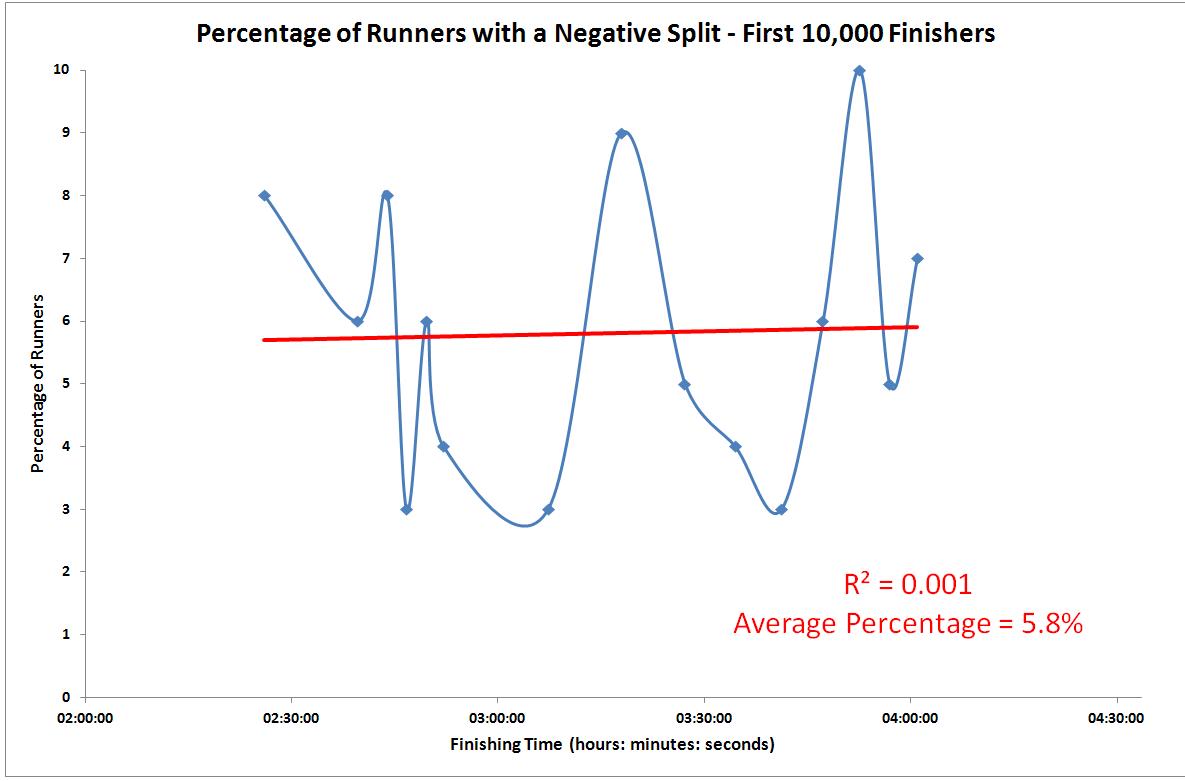
Following on from this extremely low percentage of runners achieving a negative split, I thought it would be useful to see if the percentage of runners achieving the negative split varied throughout the field. Logically, due to the fact that those that run a positive split, are those runners that slow down the most during the second half of the race, one would expect that further down the field, there is an increase in runners that positive split. One would also expect the size of the positive split would increase, further down the field. The graphs below display the number of runners in each 1000 batch of finishers that achieved a negative split. What is really interesting here is that there appears to be a clearly distinctive finishing time, at 4 hours, where something interesting is happening.

Although a line of best fit has been added to the data above, the line seems to reasonably follow the data points for finish times slower than 4 hours, but not at all for faster finishing times.
It therefore appears from the graph above that the number of runners per 1000 band of finishers, is not at all influenced by the finishing time, up to the four hour mark. The highest percentage of negative split runners was in fact at 10.6%, at a mid finish time of 3hours 28 minutes. With the fastest 1000 finishers only having 8.4% of negative split runners.
For a finishing time slower than four hours there does appear to be a relationship, with there being a smaller percentage of negative split runners, the slower, the further down the field.
So, what does the above data tell us. Firstly, the key message is that a very low number of runners achieve a negative split. It was reported at 4.0% overall on Marathon Talk, and the table below shows how this percentage varies throughout the field for each 1000 band of finishers, for the first 25,000 finishers, i.e. up to the five hour, two minute mark..
Now I wouldn't want to upset any runners reading this post, but achieving a four hour marathon time is often a huge goal for many marathon runners, as running a sub four hour time is possibly seen as a time that indicates that one is a 'good' marathon runner. Yes, simply finishing a marathon is quite an achievement, but to finish in a time less than four hours requires substantially more preparation. Therefore the fact that there appears to be no relationship between finishing time and the percentage of runners achieving a negative split , up to a four hour finish time, warrants further attention.
To those that belief that running a negative split illustrates a good performance, perhaps they would expect there to be more negative split runners further up the field. And for me, who believes the contrary, i.e. for non-elite runners, achieving a negative split is actually a sign of a poor performance, as the negative split has only been achieved by the runner running so slowly during the first half of the race, that their overall time is slower than what they could have achieved. So surely one would expect more negative splits, the slower the finish time. But the data up to four hours, i.e. for 'good' marathon runners, the first 11,000 finishers, neither of these trends are shown. There is neither of these relationships!
I then had to really think, why there is a a lack of a relationship, either way? Why no clear relationship to indicate that a negative split is a good performance or a poor performance? In terms of my belief, surely those that run a negative split, have only achieved this because they have run the first half of the race so slowly, so the data should illustrate this. I then realised why no relationships are apparent within the data. Yes, those that negative split may have performed poorly, but they just simply move lower down the finishing place list. Throughout the field people will finish with a certain time due to many factors, so there is a massive spread of finish times. Within this spread of finish times, some runners will perform well in relation to their fitness, ability, belief, whatever else, and hence move further up the field, finish faster. Whereas some runners will perform poorly, i.e. finish slower. But the good or poor performances will not stand out within the results, they simply move upwards or downwards amongst the finish results. Hence it is not possible to observe any relationship between negative/positive splitting and finish time.
I then decided to look at the 'very good' runners within the field. Now looking at the first 500 finishers, so the top 1.5% of the field. The two graphs below display this data, first comparing positive split ranking,( i.e. those runners that slow down the most in the second half of the race, having a positive split rank of one), with finishing place. Then comparing the amount of time slowed down, i.e. the size of the positive split time, with the finishing time. Again, both ways of analysing the data failed to illustrate a relationship of any strength.


One interesting aspect did 'jump out at me' though. That being, just how few negative splits there were in the very fastest of the runners. The graph directly above doesn't show many dots to the left of the vertical, which are near the horizontal axis, i.e. with the quickest times. So again back to the database, and this time looking at to see where abouts did the 84 negative split runners within the first 1000 finishers place. So I split the first 1000 finishers into place bands of 100 runners, and 200 runners. The data is in the table below.
Now the data in the table directly above now tells the true story! As mentioned above, those runners that achieve a good performance, i.e. those that run quicker than what their 'ability' or 'fitness', or 'talent', or 'whatever' suggests they should achieve, simply move up into the higher placing band, and are therefore 'lost' within the data. Similarly those runners that run slower than what their form suggests, simply move down into a lower placing band, and again it is not possible to identify these poor performances. However, if you move to the very top placing band, because all of the poor performers who should have finished within the top band move down to the second band, and all of the good performers move up into the top band from the second band, the top band therefore represents the qualities of the good performers, and doesn't include the qualities of any poor performers, as they have moved down to the lower band. (There is no higher band from which poor performers will move down from.) Once we move down below the top band, then one would expect that the number of negative split runners within each band would again be similar, i.e. no relationship between the number of negative split runners and finish time/place.
So if we have the place bands set at 100 places, within the top band, i.e. that band that truly represents the characteristics of a good performance, i.e. running quicker than what would be expected, then we clearly see that the negative split runner does represent a poor performance, as there is only ONE negative split runner within the top 100 place band. This has occurred, as those runners that have run a negative split, have moved out of this top band, down to the next band, as expected when achieving a poor performance. There is no longer the standard 8.4% of runners (the average for the first 100 finishers) being a negative split runner within the top band, It has dropped to only ONE percent! Hopefully, the above two paragraphs make sense. It is quite a hard concept to explain, but hopefully it is semi clear.
Having now identified that running a negative split is an indication of a poor performance, is it possible to identify how much slower have these negative split runners ran, by starting out too slowly? Asking the following question may help. How much slower does the negative split runner have to run their first half of the race in order to achieve a negative split. This answer can possibly be answered by looking at runners of similar finishing times, in this instance, for runners at the very top end of the field. How much of a positive split time, do these good performing runners on average slow down during the second half. This average positive split slow down time, would then be a close approximation of how much slower the negative split runners must have ran their first half in order to achieve an even/negative split. The average positive split time for the first 100 positive split finishes is 3 minutes 46 seconds. And for the first 916 positive split runners within the first 1000 finishes, they slowed down on average 4 minutes and 57 seconds, which for their average half marathon time of 1:21:12, corresponds to a slowing down of 6.1% of the half marathon time.
This percentage represents the average slowing down of the best performing 2.9% of the field. It is an average, some slowed down more, some slowed down less. Actually to get the true slowdown average of the best 1000 runners in the massed start field, one should also include the influence of the 84 negative split runners that sped up. Their average negative split was 1 minute 23 seconds, which in relation to their average half marathon time of 1:25:17, results in an average speed up of 1.6%. So overall the average slowdown for the first 1000 finishers is 4 minutes and 26 seconds, which in relation to the average half marathon time of 1:21:33, corresponds to a percentage slowdown of 5.4%.
This percentage slowdown value is actually quite an interesting figure. However, I mentioned above that perhaps the amount of positive split may vary across the field, hence why one should look at the value of slowdown of runners in a similar finish time to oneself. The fact that the percentage slowdown is only 5.1% for the first 100 finishers, in comparison to 5.4% being the average for the first 1000 finishers suggests that perhaps not only the actual amount of slowdown time will vary through the field, but there may also be some variation in the percentage slowdown throughout the field.
I therefore split the first 11000 finishers, those that finished under 4 hours, into bands of 1000 runners, which equated to typically a finish time band of around five minutes, except towards the top end of the field. To account for the wider finish time band near the front, I split the first 1000 place band into 0 – 100, 101 – 500, and 501 – 1000 place bands. This analysis produced some interesting results, which are displayed in the following table.

As indicated within the table above, it does appear that only at the very top end of the field is the percentage slowdown affected by finishing time. For runners finishing in a time between 3:17 and 4:00, the percentage slow down appears pretty consistent, and averages 9.9%. At the very top of the field whether finishing in the top 100, or between 101 – 500 there is a slow down percentage of 5.1%. This percentage slowdown therefore appears to represent the very least amount of time that the very best runners, i.e. the top 1.5% of the field., will slow down during the second half of the race. For finishing times, between 2:49 and 3:17 the slowdown percentage progressing rises up from 5.1% to 9.9%. I have identified three intermediate bands within the table. I guess with further analysis more bands could be added, but I will leave it at three bands, which therefore results in a total of five slowdown percentage bands. I haven’t carried out the analysis for finish times greater than 4 hours. However, I think the best proposal is that runners who plan to finish in a time slower that 4 hours should aim to maintain a slowdown percentage of 9.9%, i.e. the same percentage as for those runners between 3:17 and 4:00. With a slower planned finishing time even with the runner aiming for the same slowdown percentage, it would actually result in an increased slowdown amount of time, as their half marathon split time will be longer.
These average slowdown percentages are therefore very useful. In the future, hopefully now realising that trying to run an even pace for the entire 26 miles is not the strategy to use, resulting in a slower performance than one is capable of, it is quite easy to calculate what runner's half marathon split time should be in order to achieve a certain finishing time.
For example if a runner wants to run a 2:36 marathon time, they would simply divide this time (156 minutes) by 2.051. This represents a slow down of 5.1% on their half marathon time. So to obtain a 2:36 marathon finish time, with the average percentage slowdown, the half marathon split would be 76:04 (76.06 minutes), and then running the second half in a time of 79:56, results in the time of 2:36:00. So running a positive split of 3:52.
Interestingly, last month I was giving some pacing strategy advice to a friend that was wanting to achieve a PB at the London Marathon. His current PB was 2:38, but I felt that he could achieve a time of 2:36 if he adopted a positive split strategy. This predicted possible time was based on his recent half marathon race time, and also him getting wiser, gaining more experience as a runner over the last year. However, I hadn't carried out the detailed analysis of previous London Marathon data like I have recently carried out and illustrated above. I therefore went with my 'gut feeling', in terms of what positive split he should try to achieve, based on my 35 years of endurance running. I proposed to him that he should aim to go through half way in a time of 76:30 and then positive split by 3 minutes, i.e. 79:30 for the second half, resulting in a finish time of 2:36:00. Knowing what I know now, I would have realised that only positive splitting by three minutes (3.9%), compared to the average positive split of 5.1%, for that region of the field, is a bit ambitious. Based on his recent half marathon performances, running a time of half marathon split of 76:04 would have been most likely a wee bit beyond him. So in reality a finish time of 2:36:00 was really a wee bit beyond him. Applying a 5.1% slowdown to a 76:30 half marathon split results in an 80:24 second half time, so a total finish time of 2:36:54 was more likely for a 76:30 half marathon split that was decided upon.
What did he run? He went through half way in a time of 76:47 (76.78 minutes), a little slower (17 secs) than planned. With an average slowdown percentage of 5.1%, he should, following the 76:47 split time, therefore run the second half in a time of 80:42 (80.70 minutes), so a predicted slowing of 3 mins 55 secs, resulting in an overall predicted finish time of 2:37:29. What time did he run? He ran the second half in a time of 80:20, and finished in 2:37:07, so 22 seconds quicker than the average slowdown prediction. But still 13 seconds slower than the predicted finish time of 2:36:54, if he had ran 76:30 for the first half. Whereas in the past he would have considered running a positive split of 3:33 as a poor performance, having been 'brainwashed' with the myth that an even split is what one should achieve. He was therefore able to truly celebrate his good performance, as in the second half of the race he run 22 seconds quicker than expected.
Looking at the above one can quite clearly see the potential of this analysis. Runners can now calculate what pace they should go out at, i.e. what time they should pass halfway in, based on what finish time they are planning, specifically up to the four hour finish time. Please note that for runners that finish slower than four hours, I haven’t extended the above analysis as I feel that basing what one should aim to achieve on what the average of these 4 hours plus runners achieve, i.e. on the average slowdown of these runners, probably isn't ideal. As for these runners, their
more substantial slowing down is likely to be a result of less than ideal preparation, and therefore capable of changing if the preparation had been better. This level of slowdown is therefore not as a consequence of the actual reality that for a non-elite runner, one MUST slow down. As mentioned above, I think that for runners planning to finish in more that four hours, they should plan for a slowdown percentage of 9.9%, which is quite different to the typically message given out, especially by MarathonTalk, in that one should aim for an even paced marathon, so a slowdown percentage of 0.0%!
As the statistics have clearly shown above, slowing down during the second half of the marathon is a reality. It is NOT an indication of a poor performance. Yes, if a runner slowed down by a percentage substantially more than the average slowdown percentage, for their finishing time, then this would be a poor performance. If a runner was hoping to finish in a time of 4 hours, applying the MarathonTalk strategy of running an even pace, they would then plan to go through halfway in 2 hours. With a 9.9% slowdown percentage, they would typically slowdown 11 minutes 53 seconds, so typically not achieving what they felt they were capable of. Not because they ran poorly. No, because they were given the wrong advice, and started out far too slow!
In order to achieve a 4 hour finishing time, the runner needs to divide 4 hours by 2.099, NOT by 2.000 as suggested by Marathon Talk. Dividing 4 hours by 2.099 generates the half marathon split time of 1:54:20. Slowing down during the second half by 9.9% (on 114.34 minutes) results in the second half marathon being run in a time of 2:05:40, so a positive split, i.e. slowing down of 11 minutes and 20 secs. Producing a finish marathon time of 4:00:00. Achieving what the runner set out to achieve.
As you can see, taking on board the data from the thousands of runners that successfully completed the 2013 London Marathon, and not implying that a massive 96% of them have performed poorly because that didn't run an even paced race, one is able to provide a realistic pacing strategy, which doesn't actually vary that much from the even split pacing strategy. But the difference is sufficient enough for many many runners to not achieve their goal, simply as a consequence of listening to poor pacing strategy advice. In the 4 hour marathon example above, if the runner simply went out at a half marathon pace of only 5 minutes 40 seconds quicker, based on the data from thousands of runners, the likelihood of achieving their goal is massively enhanced. Running the first half marathon split 5 minutes 40 seconds quicker, means running the first 13 miles at 8:43 second minute mile pace and then slowing for the second half of the race to an average minute mile pace of 9:35. This pacing strategy which takes into account the typical slowing down percentage of 9.9% , which is in contrast to maintaining a 9:09 minute mile pace for the entire 26 miles!
Remember this slowing down is a reality, which I will hopefully be able to show why it happens with some scientific evidence within my next blog post.
As illustrated with two examples above, the application of this slowdown percentage is really exciting. The potential benefits of this percentage slowdown is huge! Marathon runners by applying the percentage relevant for their finishing position within the field, will then know how much time they should expect to slow down, rather than trying to achieve an even pace or even worse, a negative split result!
Just one last useful bit of information before finally finishing part one of this negative split myth post. With regards to the pacing strategy, the intention is that runners should be able to run at a pretty consistent even pace for the first 13 miles. However, for the 14th mile, they shouldn't instantly slow their pace to the average minute mile pace they are scheduled to run for the last 13 miles. What tends to happen is that the slowing down begins to start not too far after half way. One could calculate an accelerated rate of slowing down, where the slowdown starts of slowly for the first few miles after 13 miles, and then the slow increase accelerates, however, for ease of application, and which probably isn't too far of what happens, one should apply a linear increase in the slowing sown for the second half of the race. The best way to illustrate this linear increase in slowing down is for the 4 hour marathon example above.
The first half is run in 1:54:20 which is 8:43 minute mile pace. The second half marathon is planned to be run at an average of 9:35 minute mile pace, so an average slow down of 52 seconds per mile. This minute mile pace should then
be divided by 6.5. This value, in this example 8 secs, is then the amount the running pace slows per minute mile, every mile.
The split times for mile 14 would then be 8:51, mile 15 = 8:59, mile16=9:07, mile17=9:15, mile18=9:23, mile19=9:31, mile20=9:39, mile21=9:47, mile22=9:55, mile23=10:03, mile24=10:11, mile25=10:19, mile26=10:27. Running each mile 8 seconds slower from half way will result in running the second half at an average minute mile pace 52 seconds slower. So just with this 4 hour marathon finishing time example, where the average percentage slowdown of 9.9% has been applied, hopefully it is easy to see the benefits. When one gets absolutely shattered during the last few miles, instead on having to maintain the same pace, that was achieved during the first few miles when the runner was totally fresh. Remember this is what is proposed with the even pace strategy! (Whoever thought that this is a good approach to take, really needs to reconsider!) With an application of the 9.9% average slowdown percentage, for the last mile one is able to slow down to a 10:27 minute mile, and still achieve the 4 hour marathon goal, simply by running just that little bit faster over the first half marathon, when feeling fresh and easy. Why not run that 26 seconds per mile faster during the first half when feeling great!
Finally lets apply the same formulae to our 2:36:54 marathon example runner from above. Going through the half marathon split in a time of 76:30 is a minute mile pace of 5:50. The slowing for the second half split time of 80:24, this being the 5.1% slowdown percentage, is a minute mile pace of 6:08. The minute mile pace therefore slows by 18 seconds per mile. Divide this 18seconds by 6.5 gives a minute mile pace slowing adjustment of 2.75 seconds. The easiest approach in this situation is to round the the mile splits up or down, so rather than the following mile pace for each mile from mile 14miles=5:52.75, 5:55.50, 5:58.25, 6:01.00, 6:03.75, 6:06.50, 6:09.25, 6:12.00, 6:14.75, 6:17.50, 6:20.25, 6:23.00, 6:25.75, simply round up or down so you would then get the following mile splits from mile 14=5:53, 5:55, 5:58, 6:01, 6:04, 6:07, 6:09, 6:12, 6:15, 6:17, 6:20, 6:23, 6:26 Resulting in the required average minute mile pace of 6:08 for the second half. I guess a little bit ‘fiddly’, but I would suggest worth the effort, as at least the runner would then have realistic mile splits to aim for, rather than trying to achieve the constant running pace approach which is 96% guaranteed to fail!
I will sign off tonight with two quotes. Firstly a repeat of the quote from Tom from Marathon Talk:
“My money's still on the even / negative split but I'd be delighted to be proved wrong. My quote for the day... I'd rather know I was wrong than think I was right ;)" Tom Williams, 2011.
And the second quote from the example 2:36:54 marathon runner, who listened to the wisdom of a positive split pacing strategy, and had the humility to accept that in the past his views on the even paced strategy may perhaps have been wrong, so he took a gamble and changed his pacing strategy.
“I was delighted when I came round on to the Mall and saw the time (a PB). I think that undoubtedly your (positive split) strategy paid off and thank you so much for taking the time to advise me. It is a challenge to go in to a race with a mindset that assumes slowing down, which seems on the face of it to be a negative thing. But in reality I think that acknowledging the slow down and embracing the fact that it will require extra effort to minimise the decrease in pace is actually very positive.” Simon, 2013
Keep an eye out for part two, where the science behind why slowing down in a marathon is a reality will be explained.
All the best with your next marathon,
Stuart