Showing posts with label Nutrition. Show all posts

Monday, 1 April 2013

TORQ Trail Team Assessment Day - Loads of Positivity

Hi,

Hopefully just a quick post tonight, commenting on an excellent day I attended yesterday at Parliament Hill, London.  You may have seen my Trail Running Sussex launch blog post last week.  Well yesterday was the first outing for Trail Running Sussex.  I had been invited to do a talk to around forty keen, ambitious trail runners who were hoping to get selected for the newly formed TORQ Trail Running Team.  These runners had been shortlisted from apparently loads of runners that had applied after seeing the following information:
TORQ is looking for runners who will join the TORQ Trail Team for 2013 and enjoy many of the benefits of a professional running team.

Anyone who is committed to running on the trails and exploring the outdoors - as well as their own limits - is encouraged to apply to be part of the team: this is not just for elite runners.
Those successful in being selected for the team will spend a year as part of the TORQ Trail Team, with many of the benefits usually only available to professional teams, including:
  • A nutritional assessment and nutrition products from TORQ Fitness
  • Team-branded kit for training and racing
  • A three day training and preparation trip running in the Alps on the UTMB course around Chamonix from Thursday 20th to Sunday 23rd June 2013
  • Appearances in features in Trail Running Magazine
  • Support and advice throughout the season
As you can see, with the team not focusing on elite runners, it created quite a bit of interest.  There is also a second assessment day in Shropshire in two weeks time for around another forty runners, and I have been invited to do a talk there as well.

The day was a great opportunity to meet and chat to loads of super positive trail runners.  It was also really nice to have an audience paying full attention, listening and interacting with me during my talk. (Just a wee bit different to lecturing biomechanics to University students!)  Unfortunately I really enjoyed their enthusiasm for my 'words of wisedom', that I went on, and on, and on!  The amazing thing was that they didn't seem to wilt, a true demonstration of ultra endurance qualities!


Rather than me describing the overall day, one of the runners has provided a well written summary on his blog.  Click this link to read Chris' blog post.  As Chris describes, the day consisted of three talks and then an easy off road run up Parliament Hill, with some awesome views of the high rise buildings of London.


During my talk I covered quite a few topics. One or two of these topics I was quite vocal in terms of that what I was saying had been clearly demonstrated either within the academic literature or as evidenced during running races. I have since thought, that for these topics where I was more certain of my ideas, that perhaps I should provide a little bit of evidence to substantiate my statements.

Firstly, my statement that dehydration is not the problem in relation to decreasing performance that it is made out to be!

The first talk of the day was a talk on nutrition by Martin from TORQ.  By the way I haven't actually mentioned who TORQ are.  In a sentence they are a company that produce nutritional products, and are well used within the Mountain Biking community.  I have tasted their TORQ bar, and it tastes good.  But haven't yet tried their gels, although Luke my physio uses them and states that they are really good.

I spent quite some time checking out the TORQ website last week, and overall I was pretty impressed with the website, the material they present, and how the science is translated into their products.  Similarly, the talk by Martin was very good, and he clearly explained the purpose and benefits of adopting an appropriate nutritional strategy.  However, there were two small aspects of Martin's talk that I wasn't in total agreement with, and a little unfairly I highlighted my concerns regarding these two aspects during my talk, without providing the opportunity for Martin to reply, sorry Martin.

So, with regards to dehydration,  Martin put up the following slide.
Now this slide corresponds to data from the eighties which has since been clearly shown to be totally flawed when it comes to real life marathon running!  The following is the abstract/summary from a scientific journal article from 2012.
Drinking Behaviors of Elite Male Runners During Marathon Competition

Author(s): Beis, LY (Beis, Lukas Y.)[ 1 ] ; Wright-Whyte, M (Wright-Whyte, Moray)[ 1 ] ; Fudge, B (Fudge, Barry)[ 2 ] ; Noakes, T (Noakes, Timothy)[ 3,4 ] ; Pitsiladis, YP (Pitsiladis, Yannis P.)[ 1,5 ]

Source: CLINICAL JOURNAL OF SPORT MEDICINE Volume: 22 Issue: 3 Pages: 254-261 Published: MAY 2012

Participants: Ten (9 winners and 1 second position) male marathon runners during 13 major city marathons.

Main Outcome Measures: Total drinking durations and fluid intake rates during major city marathons.

Results: The ambient conditions during the 13 studied marathon races were 15.3 degrees C +/- 8.6 degrees C and 59% +/- 17% relative humidity; average marathon competition time was 02:06:31 +/- 00:01:08 (hours: minutes:seconds). Total drinking duration during these races was 25.5 +/- 15.0 seconds (range, 1.6-50.7 seconds) equating to an extrapolated fluid intake rate of 0.55 +/- 0.34 L/h (range, 0.03-1.09 L/h). No significant correlations were found between total drink duration, fluid intake (rate and total), running speed, and ambient temperature. Estimated body mass (BM) loss based on calculated sweat rates and rates of fluid ingestion was 8.8% +/- 2.1% (range, 6.6%-11.7%). Measurements of the winner in the 2009 Dubai marathon (Haile Gebrselassie) revealed a BM loss of 9.8%.

Conclusions: The most successful runners, during major city marathons, drink fluids ad libitum for less than approximately 60 seconds at an extrapolated fluid ingestion rate of 0.55 +/- 0.34 L/h and comparable to the current American College of Sports Medicine's recommendations of 0.4-0.8 L/h. Nevertheless, these elite runners do not seem to maintain their BM within current recommended ranges of 2%-3%.
So it is quite clearly demonstrated that elite marathon runners experience dehydration well in excess of 5% bodyweight, which according to the above figure would correspond to performance well less than 70%, but yet Gebrselassie set the world marathon record, also with a similar 9 - 10% dehydration that he had at Dubai!

But, the above article refers to elite marathon runners.  Does the same findings apply to the non-elite?  Well there is another recent 2011 article, that investigated this and here is the abstract/summary:

Inverse relationship between percentage body weight change and finishing time in 643 forty-two-kilometre marathon runners Hassane Zouhal, 1 Carole Groussard,1 Guenolé Minter, 1 Sophie Vincent, 1 Armel Cretual, 1 Arlette Gratas-Delamarche, 1 Paul Delamarche, 1 Timothy David Noakes 2

Objective The purpose of this study was to determine the relationship between athletic performance and the change in body weight (BW) during a 42 km marathon in a large cohort of runners.  Methods The study took place during the 2009 Mont Saint-Michel Marathon (France). 643 marathon finishers (560 males and 83 females) were studied. The change in BW during the race was calculated from measurements of each runner’s BW immediately before and after the race.

Results BW loss was 2.3+2.2% (mean + SEM).  BW loss was -3.1+1.9% for runners finishing the marathon in less than 3 hours; -2.5+2.1% for runners finishing between 3 and 4 hours; and -1.8+2.1 for runners who required more than 4 hours to complete the marathon. The degree of BW loss was linearly related to 42 km race finishing time.  Neither age or gender influenced BW loss during the race. Conclusions BW loss during the marathon was inversely related to race fi nishing time in 643 marathon runners and was >3% in runners completing the race in less than 3 h. These data are not compatible with laboratory-derived data suggesting that BW loss greater than 2% during exercise impairs athletic performance.
They match an extensive body of evidence showing that the most successful athletes in marathon and ultramarathon running and triathlon events are frequently those who lose substantially more than 3–4% BW during competition. So the issue of dehydration severely affecting performance at even 5% dehydration clearly doesn't seem to occur!

So even for non-elite runners, it appears that dehyration of 3.1% results in a better performance than dehydration of only 1.8% of bodyweight!

My second point of concern regarding Martin's presentation was the issue regarding how much carbohydrate does one need to consume during an ultra trail race.  Martin clearly explained the latest research that has demonstrated that with the use of a Maltodextrin (glucose polymer): Fructose blend, at a 2:1 ratio, the amount of carbohydrate that can transported across the intestine is increased from the previous thought maximum of 60 grams per hour, up to 90 grams per hour.  The real issue what was being discussed yesterday was, is there really a need to consume 90 grams an hour during an ultra trail race.

Well, I am pretty confident in stating NO!  My reason for this is that the intensity one runs at during an ultra trail race, say of 100 miles, is so low, that the body is not consuming much carbohydrate.  This relationship between exercise intensity and utilisation of fat or carbohydrates comes mainly from the nineties, but is still regarded as being correct.

Below are some figures that illustrate how the percentage of fuel from carbohydrate decreases as the exercise intensity decreases.


So these two figures above show that as the intensity of the exercise decreases more energy is created through the metabolism of fat, not carbohydrate.  The figure below clearly illustrates this relationship.


Now during the second half of a 100 mile ultra, and I guess for those runners that attempt to try to run at a constant pace/effort, then during the entire race, the intensity is going to be rather low.  For me, with a maximum heart rate of around 185 bpm, and a resting heart rate of around 45 bpm, during the last 50 miles of the Lakeland 100, my heart rate is typically at only around 120 - 125 bpm which equates to around 54 - 57% of heart rate reserve (HRR) which is max HR - rest HR, which equals 140 bpm.  It has traditionally been thought that the %HRR corresponds reasonably closely with %VO2max, so it would indicate that for the second half of the race I am exercising at only around 54 - 57% of my VO2max. (Although the latest research suggests that the % HRR would more closely equals the %VO2 reserve, either way the value will be reasonably similar.) Which from the figure above would give me a fat:carbohydrate ratio of around 65% fat and only 35% carbohydrate. It is therefore clearly obvious that there is no need to consume 90 grams of carbohydrate per hour, as the body isn't using carbohydrate at a high rate!


The final aspects from my talk yesterday that some evidence may be useful to demonstrate the point I made, is to do with slowing down during ultra races, and marathons.  I discussed this in some detail in a previous post back in December 2011, after I raced Martin Yelling from Marathon Talk at the Endurancelife Dorset Coastal Trail Marathon, and I raised this aspect of him getting it totally wrong regarding pacing!  He wasn't convinced.  I'll present the key figures and some text from my previous post that clearly demonstrate that the concept of the negative split is totally wrong, and leads to 'failure' for over 95% of all marathon runners.

To help provide evidence for the flawed concept of the negative split, back in December 2011 I looked at the results from that year’s Virgin London Marathon. Perhaps as one would expect, based on the status the negative split has, both the male and female winners ran negative splits. So therefore why have I wasted all of this time typing up this blog post, attempting to get you to consider that the negative split isn’t what it is made out to be? But let’s look a little deeper at the results. How many of the other 99 runners in the top 100 in the massed start race also achieved a negative split? Remember these runners are the very best, at the very front of a field of over 35,000 finishers. Surely then one would expect around half of the top 100, or at least a third! No, only seven other runners in the top 100 finishers ran a negative split. This ‘strange’ result could however be because at the front of the race many of the runners went out with the pace makers at nearly world record pace, in the hope of hanging in there to the finish, they therefore were never going to achieve a negative split. So if I look at how many within the next 100 places from 101 – 200 achieved a negative split, this would give perhaps a more true representation of the frequency of the negative split occurring. These runners from 101 – 200 are still top quality runners, and in relation to the overall field, very, very fast runners, with an average finish time of 2 hours 39 minutes. The results show that there were only 6 negative split runners from the 100.
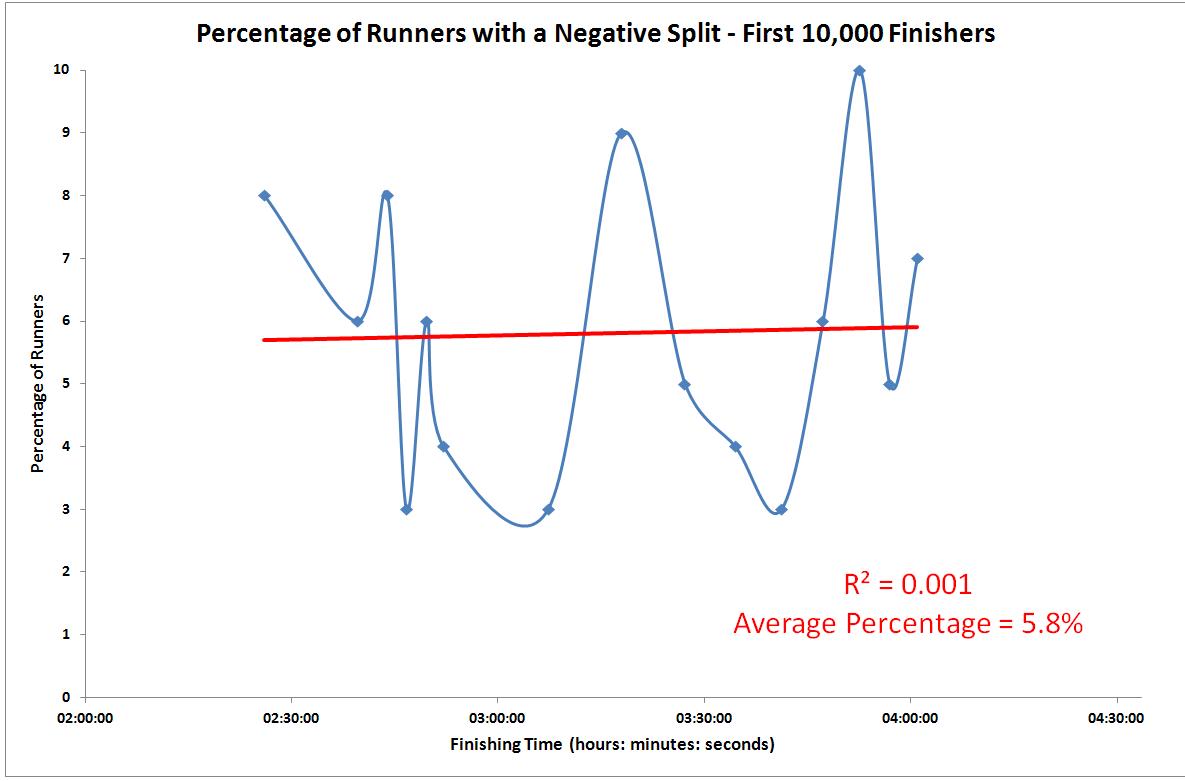


If you look at the graph above, it shows the number of runners that negative split from samples of 100 runners at different time gaps for the first 10,000 finishers, then you will see that there is ABSOLUTELY no relationship at all between the finish time of the runners and the percentage that achieve a negative split. If running a negative split was a quality of being a good runner, of a good performance, then surely one would expect that further towards the front of the field there would be a higher percentage? With a correlation of pretty well zero, one shouldn’t need any more evidence that the negative split is NOT something to aim for, NOT something that indicates that you performed well!


Another key statistic is the percentage of runners within the first 10,000 finishers that actually achieve it, being only 5.8%. With this evidence it therefore still amazes me that there seems to be the message ‘out there’ that the negative split is something all runners should aim for. If we look at a 10% sample, in batches of 100 runners, spread throughout the 23,600 runners that finished within 5 hours at London, then the percentage that achieve a negative split drops even lower to only 4.3% of finishers! The graph above also shows how the positive split slowing down time increases as the finishing time increases.

A real issue that needs attention, is in terms of the potential effect this low percentage of negative splits may have on the marathon finishers, when 95.7% of them do not achieve probably the number one goal that is drummed into them apart from finishing! Remember the message ‘out there’ that the negative split indicates that you ran well, probably even more important than your actual finishing time. So 95.7% of runners are potentially disappointed because they didn’t achieve one of their goals.  No wonder most endurance runners think negatively towards themselves!


The above figures relate to a road marathon, what about some ultra trail race data?  Well I dug out some results and did some analysis.  Hopefully it makes some sense.

Data from the 2012 Montane Lakeland 100:


So, even the widely regarded 'super human' performance by winner Terry, still involved him slowing down during the second half of the race by nine percent!  In comparison to Gancho, who obviously took it really easy during the first half of the race, being over an hour and a quarter behind me at Dalemain.  He still slowed down during the second half of the race by twenty one percent.  Yes, a reduced slowing down rate, in comparison to Paul (and Barry 2nd=, same slowdown as Paul, and also 4th place Ian with 33% slowdown) and me, with a massive 42% decrease in pace!  So only Terry slowed down less than Gancho, but Gancho only finished in 6th place.  Did his attempt to run even pace, cost him second place?  Did he gain back the time he lost during the first half of the race when running purposely slowly, by going faster in the second half of the race.  An interesting question?  I think not!

Just one last example to finish with, this time from the 2011 IAU World Ultra Trail Championships in Connemara, Ireland.  Comparing my slowing down during the second half of the race, with Julian Rendall from GB, who finished one place behind me in sixteenth place.


With regards to the percentage slowdown at the Worlds, it is much smaller than the Lakeland 100, as the first half of the Worlds course involved two very tough steep climbs of Diamond Hill, of around 400 metres climb each time!  Again the question could be asked, did Julian manage to run that much substantially faster during the second half of the race, significantly faster to gain back all of the time he lost during the first half of the race by purposely running slowly?  Again I think not!

Just to conclude "Run as fast as you can, while you can!"  The negative split is a flawed concept!

I hope that the above information has helped provide some evidence for some of the statements I made during my talk.  However, as I mentioned yesterday, the majority of the content of my talk are my views, so it doesn't automatically mean that they are correct.  The main goal from my talk was to get the audience to start questioning their ideas to training and racing.  Is there an alternative approach?

Time to sign off, and I think the words from Tom at Marathon Talk are quite appropriate.
“A large amount of what we achieve is governed by our mental state and how we see ourselves. (It is) a lot about opening the mind to what might be possible when we throw away the self imposed limitations of our mind.” Tom Williams, 2011.
To those of you that attended yesterday's TORQ Trail Team Day, thanks for making the day an enjoyable experience.  To everyone else, hopefully the above information makes some sense, even without the context of my TORQ talk!

I hope to see you all 'positive splitting' in the future,

Stuart

Thursday, 28 March 2013

A Continuation of Changes and Progress - Thoughts on Nutritional Strategies and the Endurancelife Sussex Coastal Trail Marathon Race Report

Hi, some of my thoughts on nutrition tonight, and then race report number two for 2013,
Three weeks ago my Steyning Stinger Marathon race report included some details regarding my changed approach to physical training for 2013.  Well tonight’s Endurancelife Sussex Coastal Trail Marathon race report will also include some details regarding changes I have made to my nutrition for 2013.  Well it was meant to be some details on nutrition, but I got carried away a bit, so the actual Endurancelife Sussex Coastal Trail Marathon race report doesn't start for ages!  If you aren't really interested in my thoughts regarding nutrition, skip the first bit, and look for the heading titled Race Report Finally!
It was on one of the Lakleand 100 recce runs back in June 2011 when I first met ultra trail runner Barry Murray from Optimum Nutrition 4 Sport.  We were running from Pooley Bridge to Ambleside, and whilst going up the first gentle climb the two of us slowly moved ahead of the small group we has started with.  We got talking, and around five or so hours later I was a bit more knowledgeable when it came to sports nutrition for endurance running.  Yes, it was a fortunate meeting, as Barry not only comes across as pretty 'switched on', but he is able to explain it well, supported with some evidence/science, combined with his own personal experiences.  So since then I have been giving more thought to my nutrition, not that I hadn't previously, but now I was a bit more open minded as there appeared to be quite a bit more new stuff taking place, since I had last read the sports nutrition literature back in the late nineties whilst I was doing my sports science masters degree.
Looking back at a blog post I wrote shortly after the 2010 Lakeland 100 I discussed what I had consumed during the race.  Not much really, especially for the last 40 - 50 miles, as I was running so slowly that there wasn't really the demand, the need to consume loads.  I have also identified in a previous post that nutrition/fuelling is one of the key factors that you need to get right in order to perform at ultra trail running.  So paying it a little more attention this year, fitted in with my new approach for 2013 of making big changes if appropriate.
So combined with listening to a few podcasts, discussing it with training partner Kev on Saturday morning runs, and searching through some of the latest scientific articles, the idea of doing long training runs whilst in a fasted state seemed to appeal.  My wife Frances, who is really into her nutrition, had already got me off the cardboard cereals for breakfast, and I was now consuming porridge, soaked overnight in a bit of yogurt, with ground linseed's mixed in after cooking.  The rationale for the porridge rather than cardboard cereal was something about a slower energy release, so not getting the spike in blood glucose and insulin,  Anyway, I then thought it was time to start doing the morning runs without any breakfast.  I remember that back in around May/June 2011, that I had experimented with doing a long training run without feeding, although I did have cereal for breakfast prior to starting.  On the long 40 mile run, I got to around the 25 mile mark on the run, and I was 'woossey' in the head.  I had to take on board an energy bar I was carrying, and then I got some chocolate and Lucozade was the Golf Pro shop I shortly ran past.  So back then, I clearly needed to consume carbohydrate for a long run.  It appeared that my body and mind was not capable of completing a long run without carbohydrate.  It didn't need much, as demonstrated by my three day Lakeland 100 recce run and the actual 2010 race, but it needed some carbohydrate.  Back then I barely trained for longer than 18 - 20 miles, so never taking on board carbohydrate during a long run never seemed to be a problem, but thinking back now, I do remember beginning to struggle at the end of some of my 18 - 20 milers.
Back to the present day, come the end of 2012, I am keen to give this fasted running a go.  I start with my long Saturday morning runs, all goes well.  I then decide to try it out whilst up in the Lake District for the January Lakeland 100 recce.  Saturday morning, I skip breakfast and run on my own for around 14 miles, over leg 5 and then back to Buttermere YHA via the road.  Again all is fine.  Then the big test, on the Sunday the recce run of 27 miles, legs 1 - 4 from Coniston to Buttermere, whilst fasted and without fuelling.  There is a long bus journey to take us from Buttermere to the start.  So we don't start running until 9:45am.  I have a great run with John and Tom, including running through the snow, for five and a half hours, and only consume water during the undulating 27 miles.  So it is 3:15pm when we finish, so those that know the route will see that we weren't really 'hanging around', but everything was absolutely fine, no lack of energy, no tiredness, all good.  So from the end of November / start of December when I consistently introduced fasted runs on Saturdays and Sundays, and typically on one morning run during the week.  The rest of the time I would run during the day, so would be running not in a fasted state.  Within quite a short space of time, based on my Jnauary Lakeland 100 recce experience, it appeared that my body and mind had already adapted, so completing a long run fasted and no fuelling ,was now totally manageable.

So what is the purpose, the gain in doing long runs, after an overnight fast?  Well the key is, supported by the latest research, that the body adapts and then becomes more efficient at utilising fat as a fuel, rather than using the limited bodies carbohydrate stores.  There are quite a few recent papers that confirm this, with one titled "Training with Low Muscle Glycogen Enhances Fat Metabolism in Well-Trained Cyclists" being written (first author) by one of my ex-students from Worcester, Carl Hulston.  He has done really well for himself, having gained a PhD at Birmingham working with Asker Jeukendup, (a bit of a sports nutrition guru), and Carl is now back at Birmingham after spending some time researching in Denmark.  One interesting point from Carl's article is that they created a low muscle glycogen state in the cyclists by getting them to do a hard training session in the morning, and then prevented them from consuming carbohydrate during the intervening time, before their afternoon training session.  So this method, and the overnight fasting method, are typically the two approaches used to encourage fat metabolism.  Looking at the scientific literature, all of the biochemical markers indicate that it works.  Here is the abstract (summary) of the study:
HULSTON, C. J., M. C. VENABLES, C. H. MANN, C. MARTIN, A. PHILP, K. BAAR, and A. E. JEUKENDRUP. Training with Low Muscle Glycogen Enhances Fat Metabolism in Well-Trained Cyclists. Med. Sci. Sports Exerc., Vol. 42, No. 11, pp. 2046–2055, 2010. Purpose: To determine the effects of training with low muscle glycogen on exercise performance, substrate metabolism, and skeletal muscle adaptation. Methods: Fourteen well-trained cyclists were pair-matched and randomly assigned to HIGH- or LOW glycogen training groups. Subjects performed nine aerobic training (AT; 90 min at 70% V˙ O2max) and nine high-intensity interval training sessions (HIT; 8 5-min efforts, 1-min recovery) during a 3-wk period. HIGH trained once daily, alternating between AT on day 1 and HIT the following day, whereas LOW trained twice every second day, first performing AT and then, 1 h later, performing HIT. Pretraining and posttraining measures were a resting muscle biopsy, metabolic measures during steady-state cycling, and a time trial. Results: Power output during HIT was 297 + 8 W in LOW compared with 323 + 9 W in HIGH (P < 0.05); however, time trial performance improved by 10% in both groups (P < 0.05). Fat oxidation during steady-state cycling increased after training in LOW (from 26 + 2 to 34 + 2 KmolIkgj1Iminj1, P G< 0.01). Plasma free fatty acid oxidation was similar before and after training in both groups, but muscle-derived triacylglycerol oxidation increased after training in LOW (from 16 + 1 to 23 + 1 KmolIkgj1Iminj1, P < 0.05). Training with low muscle glycogen also increased A-hydroxyacyl-CoA-dehydrogenase protein content (P < 0.01). Conclusions: Training with low muscle glycogen reduced training intensity and, in performance, was no more effective than training with high muscle glycogen. However, fat oxidation was increased after training with low muscle glycogen, which may have been due to the enhanced metabolic adaptations in skeletal muscle.
So Carl's study shows that the low muscle glycogen training enhanced fat oxidation, although there was actually no greater improvement in performance, as a result of the limited carbohydrate availability training.  One needs to look at the duration of the performance test, it was  "a 60-min steady-state cycle test at the same absolute workload as baseline measures (i.e., approximately 70% of pretraining V˙ O2max). This was immediately followed by a time trial designed to last approximately 60 min."  So therefore the true benefits of improved fat oxidaton may not have had the opportunity to improve performance as the intensity of the performance test was too high, with the duration being too short.  But when it comes to ultra trail racing, where the intensity is substantially lower, one would expect that improved performance would result, although to date, not demonstrated within the literature, mainly due to the difficulty in setting up a controlled study.  One intersting aside is that the performance improvements were the same for both training interventions, even though the intensity of training in the low muscle glycogen state was significantly lower.  A nice reminder that performance is influenced by more than simply the amount or the intensity of the physical training.

Here is the abstract/summary, from another study from 2010:
Van Proeyen K, Szlufcik K, Nielens H, Ramaekers M, Hespel P. Beneficial metabolic adaptations due to endurance exercise training in the fasted state. J Appl Physiol 110: 236–245, 2011. First published November 4, 2010; doi:10.1152/japplphysiol.00907.2010.—Training with limited carbohydrate availability can stimulate adaptations in muscle cells to facilitate energy production via fat oxidation. Here we investigated the effect of consistent training in the fasted state, vs. training in the fed state, on muscle metabolism and substrate selection during fasted exercise. Twenty young male volunteers participated in a 6-wk endurance training program (1–1.5 h cycling at 70%V ˙ O2max, 4 days/wk) while receiving isocaloric carbohydrate-rich diets. Half of the subjects trained in the fasted state (F; n = 10), while the others ingested ample carbohydrates (CHO) before (160 g) and during (1 g•kg body wt_1•h_1) the training sessions (CHO; n = 10). The training similarly increased V ˙ O2max (+9%) and performance in a 60-min simulated time trial (+8%) in both groups (P < 0.01). Metabolic measurements were made during a 2-h constant-load exercise bout in the fasted state at 65% pretraining V ˙ O2max. In FASTED, exercise-induced intramyocellular lipid (IMCL) breakdown was enhanced in type I fibers (P < 0.05) and tended to be increased in type IIa fibers (P = 0.07). Training did not affect IMCL breakdown in CHO. In addition, FASTED (+ 21%) increased the exercise intensity corresponding to the maximal rate of fat oxidation more than did CHO (+6%) (P < 0.05). Furthermore, maximal citrate synthase (+47%) and -hydroxyacyl coenzyme A dehydrogenase (+34%) activity was significantly upregulated in F (P < 0.05) but not in CHO. Also, only FASTED prevented the development exercise-induced drop in blood glucose concentration (P < 0.05). In conclusion, FASTED is more effective than CHO to increase muscular oxidative capacity and at the same time enhances exercise induced net IMCL degradation. In addition, FASTED but not CHO prevented drop of blood glucose concentration during fasting exercise.  
Anyway, enough of the scientific writing, does it actually improve endurance running performance?  Well, firstly one needs to do some more reading, and some thinking!  The duration, and the intensity the race is run at largely influences the bodies ability to metabolise fuel, and it's demand for the different types of fuel, i.e. carbohydrate or fat.  Now when racing 100 mile trail races, in all of my experiences I have slowed down massively, and I mean mega massively slowed down during the last 40 or so miles.  to such an extent, that I am going so slow that I don't really need to take on much food, as the intensity is so low, that the body can function on fat with no problems.  Although I do remember reading in my Astrand  and Astrand exercise physiology text book from the eighties, that "fat burns within a carbohydrate flame", so there is still the need to burn some carbohydrate.  But I am now beginning to think that due to my "run as fast as you can, while you can" approach to pacing an ultra, my intensity for the first few hours is pretty high, so I will be metabolising quite a bit of carbohydrate, so perhaps the benefits described within the scientific journals from fasted / low glycogen training could be beneficial even in 100 mile ultras, if working at a reasonably high intensity.  For marathon racing, where the duration is significant less in time, typically around 3 hours for a trail marathon for me, then likely benefits from enhanced fat metabolism would be expected.   What do the elite endurance runners do?  I don't really know in terms of ultra trail runners, but this increased focus on fat burning does appear to be the 'buzz' approach within ultra trail running circles at the moment.  In terms of marathon runners, well it also seems to be quite common.  A nice review paper written by L.M. Burke in 2010 stated:
In real life, most elite athletes practice an intricate periodization of both diet and exercise loads within their training program, which may change within a macrocycle or microcycle. Either by intent or for practicality, some training sessions are undertaken with low carbohydrate status (overnight fasting, several sessions in the day, little carbohydrate intake during the workout), while others are undertaken using strategies that promote carbohydrate status (more recovery time, post-meal, carbohydrate intake during the session). It makes sense that sessions undertaken at lower intensity or at the beginning of a training cycle are most suited, or perhaps, least disadvantaged by ‘‘train low’’ strategies. Conversely, ‘‘quality’’ sessions done at higher intensities or in the transition to peaking for competition are likely to the best undertaken with  better fuel support.
But the best indication that this nutritional strategy improves performance is an excellent article from 2012 titled "Case Study: Nutrition and Training Periodization in Three Elite Marathon Runners" written byTrent Stellingwerff.  The article is fantastic, well worthy of having a read.  Here are some key bits regarding the nutrition:

Well I was going to paste a few sentences from the article, but there was just too much good stuff to paste.  I am very fortunate that I can get access to the scientific articles through my day job as a University lecturer in sports science.  It is tempting to simply provide the PDF document to you, but this would be breaking copyright laws and abusing the privileged position I have.  But I have just searched the web, and someone else has broken the copyright laws by posting the PDF document onto a web page.  So to read this great article click this following link, http://www.runvictoriamarathon.com/pdf/Stellingwerf-MarathonCaseStudy.pdf  Well written applied articles like this don't come much better!

So to summarise, this nutritional strategy to encourage fat metabolism, (emphasised more during the early and middle stages of a 16 week marathon build-up), but then to modify the nutrition to focus on carbohydrate feeding whilst training leading immediately up to the marathon race, appears to be adopted by elite marathons, well at least the three elite Canadian marathon runners referred to within the article: Reid Coolsaet, Dylan White and Rob Watson.  The times they ran for the marathon at the end of  the 16 weeks training which was covered in the article were 2:11:23, 2:12;:39, and 2:16:17, but all three runners have since improved their PBs to 2:10:55, 2:10:47, and 2:13:37.  The quickest Canadian marathon runners for some time!  By the way Reid Coolsaet ran at the London Olympic Marathon finishing in 27th place.  As an aside, click this link to access an excellent magazine/news article I recently discovered when researching these guys which describes Reid Coolsaet obtaining the qualifying tome for London.  Again, another great article!

Within the case study article, it describes how for the three runners during the 16 weeks, there were in total 606 training sessions.  Of these there were 107 low carbohydrate availability training sessions, of which 11 of these were reduced glycogen training, and 96 were morning fasted training. The runners completed most of the low carbohydrate availability training sessions during the first 12 weeks of the 16 week training programme. Within the literature there is also some interesting articles that indicate that there appears to be a relationship between the amount of carbohydrate consumed DURING a marathon/ironman with the finishing time,  Those runners that consume the most carbohydrate during the marathon/ironman, have a quicker finishing time, as illustrated in the image below.


Initially I was a bit sceptical regarding this relationship, as just because there is a relationship it doesn't mean that it is causal, i.e. it could be that just by chance it is the more seriously training athletes that have read the literature so are aware of the perceived benefits of taking on board carbohydrate, so it is not in fact the carbohydrate consumption that has caused the quicker time, but the influence of the more seriously trained athletes have in fact read more and therefore consume more carbohydrate.  Anyway, that was my initial thoughts, but more searching of the literature indicates that there have been multiple studies that have shown that there is a direct relationship in terms of grams of carbohydrate consumed per hour and performance.  With one very recent article by Smith et al (February, 2013) concluding:

We estimate incremental performance improvements of 1.0%, 2.0%, 3.0%, 4.0%, and 4.7% at 9, 19, 31, 48, and 78 grams per hour, respectively, with diminishing performance enhancement seen at carbohydrate levels >78 grams per hour. Carbohydrate beverage ingestion and endurance (160 min) performance appear to be related in a curvilinear dose–response manner, with the best performance occurring with a Carbohydrate (1:1:1 glucose–fructose–maltodextrin) ingestion rate of 78 grams per hour.
The three Canadian marathon runners in the case study article are also aware of the need to consume a large amount of carbohydrate DURING the marathon race.  Previously it was thought that the maximum amount of carbohydrate able to be oxidized was 60 grams per hour, being limited by the intestinal absorption of the carbohydrate. However, it has recently been shown that when fructose is ingested along with glucose, then the oxidation rate can increase up to 90 grams per hour, due to the fructose using different transporters.  Hence you will now see that many of the carbohydrate gels now use a combination of typically 2:1 ratio of glucose polymer: fructose.  Just one last bit of research to finish off with, it appears the the gut is trainable in terms of its ability to absorb carbohydrate.  Therefore, training within a fasted low carbohydrate availability state seems to be in conflict with the principle of specificity.  The dilemma goes like something like this; in order to improve fat utilisation, beneficial for endurance performance, one needs to train without taking on board carbohydrate.  However, then come race day, when evidence clearly shows that carbohydrate feeding will enhance performance, with the more carbohydrate the better the performance, combined with the fact that the rate of carbohydrate absorption is trainable, i.e. will improve if carried out during training, then surely one must train consuming carbohydrates!  This is where looking at the nitty gritty of the research is important.  Apparently, the improved carbohydrate transportability/oxidisation only requires four weeks of training, therefore, just as athletes will use periodisation in terms of their physical training, then periodisation is also required in terms of their nutritional strategies.  The Canadian case study clearly demonstrates this nutritional periodisation, where the majority of the low carbohydrate availability training sessions took place in weeks 1 - 12, and then for the last four weeks, the frequency of the carbohydrate fuelling sessions substantially increased, and the runners were encouraged to consume carbohydrate in every training session longer than 75 minutes.

Well, a bit of a side track there leading into my Endurancelife Sussex Coastal Trail Marathon race report.  So lets finally get this race report started, where hopefully I will integrate some of my nutritional experiences for 2013 into the report.

Endurancelife Sussex Coastal Trail Marathon Race Report FINALLY!!!


The Sussex coastal trail races were venue number eight from a total of eleven venues for the 2012/13 coastal trail series. At each venue there is a choice of from 10km, half marathon, marathon, and 33 mile ultra distance races to opt for. I decided that the marathon distance would be ideal preparation for my first key race of the year, the 53 mile Highland Fling, five weeks later. I had completed the inaugural Endurancelife Sussex Coastal Marathon back in 2011, but missed last year's event due to being in New Zealand. For 2012, the course had been slightly shortened from the over-long 28 miles in 2011, and therefore my winning time from 2011 was no longer the course record. This year's course was the same as 2012, so during my preparation, I set myself a target to try to 'keep me honest' and not to 'slacken off' like I usually tend to, to help me work hard the entire way. The target set was to ensure that I ran faster than the 2012 winning time.

As opposed to the Steyning Stinger marathon three weeks earlier, when I trained hard/long right up to race day, for the Sussex Coastal Marathon I adopted a mini taper. The reason for this was to help ensure that I performed well on the day. With it only being five weeks until the Highland Fling, I felt that it would be more beneficial to feel positive from a strong run, and that this positivity would be far more helpful towards improving my Fling performance. More than any gains I may get from doing a bit more physical training. Remember training needs to be TOTAL training, not just physical!

As I am sitting in my car, keeping away from the freezing strong chilly wind, I am 'well up' for a solid run.  The fact that it is going to be arctic conditions doesn't distract me,  I am focused for a continuation of my forward and upward progress of 2013.  Again as similar to the Steyning Marathon, with it being quite, no extremely chilly, I have a dilemma over what to wear.  Endurancelife races require you to carry/wear specified clothing, and a pack with mobile phone, foil blanket, whistle etc.  Originally I was going to carry the awesomely tiny and lightweight Montane Slipstream GL Jacket within my recently purchased UltrAspire Synapse Bottle Waist Pack,  However, having been out in the wind walking back from registration, the conditions reminded me of the 2010 Hardmoors 55 mile race, where similar to today, it was only about one degree, but I had to resort to racing with all of my emergency clothing on, and with a balaclava on, and I was still cold.  So for the first time ever, I started a race wearing tights.  Luckily, I had just received Montane's newest style Trail Tights, which, yes I know I am sponsored by Montane, but these tights are absolutely 'the business'.  They hug your legs, but yet don't feel tight or restrictive in any way.  I also decided to ditch the lightweight jacket, and start with the more substantial Mimimus Jacket.  The thinking was, if I got too hot wearing this jacket, I could simply remove it and store it within the bungee cords designed for this purpose on the side of the UltrAspire Synapse Bottle Waist Pack.

The race starts and I am straight into the lead. One great feature of the race is that within the first three miles you race over the iconic Seven Sisters. These are seven short but sharp hills, which are great fun, as it is like doing rep work, attack the climb, then recover on the descent, then attack again, etc. The real bonus is that you are racing over these whilst fresh, whereas in the Beachy Head Marathon, which I have raced eleven times, you don't encounter the Seven Sisters until around mile 18, so the 'attacking' of the climbs is usually rather subdued!

I am really enjoying myself as I race across the Seven Sisters, with a very supportive tail wind, then as I turn inland at Cuckmere Haven after around three miles I get a shock. There is a runner only around ten seconds behind me! It was a shock as right from the go, I was on my own, and I hadn't sensed anyone behind, (I now never look behind, as I focus on what I am doing, not to be influenced by others). So I had just assumed I was quite clear and so I was prepared for the day being simply about me being disciplined and running hard the entire way. All of a sudden I had a race on my hands, especially as I hadn't been dawdling! I concluded that this guy behind must be a pretty competent and confident runner to start at such a quick pace, so yes, battle on! With this realisation that I was in a race, I 'banged out' a slightly downhill mile in 6:14, but more significant was that the average heart rate for the mile at 169 bpm, was the highest of the race. (GPS data on GarminConnect).  During the first six miles of the race, my heart rate strap seemed to have lost its elasticity so it was continually sliding down.  Fortunately my training partner Kevin, was marshaling at the first checkpoint at Litlington, so I was able to take it off and pass it to him.  Great that I no longer had the frustration of it slipping down, but I therefore no longer have any heart rate data after mile six, so unable to have any objective data on whether I did 'slacken off' during the race.

Shortly Before Checkpoint 1 - Working Hard to Get Away!  Notice that I am appropriately dressed for the arctic conditions: tights, gloves and four layers on my upper body!

I pass through checkpoint one, with the guy behind still pretty close, actually the official results show only 24 seconds behind. I also later see on the results sheet that his name is Matthew Yarlett. The course then travels along the first of many really muddy boggy sections, as it is next to the Cuckmere River as we approach Alfriston. As I mentioned earlier, on the day there are four different race distances taking place. The 33 mile ultra race started 30 minutes before the marathon, and marathon runners if they choose, usually the slower runners, could start 30 minutes earlier with the ultra runners. I presume due to the very demanding and rather unpleasant weather conditions, probably around half or even more of the marathon runners decided to start early. It was shortly after the Litlington checkpoint that I started to overtake quite a few of these runners, including my phsyio Luke, who was completing his fifth of the seven marathon he is completing this year from the Endurancelife Coastal Trail Series, It was enjoyable 'flying past’ these early start runners. I would typically say hi, unless I was puffing and blowing too much climbing a hill. And they would usually reply with a friendly hi. Although I always wonder just how much they appreciate me overtaking them, as the difference in our running pace is quite substantial, especially at this point of the race, as I was pretty determined to maintain the fast start to increase the gap on Matthew behind, before he got the idea into his head that he could keep up with me the whole way!

I continue to overtake the early starters as I continue running past the bottom of the Long Man of Wilmington. There is then a tough steep climb to get up above the Long Man, before a nice gentle grassy decent before entering the mud of Friston Forest. The GPS data shows 5:46 for this mile, which although appears fast, for a descent of 56 metres, it is rather disappointing. I already knew that this aspect needed addressing prior to the HIghland Fling, so to go along with the changes in terms of mega miles, and nutritional strategies for 2013, I am also reintroducing repetition sessions into my training during the next five weeks before the Fling. Something that I haven't done for many a year!

Talking about my changes e.g. nutrition, now is probably a good time to summarise what I consumed during the marathon. Having adapted my body and mind to run within a fasted state, I have found that I no longer get any urge to 'having to' take on food whilst running. However, being aware of the research I still take on board carbohydrate whilst racing and consume a breakfast of a bowl of porridge around two and a quarter hours before the start, together with a cup of coffee. Interestingly, Barry Murray, who I mentioned at the start of this blog post, doesn't consume breakfast prior to a morning start ultra race.  Take a look at his summary of his nutrition for his 2011 Lakeland 100 race.  The one key thing that is apparent within all of the material I have read, is that individuals vary immensely in terms of what works for them, what levels of carbohydrate they can handle, whether they suffer from gastrointestinal problems.  So one of the key messages is to work out what works for you! 

With regards to my race day nutrition, I have a bowl of soaked porridge and a cup of coffee 2:15 before race start.  Then 15 minutes before race start I consume one CNP Pro Energy Gel Max- Cola flavour (the only flavour) which contains 25 grams of carbohydrate, and 100 mg of caffeine, and 50 mg of guarana.  I then consume three of these gels during the race.  I used to consume typically four for a marathon, but since I have been working on fat utilisation I don't actually feel that I need four.  In fact in both the Steyning Stinger and last Saturday's marathon, I didn't get any sense of 'needing' to take on board carbohydrate.  I never got that feeling of 'woosiness' in the head!  I actually only consume the carbohydrate gels, as I know that I am working at a pretty high intensity, and the literature clearly states that performance will be improved. 

Having to carry water during Enduranceife races means that I can consume the gels whenever I want, and aren't restricted to the water stations (as it is important to consume the gels along with water), so I aren't exactly sure when I took my first gel, but I had my second gel at checkpoint 2 after 1:37 and the third and final gel at checkpoint three after 2:40 of running.  So for 1 hour 3 minutes, I consumed only 25 grams of carbohydrate, well below the recommended 60 - 90 grams per hour, or the 'ideal' 78 grams per hour.  Interestingly, even though I don't have any signals indicating that I need carbohydrate, would my performance improve if I took three times the number of gels, so around 75 grams per hour rather than the 25 grams per hour I consumed?  Within the Canadian case study, the three marathoners consumed 49, 56, and 77 grams per hour respectively, so also less than the apparent recommended and ideal, (remember the importance of individual variations though)!

At around the 16 mile mark, shortly before the village of East Dean the marathon course is joined by the half marathon runners. I probably join into the half marathon race at around the two-thirds, three-quarters mark of the field. At first I am running substantially quicker than the half marathon runners, but then the further up the field I move, the difference in our running pace is reduced, which I recall from the first time I experienced this back in 2011 created a negative mindset. It was as if I was receiving negative feedback. The judgement of my performance was being made on the quickness at which I overtook the half marathon runners. So due to this speed of overtaking being reduced, as I moved closer to the front of the field, I was interpreting this as my performance was declining, I was tiring, I was running slower. This year though I was prepared for this situation, so I didn't have any negative feelings affect me. In fact this year I really enjoyed working my way through the half marathon field.

After East Dean, we reach the coast line again, at Birling Gap. During the Beachy Head Marathon, this usually indicates less than four miles to the finish. For the Sussex Coastal Marathon, there were still nine miles to go. Not that I was counting down the miles! No, I am fully aware that counting down the miles is the start of negativity taking over! I try to continue to maintain a good running pace as we are now totally exposed as we run into the massively strong and chilly head wind. As I make my way up to the climb of Beachy Head, the GPS data shows a mile split of 10:15. Looking at a pretty identical mile split from the Beachy Head Marathon last October, my mile split was 8:44, so 90 seconds slower. Clearly illustrating the strength of the wind last Saturday!

I continue to maintain a high intensity, which I feel I did, although no heart rate data to confirm. Climbing out from Eastbourne, I do recall that I was really puffing and blowing, making a really noise, continually passing runners. There was then a nice gentle downhill mile with the wind now behind. After some very slow miles of 10:15, 8:16 (steep downhill into Whitbread Hollow) and 9:39, the pace quickens to 7:34 and then for the nice gentle downhill mile with 47 metres descent, I bang out a 6:04 mile. I recall at the time that it felt reasonably quick, but on reflection, this should really be 30 seconds quicker. Yes, I think one thing I have let slip over the last few years is my leg speed. Exactly what form of 'speed work' is appropriate for ultra trail running, I am not entirely sure. For trail marathons it has increased importance. But I am now beginning to reconsider some of my earlier ideas, and perhaps some form of 'speed work' is relevant for ultra trail racing. Yes, 2013 is definitely turning out to be the year of reflection and change!

After viewing the finish flags not too far away, we have to turn away from them and battle again back into the headwind, before another small climb and then finally a tailwind three=quarters of a mile to the finish. At the last checkpoint on the edge of Eastbourne, with around 5 miles to go, I take a look at my watch an calculate that I will finish pretty close to 3 hours 20 minutes. Knowing that the course record is 3:20 and something, is a great motivator, to keep me working hard, so I don't slacken off. With probably around 500 - 600 metres to go, my watch has passed 3:18. The course record could be touch and go. As I pass a half marathon runner, he recognises me and starts to initiate a conversation. Ninety nine percent of the time, I am welcoming of a friendly hi, how's it going, but at this exact moment in time, was the one percent when I wasn't. I grunt something aggressively back, like "I'm trying to concentrate!" So if you are the half marathoner reading this who I grunted at in reply to your friendly comment, many apologies, I assure you I'm not usually that rude!

I cross the finish line in a time of 3:19:48, so beating the course record by 42 seconds. Just before crossing the line, I unzip my jacket for the first time, to ensure my number is visible to help easily identify my race photos which are available for purchase from the Endurancelife website. It then occurs to me that not once during the entire 25.82 miles (my GPS watch reading) did I feel too warm. In fact my zip remained up and my gloves on the entire race. Yes, it wasn't your typical spring day in Sussex! I immediately jog back to my car, get some dry clothes on and then spend the next hour or so distributing under car windscreens leaflets for my newly launched running venture I highlighted in my previous post. Please visit the website http://www.trailrunningsussex.co.uk and if you have any questions please zap me an e-mail or give me a call.

Second place finisher actually does turn out to be Matthew Yarlett, the chap that was giving me the 'hurry up' for the first few miles, in a time of 3:34:01.  Matthew narrowly beats Scott Forbes by eight seconds, who I mentioned in my quick update on Saturday, accidentally started 30 minutes earlier with the ultra runners and the less quick marathon runners.  The winning women was Sarah Dudgeon, in 11th place overall in a time of 4:13:25.  Full results are available on the Endurancelife website.

Well, although 2013 may be a year of change, one thing that hasn't changed is the length of my posts.  Yet another ultra effort!  Well done to you all, if you have manged to get yourself through to the finish of this blog post.  You demonstrate true endurance qualities.  Time to sign off with a quote.  "One must always remain open to continued learning, even if it may mean that you have to accept that perhaps your ideas and beliefs require changing.  The process of learning is an enjoyable and never ending pathway, which simply requires thoughtful navigation."  Stuart Mills, 2013.

Happy questioning, investigating, and learning,

Stuart

Tuesday, 10 August 2010

Race Nutrition - Is More Always Better?

Hi Again,

Thanks to those of you who have left a comment.  It is always nice to get some feedback on what I write.  Following the Lakeland 100 race I spoke to a number of runners about my race nutrition, in addition, two comments left on my previous post made reference to my race nutrition, so hence the title of tonight's blog; "Race Nutrition - Is More Always Better?"

Since the Lakeland 100 race I have spent a few days in the Lakes District with my family, and now I am again on holiday with my family down in the Channel Islands, on Herm Island, the smallest of the Channel islands.  There is a track around the entire island, and on Saturday was the Herm Run consisting of one undulating lap of the island, a grand total of 2.82 miles.  I ran with my youngest son Chris, and finished in 46th equal place in a time of 27:49.  Robert my other son and Frances my wife both finished ahead of us in times of 25:24 (30th) and 27:01 (42nd) respectively.  If you are looking for a great place to relax and take it easy after running 103 miles, or to do a low key friendly race, then Herm Island is a great place! 

In between my two holidays I was back at work at the University of Brighton and a number of colleagues were commenting about my UltraStu blog.  They were rather critical at the lack of evidence to support the statements I make.  The need to provide evidence is something that we really drive home with the students, and they were rather disappointed at the lack of references I provide.  I am well aware that some people will consider the lack of references within my posts as poor writing, however, my blog is not supposed to me an academic piece of writing.  So when it is easy for me to provide a reference to support my comments I will, e.g. in my posts on running economy.  However, on most occasions my posts are based on my own personal experiences, or material I have read in academic journals in the past, but I just can't remember the author and source!  So if you are like my colleagues and wish to see references, then tonight's post you are going to be overly disappointed.  Being on holiday I don't have any access to the academic journals, and actually I can't really be bothered.  So tonight is straight from my own 'gut feelings'!

In last week's post I made the comment that "Ultra trail running is so TOTALLY DIFFERENT to trail marathons".  The massive difference is due to the much lower intensity one races at in an Ultra, especially an Ultra lasting 24 hours, in comparison to marathon race intensity.  Looking at my heart rate data for leg 8 of the Lakeland 100, the middle leg.  The leg lasted 2 hours 6 minutes, and my average heart rate was only 124 bpm, with a maximum during the leg of only 138 bpm.  Massively different to say my heart rate for the South Downs Marathon back in June, 2 hours 55 minutes of  running, and an average heart rate of 171 bpm and a maximum of 182 bpm!  So this much lower race intensity not only affects the type of training that is most appropriate for ultras, but also affects the most appropriate race nutrition for ultras, as I will later explain, this is also different from marathon racing!

Before I expand upon this, with details of what I consume during the Lakeland 100, it is time for some more Millsy Memories!  Marathon Number 3 - Christchurch Marathon - June 1984.

Those of you who have read my post titled " Marathon Number 1 - April 1980 " will know that I achieved my goal of running a sub 3 hour marathon on my first attempt.  Well, come four years later I set myself a new goal, a sub 2 hour 30 minute marathon.  I decided upon the Christchurch Marathon, which used the same course as that used for the 1974 Commonwealth Games marathon, which was won by the English runner Ian Thompson in a very quick time of 2:09:12, the second fastest marathon time ever, in 1974 (see race history), so it was a quick course.

In preparation for my sub 2:30 marathon I ran a training marathon, the Mangaroa Marathon, just a few miles from where I lived in the Hutt Valley, eight weeks prior to Christchurch Marathon, finishing in 6th place in a time of 2:45:32.  At the time I thought that running a training marathon was the ideal thing to do.  At the age of 21, I didn't know any better.  Now with a wee bit more experience I would now state that you probably don't need to run a training marathon in preparation for a marathon, but that is another topic.  Lets get back to marathon number 3 and race nutrition!

Come race day, a rather cold morning on a June winters day, I am well prepared, totally focused to achieve my goal.  My plan is to run at a consistent even pace (yes a different strategy to ultra racing as the event is so different), 3:30 per km, which gives a 2:27:41 marathon time.  So I have a wee bit over 2 minutes 'up my sleeve' to slow down during the latter stages, in preparation for the so called "marathon wall", which I had read about in New Zealand running magazines.  I had also read in running magazines (at that time in 1984 my only source of running information) the need to carbo load, so I adopted this approach in the last few days as best I could, basically eating loads of carbohydrate food.  I didn't adopt the depletion stage at the start of the week which was the traditional approach proposed by Bergstrom (1967) and frequently used by the great runner Ron Hill in the early 70s.  Now if you want to read two good books, I recommend you read Ron Hills' autobiographies. I found them absolutely superb, although some people I know found them a bit excessive.  If you love running and racing, then you will love his books.  He had so much too write, he published them himself, around 450 pages each book, as every publisher said he had to massively shorten it.  Ron Hill's attitude of 'doing it his way', not following the norm, is what I liked so much about his approach to running described within his books.  Sorry, I just got distracted again, lets get back to Christchurch 1984!

So the marathon is going well, I'm 15 seconds up on schedule at 5km, and pretty well stay bang on target 3:30 per km, and at 35 km I am only 5 seconds down.  And then, 'the wheels fall off'!!!  As if instantly I go really 'woozey' in the head, I feel really tired, can barely keep my eyes open, and during the next 7.2 kilometres I lose all of the time I had gained on my 2:27:41 schedule and cross the finish line extremely, extremely disappointed in a time of 2 hours 30 minutes and 40 seconds.  I am so disappointed it is over eight years before I run my next marathon!

So what went wrong???  It was simple, I simply ran out of carbohydrate, I suffered from hypoglycemia, i.e. low blood sugar.  Back in 1984 in New Zealand there weren't such things as carbohydrate gels, and water was the only drink available at water stations.  The running magazines didn't mention the need to take on carbohydrate DURING the actual marathon race.  They only highlighted the need for carbohydrate in the days before the race! 

But it wasn't until three years later, when I was down at Otago University studying for my Sports Science degree that I got really really angry!  I still have anger now when I think back to it.  There I was in the University library reading some academic journal articles on carbohydrates and endurance performance where I read that way back in 1982, two years before my Christchurch Marathon, the South African Athletic Association made it compulsory for marathon organisers to provide carbohydrate drinks at drink stations during a marathon.  Why didn't the New Zealand Athletic Association have the same requirement?  Why weren't the running magazines providing this essential bit of information that you had to consume carbohydrate DURING a marathon?  I was more than capable of running sub 2:30, but without consuming carbohydrate DURING the marathon, it makes it rather difficult, as the body has only limited stores of carbohydrate, and running at marathon pace, at around ones lactate threshold a runner typically will deplete their carbohydrate stores before reaching the 26 mile mark!  I guess from that day in the library onwards, I took the approach that just because it's the norm, e.g. running a marathon on water only,  it doesn't mean it is the correct thing to do.  I took the approach that I will always question things and try to find the answer, and if need be, differ from the norm and do it my way! 

So how does race nutrition differ between marathons and ultras?  As mentioned above it is all down to the intensity you race at.  Although I lecture in Sports Science, I haven't taught any physiology or nutrition modules for a number of years, so I don't have the references at hand.  However, I have read alot in the past and hopefully my interpretation isn't too far 'off track'.  If any sports scientists or physiologists out there wish to confirm or contradict what I state with evidence/references, please feel welcome to do so by leaving a comment.

So time for some simple physiology.  The body needs fuel to run, typically either fat or carbohydrate (ignoring protein).  How much of fat or carbohydrate is determined by the intensity you run at.  I could expand on this with some biochemistry, Krebs cycle, ATP etc, however I wont.  If you are interested in more detail, have a look at an exercise physiology book such as McArdle, Katch and Katch.  So the higher the intensity the more carbohydrate is used.  The only problem with running at a high intesity and using more carbohydrate is as mentioned above there are limited carbohydrate stores within the body, whereas we have pretty well unlimited fat stores.  It is possible to estimate the ratio of fat and carbohydrate consumed while running, referred to as one's respiratory exchange ratio (RER), by simply measuring the amount of oxygen and carbohydrate contained within one's expired air, usually collect in a large bag called a Douglas bag during a lab test.  As there are limited carbohydrate stores, there are various strategies used during marathon running to help you to not run out of carbohydrate, such as carbo loading prior to the race, and consuming carbohydrate during the race.  One other strategy to help preserve the limited carbohydrate stores is to try to train your body to consume more fat.  Although I haven't found any research to confirm the best training to achieve this, it is speculated that by training at an easy pace, below lactate threshold/turnpoint, it enhances one's ability to burn fat.  Hence another reason why I stated in the What Training is Appropriate post that "To run faster in ultra trail races, train slower!"

I received an e-mail a month or two back asking me whether I consume carbohydrates during my training runs.  Apart from when I do excessively long runs (more than 22 miles), which isn't very often, usually only on a unique occasion, I never consume carbohydrate in training.  I hadn't got around to replying to the e-mail as I was hoping to find some research confirming my 'gut feeling' that consuming carbohydrate during training isn't wise.  About the year or two ago I was chatting on the phone to one of my ex-students who was completing a PhD at Birmingham University under the guidance of Asker Jeukendrup, who is a bit of a sports nutrition guru.  My ex-student Carl Hulston was investigating this very issue.  His hypothesis, which was in agreement with mine is that one of the aims of long endurance rides or runs is to improve the body's ability to utilise fat, and to feed on carbohydrate during training simply negates this 'learning process'.  Carl has been working overseas recently, but is coming back to the UK in September, so I'll give him a call upon his return and keep you updated on what his PhD research found.  Until then, I will continue to rely on what feels right and seems to work for me, i.e. no carbohydrate feeding during training.

But what about whilst racing?  As mentioned above, for marathon running, you definitely need to take on board during the race carbohydrate.  Extensive research has shown that what is really important is the concentration of this carbohydrate, which should be around 6 - 7%  Therefore it is ESSENTIAL that if you consume a carbohydrate gel typically around 25 grams, you MUST also consume around 400 millilitres of water, i.e. two full cups of water, not one or two mouthfuls splashed over your face!  The problem with not consuming water is that the high carbohydrate concentration within your stomach will cause water to be drawn out of your body into your stomach, to dilute this high concentration.  One major concern during racing is getting dehydrated, consuming high percentage concentrations of carbohydrate, such as jellie babies significantly increases the risk of dehydration, as the water is drawn into your stomach!  And with dehydration performance rapidly decreases!

One other problem that may arise when consuming high concentrations of carbohydrate (sugar) is that you may get a large release of insulin.  One of the functions of insulin is to lower one's blood sugar level, return it back to normal.  As long as your intensity is sufficiently high during racing, this insulin release is inhibited, so you will not get an insulin 'overshoot', resulting in excessively low blood sugar levels.  However, I have a real concern that during ultra running, because the intensity is so low, that this insulin overshoot may occur.  Where the blood sugar fluctuates from a massive high after consuming the high concentration of sugar, which is then followed by a large drop in blood sugar levels, due to this overshoot!  Hence my main focus during ultras when consuming carbohydrate is to ensure that the percentage concentration is never more that 6%, so I am always consuming water whenever I take on board carbohydrate.

Now getting back to how the ratio of carbohydrate:fat utilised is determined by one's race intensity.  At a heart rate for me of anything less than say 145bpm, I find that my body only uses minimal carbohydrate and burns loads of fat.  During my three day recce run of the Lakeland 100 course back in May, whilst actually running, disregarding breakfast and the evening meal, during the entire three days running I only consumed 5 Cliff bars in total, (two on days 1 and 2, and one on day 3) and towards the end of day two I also a handful of chocolate covered coffee beans as I started to get a bit tired, and that was it!  I didn't need any more carbohydrate, as the intensity was so low, so a good opportunity to burn some of my excess body fat!

Now come race day, yes I start at a really fast pace, average heart rate of 163 bpm during leg 1, so burning loads of carbohydrate, so I consume a carbohydrate gel, then on leg 2 I eat a Cliff bar as the average heart rate drops to 155 bpm.  As the race progresses, my intensity decreases, so I consume less carbohydrate as my body is not burning it. As it so happened during the Lakeland 100 during the second half of the race, I was running at an even lower intensity than during my recce run.  So while racing I simply thought, if I only need a few Cliff bars back in May, I don't need any more carbohydrate now.  However, what I do need during the Lakeland 100 race is caffeine.  I find that during long ultra races, I begin to get mentally tired, which corresponds with overall tiredness, as the body and mind are one.  Caffeine is excellent at masking this tiredness, so I frequently consume cocacola during ultra races.  Listed below is as far as I can remember what I consumed during the race. 


As mentioned above, one thing which I have found that works for me during ultra races is consuming coca cola.  Coke typically has a 12% carbohydrate percentage, so I ensure that I dilute the coke 50:50, reducing the concentration to the ideal 6%.  During the Lakeland 100 at those checkpoints that had coke I therefore consumed two cups of coke and two cups of water.  One can do calculations to work out how many calories (kilojoules) one burns while running at different running paces.  I haven't bothered to do the calculations, but all I know that to run 103 miles, it isn't actually as many calories as one would expect!  So is there really a need then to eat excessively during a 100 mile ultra?  I think not.  Why eat more than you need?  What benefit does it give you? 

The main benefit is the self belief that it will make you run better, give you the energy to go faster, to keep on going.  As I mention in other posts performance is largely determined by ones self belief, so continue consuming large amounts of carbohydrate/food during races if the self belief improves performance.  However, is it possible that consuming loads of carbohydrate/food may actually hinder your performance physiologically.  Does having this food in your stomach draw blood away from the muscles to start digesting the food?  Does the high concentration of carbohydrate in your stomach draw water away from your body into the stomach, making you dehydrated.  Yes positive self belief may be useful, but if there are actual physiological negative consequences, then the overall effect may be a decrease in performance.  What is the answer?  I don't know, but for me, I know what works from many races of trial and error.

Well, another ultra endurance post.  I didn't quite finish it last night.  But as it is currently raining outside at the moment, the beach has been delayed until the sun comes out!  I hope you find my details on my race nutrition interesting.

Time to sign off with some 'words of wisdom'.  "Always question what you have been told, what appears to be the norm.  Try to find the answer from whatever sources are available.  If you can't find THE answer, go with what feels and works best for you!" Stuart Mills (2010)

All the best with your fuelling,

Stuart