Showing posts with label TORQ Trail Team. Show all posts

Sunday, 18 May 2014

The Fellsman - Still Making Mistakes After 34 Years!

Hi, This race report is a bit later than usual, but it required quite a bit of self-reflection!

Saturday the 26th of April is a significant date for me.  No, not because the 61 mile Fellsman took place on Saturday 26th April, but because exactly 34 years earlier, on Saturday the 26th April 1980 I ran my first marathon.  Even 34 years later I still have strong memories of that day, which set me on my path of a lifetime of endurance running.  And as the post title suggests even after 34 years, I still struggle to put into action what I know I should be doing.

My most recent post (not that recent now!) was about road marathon racing, and it was while researching  material for that marathon post, when the significance of exactly 34 years became apparent.  Back in 1980 I was racing my first marathon, and now in 2014, I was racing my first fell race.  Not just any fell race, but the Fellsman race, probably one of the hardest fell races in the country, and one with a huge history, with this year being the 52nd edition.

Yes, I have raced many trail races over the last thirteen years (I didn't really get into trail running until 2001), but a trail race involves running along a set trail, a set route, which is usually published in advance.  A fell race differs in that there is no set route.  For the Fellsman, the 24 checkpoints were published in advance, and I had in fact purchased one of the 50th Anniversary Fellsman maps with the checkpoints printed onto the map.  However, what differs from a trail race is that there is no specified route between the checkpoints.  Runners are able to decide the quickest route to take, which may often not be the shortest route, due to it being a lot slower running over boggy ground, or it may be quicker running a longer route to avoid losing and then needing to regain any lost elevation.

The Fellsman Checkpoints

Whereas in preparation for key trail races, I typically would recce the race route, and this can be achieved pretty well on one running of the race route.  For a fell race it takes many runs between checkpoints to fully recce the route, so able to know the quickest route between checkpoints, i.e. the straight line, or perhaps circling round to the left, or to the right, etc.  Living way down in East Sussex, getting up to the Yorkshire Dales to carry out multiple recces wasn't possible, so I decided to do no recce runs.  My non-physical race preparation therefore had to take into account that I would not know the route come race day.

I have spent quite a few words above explaining my situation re knowing the race route, as this point had a key bearing on my dilemma in planning a clear race strategy, and then come race day, it strongly influenced my race performance.

Preparing for a race, I always start with answering the three questions:  What do I want?  Why do I want it?  How much do I want it? Getting the answers right for these questions is critical in terms of increasing the likelihood of achieving a good performance, and it is actually quite difficult, formulating these answers.  I have found over the years that it is a lot better to have a journey goal, rather than a destination goal.  And in fact this was one of the key points I spoke about to an audience of fifty trail runners at the recent Trail Team Day in London, which I will briefly comment on at the end of this post, that is if I'm not 'blogged out' by the time I get to the end!

Trail Team Day at London

Reflecting back to my Fellsman race goals, they really weren't that clear.  Probably something like "running strong, positively and being totally focused" for the entire race.  With my plan being that if I achieved these goals, then a good performance would result, which I thought would equate to a likely top five/ten finish position, dependent upon who is racing, and a likely finish time of 10:30 - 11:30 hours, dependent upon the ground and weather conditions.  Although I believe that journey goals are more effective than destination goals, I do also believe that it is important that prior to race day, that you have a 'ball park' idea of what your likely finish time will be.  This is so your sub-conscious knows the likely race duration.  As one's perception of effort is influenced by the sub-conscious' knowledge of the race duration, and the larger the uncertainty over the race duration, the greater the 'safety net' set by the sub-conscious, and therefore the greater the perceived exertion for a set pace, in order to get you to run slower!

So standing on the start line my intention was to run within a group and to rely on my fellow runners to ‘guide’ me around the unmarked route.  Which group I would run in I wasn't too sure.  With my three most recent race results consisting of : Did Not Start (DNS), Did Not Finish (DNF) and my lowest ever finishing position in a trail race (5th), I was struggling to find the my self-belief that I was capable of running within the front group.  In addition my "Run as fast as you can, while you can strategy" didn't seem to really suit this race, as my start fast strategy typically results in me slowing down after the initial fast start, which wouldn't be much use in the Fellsman, as I would then be stuck in 'no man's land' once I slowed down, that is assuming the front group runners don't slow down as much as me.

At the top of the first tough climb up to the summit of Ingleborough at an elevation of 2373 feet, even though I was a bit uncertain about the 'wisdom' of running in the front group, I was actually running at the front of the race, in a group of around six runners.  I had found the pace reasonably comfortable, and the thought of deliberating running slower than what felt right, was definitely not an option!

The Checkpoint Clicking Disc

At each checkpoint, one is required to get their round checkpoint disc clicked by the marshal.  Queueing for the clicker led to a split in the front bunch, with last year's winner Adam Perry, last year's third place finisher Kim Collison, and a runner I didn't know quickly running out of sight.  Which in fact was only a lead of around 10 metres, as there was very thick mist, or I think they refer to it as 'clag' way up north.  Anyway I descended with three times winner and course record holder Jez Bragg, and Stuart Walker, a runner that seems to be getting better with each race.

Jez, set the pace going down, and although the pace was reasonably quick, I was aware that it was likely that we would lose a little bit of time to the leading three.  But when we emerged out of the 'clag', the leading three runners were nowhere in sight, and as we approached the first checkpoint, we could see them running off into the distance at around three minutes ahead, which the split times results later confirmed.  At the time I thought it rather strange that they had got so far ahead.  It wasn't until chatting with Jez at the finish when he explained that they must have taken a much steeper, riskier route down, which he thought was likely to be faster, but he had decided to take the safer route down the main path.

Bottom of Ingleborough - Approaching Checkpoint 2

A quick 'click' at checkpoint two and then it was straight into the climb of the second but highest peak of the day, Whernside at 2419 feet elevation.  As we approached the summit, there was a short out and back.  The conditions were pretty extreme, with gale force winds, and poor visibility due to the thick mist, which probably exaggerated the speed at which the leading three ran past our group of three, as they were only visible for a very brief period of time.  But I did think they they were really shifting!

Battling as a Cyclist in the Eighties

As part of my preparation for my Trail Team talk, I had been digging out some old photos of my younger days, when I really use to 'battle', and 'fight' my way to the finish line.  Again if I get some time I will expand on my ideas on how 'battling' in races can be an asset, but it also can detract from performing well.  For a few years I was a competitive road cyclist, and I really enjoyed the tactics involved in road cycling where one just has to stay in contact with the bunch when climbing a hill.  This thought therefore sprung to mind as I 'sat in' directly behind Jez and Stuart on both the Whernside climb and the following Grageth climb.  Really focusing to maintain contact up the hill, as once we got on the flat, or a slight descend, just like my old cycling days, I found that it was that little bit easier to follow.  As the three of us get clicked at checkpoint 5, Gragareth,  a small gap of a few seconds had just opened up to Jez and Stuart.  On the next flat section I found that closing the gap was just taking that little too much race focus, and so after around three hours of running, I decided that I really needed to reduce the intensity a wee bit, as after all it was going to be a 11 hour race.  I then had the anguish of watching my ‘guides’ gradually run off into the distance.

'Sitting In' Behind Jez Bragg and Stuart Walker Climbing Whernside

Although not a complete novice to navigating my way by interpreting a map; it takes me a minute or so to work out exactly where I was on the map at the first track junction I came across, as up to that point my map had stayed in my pocket.  Although my race plan was to be guided between the checkpoints, as there was no-one in sight behind, I had no choice but to run on my own.  At that period of the race I was really race focused, and pretty happy with how I was racing.  So I had no intention at all of easing off the pace to 'wait' to be caught.  Reflecting back now, it was this 'over excitement' that probably led to my first big mistake of the day.  Rather than taking my time to have a thorough check of the ideal route to CP9, Blea Moor, I just had a quick glance at the map, and then mistook a tent located next to some scaffolding by a tunnel air duct as the checkpoint.  I therefore headed off far too much to the right, which also had me descending deep into a rather boggy valley. As I struggled to maintain pace across the wet and soggy ground, I noticed far away higher up to my left, two runners moving a lot quicker than me.  I had suddenly dropped down to eighth place, so I thought at the time! 

After finally reaching checkpoint nine, I decided that I would take substantially more time familarising myself with the map, so I hopefully wouldn't lose any more places getting to the next checkpoint.  I headed off in what I thought was the correct direction, but soon realised that I was making tough work of the route I had chosen, and noticed that the runner behind me was taking a different line, and rapidly gaining time on me.  With the frustration mounting at losing time, not due to my running ability, but due to not having recced the route, I decide that I might as well simply wait for him to catch up, and run with him as it appeared that he knew a more ideal way to go.  So that is what I did, and reflecting back now, making that decision had a big effect.  I was no longer in race mode, but now in training mode.  I distinctly recall thinking at the time that I could just 'cruise' along with this runner, and it would result in me finishing in an okayish position. 

I mentioned about the importance of establishing clear race goals.  Having well thought out, clear race goals that you are strongly committed to I find really helps in keeping me race focused.  It  helps me provide an argument against the messages within my head during the race which are persistently arguing that I should slow down.  So with my rather vague, uncommitted race goals, I quite easily accept that running slower than I am actually capable of is totally fine, and replace the vague journey goal I had prior to the race start, with now a destination goal of finishing in the top ten will be fine.

So we ran together to the next checkpoint, and then up the next climb, which was an out and back section.  Up to that point I had assumed that we were running in 8th equal place, but I soon realised that on my poor route choice to CP9 Blea Moor, I had actually lost four places, not two!  As at this point in the race I was now focusing on a destination goal, this realisation of now being out of my top ten finish place target, was not very well received. Instead of being in the moment, taking in the surrounding environment, which by now was quite pleasant with the rain gone, and with glimpses of blue sky and sunshine, I was 'feeling sorry for myself'', thinking that this Fell racing wasn't 'fair', with those that know the course having an unfair advantage.  I recall feeling totally un-engaged in the race.  Then to 'top it off', on the descent of Great Knoutberry my foot comes out of my shoe, as my shoe remains stuck in the mud.  I finally manage to stop, retrace my steps, get my shoe back on, but then have to make a big effort to catch up to my running 'guide'.  So after the chase, no longer am I cruising, I now find that I am working quite hard, even to simply stay running at his pace once I had re-caught him.

Now those of you that have read my UTMB 2011 DNF race report will probably recognise some common aspects here.  Yes, I am entering a downward spiral of negativity, which back in 2011 led to me pulling out of the race.  On the day during the Fellsman I also began to recognise the similarities, so I tried to break out of the overwhelming negativity.  But how?  I found that now having 'switched' out of race mode, that there was no buzz, there was no excitement, and with there no longer being the goal of running to the best of my ability, which is reliant on maintaining my race focus, I found running at what would usually be a reasonably comfortable pace, quite difficult.  As we leave checkpoint 12, the runner who I have been running with, Ed Williams who ends up finishing in 6th place, gradually leaves me behind.  I simply can't stay with him. And it doesn't take too long for him to be too far ahead that I can no longer follow his path.

I am back to running on my own, and again find that I am struggling to find the best route to take. At one stage I actually fall into a 'puddle' up to my waist!  Well to cut a long story short, the remainder of my 'journey' around the Fellsman tends to consist of feelings of frustration at not knowing the 'best' route to take, disappointment at being further down the field than I was expecting, and a bit of 'shock', that overall I am feeling so 'weak' that I am just unable to maintain the usual running pace that I typically am able to run at.  So as you can imagine with all of these negative feelings, I am not really enjoying myself, which then adds to the downward spiral, which makes things even worse!

In relation to my high performance levels I expect from myself, I end up running slower and slower, and continually lose places.  As runners pass me, they are all very supportive as they see that I am struggling.  A number of them get chatting about how they have raced me in the past, but usually all they see is me 'flying off'' into the distance.  As you can imagine, these types of conversations further confirm that I am having a really 'bad day', which doesn't really cheer me up.  I therefore run/walk even slower, maybe so I can be on my own again.

Shortly before checkpoint 18 at Cray, I decide that due to it just 'not happening today', that I might as well stop racing.  In reality, I guess I had already stopped racing many hours back, the moment I had deliberately slowed down to let the following runner catch me up so he could guide me around.  As there was absolutely nothing physically wrong with me, as all of the 'problems' were in my head.  I couldn't find a valid reason to stop running, and to record yet another DNF so soon after my Steyning Stinger DNF, so I decide that at the next checkpoint I would have a lengthy stop and then simply 'jog' the last 18 or so miles to the finish.

So I stop at CP18 for around 26 minutes, drinking hot coffee, and putting on some extra layers. By this time the temperature was beginning to drop, and with my intention to really take my time getting to the finish, actually because the way I was feeling at the time, I didn't think  I would be able to go any quicker anyway, I didn't want to get too cold, especially on the tops of the two last climbs that I had to get over.

What actually eventuated was that, due to not wanting to get lost again, I somehow managed to stay in contact with another runner (Duncan Steen), even though we weren't actually running that quickly, who was then able to guide me to checkpoint 21, Park Rash.  We arrived at the checkpoint at 7:55pm, so we had missed the 7:30pm cut-off time to get through the checkpoint before the grouping rule was enforced.  Fellow Torq Performance Trail Team runner Jon Hedger who had also missed the grouping cut-off was already waiting at the checkpoint.  But as the grouping rule requires a minimum group size of four, the three of us end up waiting 20 minutes for our fourth group member Andrew Slattery to arrive and then be ready to depart.  Not that I minded the wait, as I had found keeping up with Duncan for the last hour or so, was a real struggle.

Once grouped, the group must stay within visible sight together.  My plans to simply 'jog' to the finish was no longer possible.  It is hard to describe, but for the next two hours all I had in my head were negative feelings and guilt that I was slowing down the other three runners.  I had accepted many hours earlier that I was having a 'bad day', where I had taken the easy option, and disengaged myself from the race, rather than trying to work my way through the difficulties.  So now there was a real belief that I was a hindrance to their performance, which really does make one feel even worse.  Something which was quite a new experience for me in terms of ultra trail running!  And to be honest, something which I don't really want to experience again, this feeling that your poor performance is 'harming' the performance of other runners!

I therefore massively struggle, and not just mentally finding it mega difficult, but also physiologically I found keeping up with the other three runners mega difficult.  We finally reach the last checkpoint, CP24 Yarnbury,  at the start of the sealed road to the finish at Threshfield.  The group was then allowed to ungroup here, and immediately Torq Trail teammate Jon just sprints off immediately out of sight.  You can imagine how that made me feel, realising that for the last two hours my slow running must have been so frustrating for him, slowing him down.  Duncan also quickly disappears as he obviously also had plenty 'left in the tank'.  But at least I gain a tiny bit of 'redemption', in that our fourth group member, Andrew, stays that little bit longer at the checkpoint for refreshments, so at least I wasn't holding him up!

I finally reach the finish, after 13 hours and 56 minutes, but my official time is recorded as 13:36, as the 20 minutes of grouping time is removed from my finish.  I finish in 20th place overall, although in my mind it feels more like a DNF, in that I stopped racing, many hours earlier.  Click here for the results.  The really strange feeling was that even though I 'stopped' racing many hours earlier, the last three hours of running I found really tough, really difficult.  A lot more 'painful' than I usually experience.  You may notice something quite different in the last sentence.  Yes, I have used words to describe my running that I never would usually use.  But for some reason, the Fellsman race was such a 'different' experience for me, that using the negative words seems totally apt!  The graph below displays my heart rate trace from my Garmin GPS data.  The massive decline in heart rate as the race progresses is quite evident!

Fellsman Heart Rate Trace

I actually started writing the above race report around two weeks ago, and as you can probably gather from the above summary, I found the Fellsman experience quite disappointing!  Yes, it was good to catch up with various runners that I have met and chatted with at previous races, but at 'the end of the day' the actual running must be enjoyable and satisfying.  I returned back to East Sussex on the Sunday after the race, which was actually my son's birthday, in time to go out for a birthday meal.   To say I wasn't really a 'bundle of joy' would be quite an understatement.  Which got me really questioning the whole purpose of this Ultra Trail racing.  I had missed the majority of my son's birthday, driven over 600 miles, to achieve what?

When I wrote my over dramatic UTMB DNF race  report, at the time back in 2011 I was quite 'devastated' at DNFing.  Back in 2011, UTMB was my number one focus race of the year.  The feelings this time were quite different.  Although I always aim to perform in all races I do, the Fellsman was not one of my key races for the year.  The disappointment wasn't so much to do with my relatively poor performance, but more to do with a realisation that maybe I had got my life balance wrong.  Was all of the effort, the time, the 'sacrifices' to do with ultra trail racing really worth it?  I'm not really sure why I got so down, so philosophical following the race, but I did!

How long did this questioning, this doubt about the worth of ultra trail racing last?  Well fortunately, the following weekend after the Fellsman I was doing a presentation at the Trail Running Team London 'Selection' Day.  And it was exactly what was needed.  Spending a day with 50 super positive, inspirational runners, all really experiencing the joy of trail running, 'snapped' me out of the questioning, and I was 'back on track', focused again on performing to a level that I feel I am capable of at my next race, the Petzel South Downs Way 100 mile.  However, in terms of the overall life balance, I feel I am a bit more 'aware', but I also feel that it is important that one does have to follow their passion, and yes at times does have to make sacrifices, and yes, also at times perhaps be that little bit selfish.

Anyway, as I tried to finish writing up my Fellsman race report, there was a real feeling that my report seemed to be making excuses for my lower than usual performance.  The fact that I seemed to simply 'give up' just because I was lower down the field than what I expected, what I wanted.  There was a sense that I was 'behaving' a bit like a spoilt brat, always wanting to get their way, and can't accept when one isn't rewarded with pleasure, recognition, things that make them 'happy'!

Maybe, my self expectations of what I am able to achieve in ultra trail racing is just unrealistic?  Maybe, it is quite obvious why I had to slow down so much during the race.  Because I started out running far too fast, trying to keep up with runners that are far better than me, and I simply 'paid' for my foolishness, I simply 'blew up'!  It is nothing to do with my state of mind, nothing to do with a negative downward spiral.  Accept it, I am just not physically fit enough.  Spend more time doing some actual hard physical training, like everyone else does, and forget all of this race focus, positivity bulls**t and train hard, pace myself sensibly, and then maybe I won't slow down so much!

So rather than publish my race report post on my blog, as much as I know that the above paragraph is totally the type of bulls**t that restricts so many runners from really performing, I felt that I needed some evidence, that the reasons I suggest for my below 'par' Fellsman performance, are actually valid, and not simply due to me being physically 'unfit'!

How do I collate this evidence?  Simple, do a trail race, ensuring that my mind is in the 'right place' and then I will perform to the level I expect.  But my next trail race isn't until the middle of June, the SDW100.  And really using that race as an evidence gathering task, I felt would really be a hindrance in maximising my performance on the day.  So a quick search of the trail racing calendar and a new trail marathon, the Stroud Trail Marathon, just two weeks after the Fellsman 'jumps out' at me.

So last weekend I again alter the life balance and drive the 300 miles across to Stroud and back, but this time having really spent significant time getting my race goals sorted, getting my mind in the 'right place'.  Well did I gain the evidence I required?  Yes!  During the 27.5 mile trail race, which included a real mixture of terrain, from canal paths to quite steep and lengthy hills, I felt that I 'stayed within the moment' pretty well the entire journey, and finished a close second place, just 31 seconds behind the winner.  My time of 3:23:23 at first glance doesn't look that quick.  But as in this situation, I feel comfortable in that the overall finish time doesn't truly reflect the quality of my performance.  My Garmin GPS data shows some quick miles, such as 6:04, 6:09, 6:08 for the first three miles, as well as some slower miles, largely as a result of the terrain.

So, following last weekend's race I am a lot happier.  Not really due to finishing second, but more due to the 'confirmation' that my interpretation of my performance at the Fellsman does seem to have some validity, and it is not just me 'making excuses'.

Phew! Time to catch my breath!  Well another rather ultra length blog post.  Hopefully those of you that have persevered have found it worthwhile.  As the post sub title states: "Still Making Mistakes After 34 Years", which seems really apt considering the focus of my talk at the Trail Team Day was simply about the three factors that I considered I had 'changed' during my 34 years of running, since my first marathon back in 1980, right up to now, which does include some excellent trail running performances which I am very proud of.  As expected I am a bit blog post fatigued, so I will simply sign off now with a few slides pasted from my recent Trail Team presentation, and maybe expand upon these a bit within future posts.


Enjoy your journey,

Stuart

Monday, 29 April 2013

The Challenges of TOTAL Training - Application in Relation to the Hoka Highland Fling Race

Hi

Usually I start my race report not really knowing where the report will lead, however, tonight, having already given some time reflecting on Saturday's race I already have a feeling of what I have learnt, and what message I wish to share.

The Hoka Highland Fling covers the first 53 miles of the West Highland Way.  This year was the third time I had raced this excellent event, having finished 10th in 2009 after running significantly off route (yes, I know difficult to do as the entire path is clearly signposted!), and finishing 6th in 2011.  Apart from the Fling consisting of a fantastic scenic course and the race being extremely well organised, the other main reason that I enjoy the event is that due to the race being the UK Ultra Trail Championships and a UK Athletics selection race for the IAU World Trail Championships, it draws a really strong field, arguably the most competitive ultra trail race of the year within the UK.

In preparation for the race, I had been carrying out TOTAL Training.  What I mean by TOTAL Training is preparing both physically and non-physically.  This need to prepare non-physically relates to understanding what causes fatigue and what influences performance in ultra trail racing.  With it being a lot more than just ones physiology and their physical training.

One of the first things I consider when developing my training schedule is to answer the following three questions in relation to the key race:

What do I want?
Why do I want it?
How much do I want it?

Asking yourself these three questions, and providing yourself with the three answers, which are a result of detailed self analysis and reflection, is essential in order to maximise ones performance.  Although I don't want to dwell too much on the distant past, reflecting on past performances is important in terms of learning and developing as an athlete, and as a person.  So tonight's race report will include comparisons with 2011.

Back in 2011, although it was selection race for the GB Team, with a team of up to five runners being selected, in response to the three important questions, my aims for the race weren't about finishing in the top five.  No back in April 2011, having run well during 2010, with some good race wins; Hardmoors 55, Lakeland 100, South Downs Way Marathon, Beachy Head Marathon, and some high placings to top quality opposition; 3rd Marlborough Challenge (33 miles) to Allen Smalls and Paul Fernandez, 3rd Pumlumon Challenge (26 miles) to Jon Morgan and Ben Abdelnoor, and 4th High Peak (40 mile) to Duncan Harris, Brian Cole, and Ian Bishop, I felt that I was one of the best ultra trail runners within the country.  But what was more important was that I didn't just think that possibly I was one of the best, I believed that come race day, if all went well, then I could get close to the best in the UK, who at the time was recent 2010 UTMB winner Jez Bragg.  And looking at my 2010 results there was some evidence to support my belief.  So it wasn't just wanting, wishing, hoping that I could perform at the very front of the race, there was deep down belief!  There was the expectation that, if all went well, it would happen!

I am highlighting here the need to have a race goal, but more importantly a race goal that you believe in, as I feel that getting ones race goal 'right' plays a massive part in determining ones race day performance.  The only problem is, that getting it right isn't easy.  As with many things, it takes loads of time, loads of practise, loads of training, TOTAL Training.

Just before I move on to this year's race, I will just reflect back once more to the 2011 race, as much can be learnt from comparing the 2011 and 2013 experiences.  So leading up to the 2011 Fling, I had the strong belief that I could get close to winning the UK Champs, however, I had just recovered from a fractured shoulder from a skiing accident, so the confidence was lacking.  Although the terms belief and confidence are often interchanged, there is a difference between the two.  To me, belief, is a deeper emotion, something that takes time to change, to evolve.  It is more related to ones inner core, their inner spirit, their 'heart'.  Confidence, is closer to the surface, it can fluctuate more readily.  Both contribute to performance, but it is the belief, which is the more influential of the two traits / qualities.

Race day 2011, I have the belief that I have what is required to win, but I don't have the confidence.  So instead of adopting my usual 'blast out from the gun' tactic, due to the reduced confidence, I simply adopt a strategy of run with the leaders for as long as possible.  I am there to do the utmost to win, not to get fifth, not to simply make the GB team, even though being selecting to represent ones country had always been a 'dream' since seeing Dick Taylor win Commonwealth Games Gold in the 10,000 metres on the track way back in 1974!  No, 2011 was about racing hard, racing to my beliefs, and letting the finish place, the finish time, look after itself!  More specific details on the 2011 Highland Fling race can be found within that year's race report, but now it's time to finally look at what happened last Saturday. (Interestingly having just re-read my 2011 Fling race report, it appears that back then I used the two terms belief and confidence interchangeably, so it does get a bit confusing especially in relation to my defining of the two terms above.)

So leading up to last Saturday's race, my TOTAL Training had been going well.  So I thought!  I have mentioned in previous posts how I have changed quite a bit in terms of my preparation during 2013, including changes to physical training (a large increase in mileage, and changes in intensity) and to nutrition (a periodised carbohydrate availability programme including long runs within a fasted state, and increased carbohydrate fuelling during races).  I also continued with my non-physical training, including answering the three important questions, spending extensive time visualising the race, reviewing the race route, calculating split times for each leg, etc.

My physical training for the year had gone really well.  I had ran more miles than I have ever run, I was the lightest I had been since I was sixteen, and overall I felt physically very fit.  I had raced twice so far during 2013, winning both trail marathons.  Although the winning times weren't  super fast, with the Steyning Stinger Marathon, taking into account going off course a wee bit, my time was around four minutes slower than my quickest time.  What was really positive though, was the manner in which I was able to run strong throughout the entire duration of the race.  I wasn't finding the races so challenging, in terms of struggling to maintain my focus, to maintain my pace to the finish.  So my confidence was high.  I knew I was fit, I was expecting a strong performance come race day at the 'Fling'.

What about my belief though?  Remember, confidence isn't the same as belief.  In answering the three important questions, what was interesting was that this year, I didn't answer "I want to win".  No, whether it was due to my race performances in 2012 being not so great, or whether is was due to two small digits, i.e. the number 50, I don't know.  Most likely a combination of the two.  But I no longer had the belief that I could win the 2013 Highland Fling.  And therefore to avoid disappointment, I decided that all I simply wanted to achieve was to finish within the top five, which in conjunction with my previous race performances, including being the first GB finisher at the most recent IAU World Trail Championships, should then have been sufficient to get selected in the GB team again for this year's world champs, as indicated within the UK Athletics selection criteria.

Why do I want it?  Why do I want to be selected for the GB team?  Well as stated above, to represent ones country at a World Championships had been an ambition, something which many people dream of, but never expect to happen.  Back in 2011 it happened to me.  Not because I expected it to happen, but more of a consequence of my believing that I was good enough to perform at the very front of the 2011 Fling field.  But, come 2013, I had already achieved the 'school boy dream'.  Also, there was in the back of my mind, what if I did get selected in the GB Team, could I expect to perform to such a high level as I did in 2011, where I finished in 15th place?  That 2011 Worlds performance I rate as my best ever running performance, so in reality, I was never going to be able to perform to that level again.  My best running days were over!  I am now 50 years old.  Accept it, no 50 year olds are really still able to compete at the elite level.

So although, I felt that my training had been going well, I hadn't really sorted out these underlying thoughts.  My deep down beliefs, what I really wanted to achieve and why.  I had spent too much time focusing on the physical, which had gone superbly well, but I had not paid sufficient attention to the non-physical training.

Racing through Milngavie town centre after 150 metres.
From left of photo: Matt Wiliamson (3rd), Paul Tierney partly obscured directly behind me (DNF, hamstring issues), Me (8th), Hugh McInnes? (16th), Ricky Lightfoot (2nd), and Duncan Harris (6th)

As mentioned in my quick update blog post the other day.  For the first few miles, the pace wasn't excessively quick.  Then when the pace was quickened, which looking at my heart rate trace, looks like it occurred during the fourth mile, rather than maintaining the increased intensity to stay with the lead group, I simply let the three lead runners go.  There was no real fight, no competitive instinct to stay in contact with the leaders.  I had decided that 5th place was what I wanted, so no need to increase the focus, increase the challenge and stay with them.

The bunch near 11 miles?, just before getting dropped!
From left of photo: Paul Giblin (10th), Paul Fernandez (9th), Hugh McInnes? (16th), obscured behind Marco Consani (7th), Me (8th) and Matt Williamson (3rd)

Now, some may consider that I didn't stay with the initial increase in pace at around the 4 mile mark, and the next increase in pace at around the 11 mile mark, where I later got dropped from the bunch of six or so runners, as because I just wasn't physiologically fit enough!  Those that put too much emphasis on the influence of physiology on trail running performance are most likely to perhaps offer this as a possible reason.  However, I know otherwise, as I am the actual subject involved, and I was there!  But to help illustrate why it wasn't physiology that led to me getting dropped, but other factors, one simply needs to view my heart rate trace, for the Highland Fling race and the Steyning Stinger Trail Marathon a month earlier.  Yes, I know heart rate can vary between races due to many factors including air temperature / body temperature, but in the graphs below, which display the heart rate data, from the Garmin GPS data which provides an average heart rate (and maximum HR) for the entire mile, it should be clear that getting dropped wasn't physiologically determined!  With an average heart rate of only 160 bpm (max for the mile of 165bpm) for mile four, where the three lead runners moved away, and then only an average of 155 bpm, (but a max of 167bpm), when I lost the bunch and then ran on my own in 10th place.  In comparison to the heart rate data for the Steyning Stinger Marathon, one can clearly see that physiologically during the Fling I was working at a substantially lower physiological intensity!


So hopefully the heart rate data illustrates that it was other factors that contributed to me getting dropped, when the change in gradient of the short steep undulations after we left the disused railway required an increase in intensity.  I initially responded to the need for an increase in intensity, however, due to my poor non-physical preparation, the physiological intensity required resulted in a much more substantial demand in mental effort, in concentration, what I refer to within my Race Focus Energy (RFE) model as RFE, than what was physiologically demanded, i.e. what the increased heart rate should have created.  It wasn't that I didn't try to stay with the bunch at around the 11 mile mark.  I did try.  But it just felt too hard, and reflecting back now I also feel that it did perhaps seem too easy to readily accept to let them go.   Which I attribute now to my TOTAL preparation being lacking, not having resolved the conflict between my wants, i,e, finishing in 5th place, and my underlying belief, i.e. I am now too old to compete at elite level, even though I had thought the TOTAL preparation had been good.  What is most strange from Saturday' performance is that in comparison to 2012 when I was at times just 'going through the motions' in terms of my running.  This year I have been really excited by the prospect of racing.  I have been really enjoying my running.  So to not have the total competitive drive on race day was, like I say, strange!

I attribute this unproportional increase in mental effort (RFE) in response to the increased physiological demand is as a result of poor TOTAL Training.  Rather than trying to explain the concept here.  I suggest that you have a good look around my blog, especially my Race Focus Energy Fatigue Model article.

Those of you that know me, those that have raced against me, will know that I am more than a little bit competitive.  I love being involved in a battle, and this is one aspect of ultra trail running that I love.  I am fortunate in that usually I am able to battle it out near the front of the field, so I get this enjoyment in addition to the tremendous enjoyment of running in amazing scenery, and the satisfaction from the internal challenge as I focus hard to get the very best out of myself.  Once I had lost touch with the top ten runners, and then having dropped down to 11th place going up Conic Hill,  I then quite happily forgot about the competitive side of ultra trail racing, and ensured I got enjoyment from being within such a spectacular outdoor environment, and also from the personal challenge.  My approach was that I would still run hard in an effort to obtain a personal best, but with the key emphasis now being dominated by maximising the enjoyment of the present moment.  My rationale was if I focused on the enjoyment, my pace would remain pretty quick, and a personal best (PB) finish time could result.  I also decided that if any other runners did catch me up, (none did though), I would immediately get back into competitive mode, up the focus, the concentration and not drop to a lower place.

Running in 11th place, I also had in the back on my mind, that it is likely that a few runners ahead may struggle and slow down,  So I was expecting to gain one or two places, so was expecting to finish within the top ten, and with this placing I concluded that this position was 'respectable'.  This is what actually happened later along the route, and I moved into 8th place at around the 48 mile mark.  After crossing the busy A road, at around the 50 mile mark, I noticed that Paul Fernandez, who had been struggling quite a bit as I had overtaken him about five miles earlier, was now running strongly again, and not too far behind.  Within an instant I was back fully into competitive mode.  There was no way that I was going to let him overtake me.  Back in 2010 in the 33 Marlborough Challenge Paul had finished ahead of me in 2nd place, when I had finished 3rd.  I was not going to let him beat me again!  So for the last 3 miles, it was back into full race mode.  Maximum focus, maximum concentration, and yes maximum 'enjoyment'.  But a different form of enjoyment, now from really extending myself, as I gave it everything right though to the finish line.

Working hard right to the finish line

I managed to hold Paul off by a little over a minute and a half, and finish in 8th place overall in a time of 7:59:03.  This time, being nearly seven and half minutes slower that my 2011 finish time (6th place) of 7:51:36.  This year's course was however slightly longer due to being re-routed near Drymen.  John Kynaston had measured the changed route and compared it to the normal route and concluded that the route was 0.36 miles longer.  So this would equate to being around 3 minutes longer.  So in real terms my finish time was only four minutes slower than 2011  Not a PB for the Fling, but not too far off!

Looking at the Garmin GPS/HR data, available on GarminConnect, there is quite clearly an increase in intensity which results in an increase in pace over the last three miles.  However, although I may have felt that I wasn't really going as hard as possible for the majority of the race, since Conic Hill, it is pleasing to see that I hadn't actually eased off that much, as giving it one hundred percent for the last three miles didn't actually increase my running pace that much.  I was still unable to go quicker that a 8:06 mile!  So looking at the data it is pleasing to see that I did run not too far off my maximum the entire way.  But with better TOTAL preparation, with the RPE - RFE needle consequently being rotated downwards, what could have been achieved?   See RFE articles for detail.

After the race, the atmosphere was fantastic.  Yes, there is more to ultra trail racing than the actual racing / running of the course.  The ultra trail community is so friendly and the positive energy that was at the finish line, even though people were pretty exhausted from running 53 miles, was again amazing.  A few runners asked me, "Was I disappointed with my finish place and finish time?"  I gave it some thought, and replied that I was actually disappointed in that I wasn't disappointed!  In the past, running slower than a previous year, would have upset me.  Not having that 'never ending competitive fight' would have upset me.  But, it was strange, I wasn't upset.  I really enjoyed the whole day.  Not running faster, not finishing higher up didn't really seem to really matter!

Having just typed the above, I can't actually believe I have typed those words!!!  "Not running faster, not finishing higher up didn't really seem to really matter!"  I am in definite need of working on my TOTAL Training!  Or maybe it is something to do with getting a bit more 'mellow' as one gets older.  On paper I may have moved up into the next age category, but in my mind and spirit I'm not yet ready.  So as much as 'smashing' the 50+ Highland Fling record by 70 minutes is pleasing, I am not yet ready to change my trail racing focus.  So, having already spent significant time reflecting on Saturday's race, I know what I need to work on, in preparation for my next race.  Yes, every race is a learning experience.  After 35 years of endurance racing, I am still learning, still trying to get the best performance from myself in each and every race.

I would just like to finish this post with a few thank yous.

Firstly to John and Katrina Kynaston who were such fantastic hosts, and making my weekend in Scotland so very enjoyable.  John is famous for his Ultra Trail Running Blog at http://www.johnkynaston.com/  If you haven't been to it before check it out, and take a look at his extremely high blog viewing numbers, clearly reflecting the quality of his blog.  Whilst staying with John and Katrina, John interviewed me for Episode 39 of the West Highland Way 95 mile Trail Race Podcast.  Click HERE to listen to the one hour interview which includes both pre-race, and post race discussions.  (Just one note though in relation to the interview.  Having just listened to the podast, there is one bit that could be a bit confusing, where I am talking about how in a race getting to a checkpoint too quickly can be seen as a negative.  Off course this isn't my view, as the quicker the better.  But I was trying to illustrate how this is often interpreted, i.e. the generally accepted view being a negative response.  Within the podcast I don't think I made that point clear, so it does sound as though I am contradicting myself, especially in relation to my approach of starting fast in a race as being ideal.)

Secondly, I would like to thank John Duncan and his massive team that put on the Highland Fling.  Having run the event three times, every year it just gets better and better.  Your time and effort, and attention to detail are massively appreciated.

And lastly I would like to thanks the many readers/ followers out there who wished me well for the Fling race.  The support does really aid my performance.  If you have read a little bit of my Race Focus Energy (RFE) Fatigue Model, you will understand just how important the surrounding positivity can boost ones RFE tanks prior to the race day.

May you all have enjoyable, satisfying trail running experiences,

Stuart

PS To those of you I have recently met on the recent TORQ Trail Team days, reading some of the words above, especially the "Not running faster, not finishing higher up didn't really seem to really matter!" are probably quite a surprise, especially after I had spent quite a large portion of my TORQ presentation trying to get you to reflect on your aims, your self perceptions, and to challenge yourself to question whether you should focus on a faster time or a higher finishing place.  Well, although I seem not to be putting what I say into action, it has been very, very rewarding to read how many of the TORQ community runners have been reflecting on some of my messages from my TORQ presentations, and have been achieving some great performances.  So below are a few comments I have received which I would like to share with you, to help increase the level of positivity with the running community:

First, Ashley, who recently raced the Snowdonia road half marathon.  "My first road race, and potentially a good placing. I'm happy with the mental approach though thanks to Stuart Mills " Click this link to read his blog post.  But here are a few bits from Ashley's post: "I don't know what it was about the TORQ trail team assessment but it tempted me to run a road race. My first road race. Eeugh!  There was something about what Stuart Mills was saying about belief, and mental attitude that I wanted to test, and a half marathon with hills was just the right thing to do it on."  ....  "Look at the watch, just under 1hr 35 and a 4:29 min/km pace. Tick. I ask whether I might of made the top quarter. "Definitely" says Michaela, "Probably top 40".I can't quite believe that. The finish area is pretty quiet, maybe that is why. I still can't quite process that though." ....  "Did I enjoy it? I enjoyed running well, I enjoyed controlling my mind and I enjoyed my finishing position."

Next, Sally, who ran the North Lincolnshire Half.  "Your motto worked for me today, I got a massive pb in my half, ran the 2 quickest mile splits in the first 2 miles (despite the headwind!) and gradually slowed, but managed to hang in to get 3rd lady and 32nd overall in North Lincolnshire Half in 1:22:26. It was also a 10k and 10m mile pb along the way."

Also Sotiris, who recently ran the Paris Marathon: "The weekend after (the TORQ trail team day) and having run a fastest of 3:35 in the five previous road marathons I had attempted, I was determined to go below 3:30.  That was my target. Being late (to the TORQ day), I ended up sitting at the back of the room and I was absorbing, thinking and analysing the information I was receiving.  It  made sense to me, I was convinced and I decided to use some of your tips for my race on Sunday." ....  "To cut a long story short, before your talk I would have run the marathon probably do 3:29 and be very happy.  Having gone through the changes, I ran my fastest marathon at 3:13 and it was a highly enjoyable experience and I managed to maintain my positive approach throughout.  I had just delivered a performance that I did not consider possible. I learnt a lot in one day about how your frame of mind determines your performance and unleashes your potential and how physical training is not the main determinant."

And lastly Simon, who ran London Marathon:  "So I had decided that I would try out the Stuart Mills method - I was trying quite a few new things anyway, so why not that?"  ....  "I was delighted when I came round on to the Mall and saw the time. I think that undoubtedly your strategy paid off and thank you so much for taking the time to advise me."  .... "I was delighted to get a PB - they are not as easy to get as they once were."

"TOTAL Training does work, but as with all training, it can be difficult to get totally right, hence the need for patience and perseverance, but most important, BELIEF is the key!"  Stuart Mills, 2013

Wednesday, 17 April 2013

TORQ Trail Running Team - The Enjoyment of the Trail Running Community

Hi
 
It should be a short post tonight, looking back at my enjoyable time at the TORQ Trail Running Team day in Shropshire last weekend.  And don't worry, there are no academic journal articles tonight, so hopefully it won't feel like 'school work'!
 
Yes, last weekend was the second TORQ Trail Running Team day following on from the successful first TORQ Trail Team day at London two weeks earlier, which I commented on in an earlier post.  The venue was the Ratlinghope Youth Hostel over the hill from Church Stretton.  I arrived late Friday afternoon, having travelled up with Simon and Julie from freestak, the two people that created the concept of the TORQ Trail Running Team.  Upon arriving I recognise a familiar face, Simon, who I had met at a trail running camp out in France back in 2011.  There were a few other runners that had arrived early, so a small group of us headed into the very undulating, no, rather hilly, surrounding countryside to stretch the legs.
 
 Fridays Run in the Snow
 
During the run I got talking to Mike Evans from Wales, who as part of his 'taper' for the London Marathon had won a 32 mile trail race the weekend before.  Mike told me about how he had been running marathons for years, had  a PB of 2:32, had run in the 2:30s about eight times, but had never broken the magical 2:30 barrier.  So I started questioning him regarding why?  Why no sub 2:30?  Could it be his pacing?  Could it be that he always tried to achieve the negative split, which is 95% guaranteed to fail!  No, there were other reasons, not pacing, that had resulted in a lack of a sub 2:30 time.  As it transpired, or perhaps Mike was just agreeing with me to 'keep me happy', but we came to the same conclusion on what would be an ideal half marathon time which would result in a sub 2:30 time.  So, Mike is just one of many runners I met during the weekend who I will be following this Sunday.  No pressure now Mike, with the whole world, well maybe not that many, perhaps only in the thousands / hundreds(?) of blog followers who will now be tracking your progress on Sunday.
 
Following an enjoyable hostel meal, it was off to the local pub, a walk of 100 metres, to sample some of the local beers, and to talk, yes you guessed it, talk trail running all night.  Over the weekend I spoke to loads of runners, most with some amazing achievements, not just running, including getting to the top of Everest.  So as you can imagine, with there being fifty high level achievers, the energy the entire weekend was pretty unreal!
 
Saturday morning, some of the 15 or so runners that had stayed the night at the hostel had gone out quite early to get a few miles in.  Since the day wasn't starting until after 10am I headed out a little later, just for a gentle hour or so with two other runners, Simon, a local from the area, and Matty, a kiwi from Hokitika.  The surrounding area was fantastic, loads of trails, loads of climbing, and still plenty of snow on the ground.    It was then back to the hostel ready for a presentation by Ben from TORQ, and then my presentation.
 
Ben's talk went really well and created some discussion regarding the trade-off between consuming carbohydrate food during ultra trail races, which is the best fuel, compared to consuming less ideal food for fuelling, but which is heaps more enjoyable, so results in psychological benefits. As with most things related to trail running, one really needs to experiment and try things with an open mind.
 
It was then my turn, Julie introduced me, explaining how she had first met be on the 4:00am bus ride from Lands End to the start line of the Endurancelife Classic Quarter last June.  She experienced my talking for close to an hour on the bus, so when her and Simon were thinking of a trail runner to do a talk for the TORQ days, I immediately came to mind.  Back in London, I was allocated 1 hour 15 minutes and went slightly over time.  So for Shropshire I was allocated 1 hour 30 minutes.  I therefore started my talk at a relaxed, comfortable pace, knowing with the extra fifteen minutes I would have plenty of time.  Well what a mistake!  I should have stuck to my philosophy for ultra trail racing "Go as fast as you can, while you can!"  As before I knew it, one and a half hours were up, and I was only two thirds through my slides!  Apart from my timing, the talk went pretty well, and it achieved what I had set out for it to achieve, i.e. to get the audience to question their approach to training, to racing.  To highlight that there are alternative approaches.
 
 Confusion! Someone Isn't Totally Convinced!
 
 
I think I got one or two of my key messages across, in that ones performance is massively influenced by ones self-expectations, and the importance of focusing on positivity and not letting negativity have an impact.  However, due to my poor pacing, I didn't really have time to explain strategies to develop heightened self-expectations and strategies to maximise positivity.  So below are a few slides that I didn't have time to explain.


So developing Race Focus Endurance is the key to trail running performance.  And as the slide directly above states there are two aspects, preparation prior to race day, and then strategies during the actual race.  In terms of preparation, obviously improving physiological fitness is important, but it isn't the only thing to focus on whilst preparing.  I didn't have time to explain my concepts on physical preparation during the weekend's presentation, and so I summarised very concisely with the statement "In terms of physical training, it doesn't really matter what you do, you just have to do it!"  In essence this short statement is reasonably true, in that often people make physical training a lot more complicated than it actually needs to be.  They will scrutinise other peoples training plans, ideas, and often want to include every type of physical training possible, and then still think they need to do more, or haven't done it right.  In terms of physical training there are some important principles, so the phase "it doesn't really matter what you do" I guess is a bit misleading.  But as long as one uses their commonsense and doesn't attempt to do too much, or too little, then they shouldn't go too far wrong.  
 
I seem to getting myself in a mess here "too much or too little" how do you know???  I guess the best solution is to come along to the South Downs Ultra Trail Running Camp, that I am leading that takes place within the National Trust Slindon Estate, near Arundel, Sussex, on the 21st - 23rd June 2013.  The intention is to live, talk, eat, experience, and sleep trail running for the entire weekend.  So there will be more than enough time to have all of your questions answered, hopefully!  Click the following link to get to the Trail Running Sussex website http://www.trailrunningsussex.co.uk/  to obtain more information on what the Running Camp involves.
 
In terms of preparation, it is important that you carry out research on the demands of the race, so you are totally aware of what you may encounter.  Encountering the unexpected whilst racing tends to reduce performance.  Carrying out TOTAL preparation will hopefully result in increased confidence, which is an extremely important commodity that is needed in order to maximise ones performance.


In terms of strategies to respond to the challenges you will encounter whilst racing.  Remember the idea of a race is to challenge yourself.  So it should get challenging, which is a much more positive expression than "finding it hard or tough", or the very negative expressions "hurting or painful"!  Terminology is important, so use positive terminology all of the time.  So strategies that will enhance performance, are heavily focused on visualisations.  Visualising what could happen during the race, the many possibilities, the many challenges one could face, and then visualise the positive response to them all.  A simple concept, but often quite difficult to carry out.  Somehow the negative response seems to try to dominate.  As with most training, it takes time for the benefits to eventuate.  Hopefully the above slides and brief comments help fill some gaps, especially to those runners that were present during the weekend.
 
After the trail runners had displayed true ultra qualities through enduring me going on and on and on, we all headed off for a, yes, hilly run.  But by now the glorious blue sky and sunshine from the morning had been replaced with wind and rain.  Although it didn't seem to 'dampen' any ones spirits.
 
 
 Saturday Afternoons Run - Still All Smiles in the Rain
 
Following another great night in the pub chatting non stop, come Sunday morning there were I guess around 30 runners that had stayed for a choice of three runs, of different distances and speeds.  Not sure whether it was the planned duration of four hours, or that the group I was in was being led by Jon Hedger, the winner of the 2012 Osmotherley Phoenix 33 mile Ultra Trail race, but our group consisted of only five runners, with the majority of the runners going in the 2 - 3 hour groups.
 
 Sunday Mornings Awesome Run
 
Anyway, Jon a local, was a fantastic guide.  He took us on an amazingly scenic route around Church Stretton, where we summited many steep hills.  The first hour was pretty solid, as everyone wasn't really sure at what pace to run at, and off course none of us wanted to acknowledge that the pace was pretty quickish.  Luckily, the pace then settled down, as we continued our great tour of the undulating countryside.  The weather was variable in terms of sunshine and showers, but not in terms of the wind.  I would have to say that the wind was pretty well the strongest I have run in whilst living in Britain.  It reminded me of good old windy Wellington, back home in New Zealand.
 
 
 Struggling to Stay Upright in the Wind! With James Harris (red top), Jon Hedger, and Dwane Dixon (black)
 
After over three hours of running, we started climbing the last big hill of the day.  With it being two weeks out from my first key race of the year, the 53 mile Hoka Highland Fling, and with this run going to be my last bit of strenuous training, I felt I needed a bit of a blast out, to finish off my 18 weeks of consistent quality physical training.  So being well aware that I could be setting myself up for a tough battle, as there had been a little bit of 'smack talk' during the run, as the gradient of the hill steepened, I simply maintained my pace.  Expecting the other guys, especially Australian Dwane , to take up a Kiwi - Aussie battle, I was prepared for a good ten minutes or so of focus.  Unfortunately, or actually more probably fortunately, none of the other four runners took my increase in intensity as a challenge, and they maintained their sensible pace to the top, and were most likely thinking "Bloody Kiwi, he should know better, to keep the racing to race day!"
 
So another tremendous weekend as I experienced the great friendship of the Trail Running Community.  Yes, one may focus on the performance aspect of the racing, or on the scenery, adventure aspect of the outdoor environment, but often the most rewarding aspect of ultra trail running is simply feeling part of a supportive friendly community.
 
I hope what has been initiated over these two TORQ Trail Running Team days, is just the start.  I am looking forward to many more great weekends full of positivity, either associated with the TORQ Trail Running Team, or otherwise.
 
Hopefully see you out on the trails somewhere, sometime.
 
Stuart
 
PS  I nearly forgot to sign off without a quote.  So here is one I have used before, probably twice before, but I think worth repeating again.  Taken from one of my presentation slides last weekend.

“Stay 'within the now' whilst racing. Focus on enjoying every moment, staying confident in that your preparation has been sufficient for the realistic goal you have set yourself, and feel assured that the fast, but comfortable pace you have started at, is correct. Listen to your own 'deep and inner beliefs', and ignore the comments, views and actions of others if they are in conflict with your well thought out and planned strategies.”
(What Determines Performance in Ultra Running? - Part Two – UltraStu, May 2010)
PPS I received an e-mail the other day from ultra trail runner Andy Mouncey and he asked if I could spread the word regarding his latest project.  His new project involves writing another ultra trail running book, following on from his Magic, Madness and UltraMarathon Running book.  This time the book will include short case studies from ultrarunners of all abilities.  So Andy is looking for ultra runners to contribute to the book.  Below are the details he sent me.

Wanted: Ultrarunning Life Through Your Lens


Andy has been commissioned by Crowood Publishing to write a new ‘How To’ book about ultrarunning. The book will include short case studies from ultrarunners of all abilities on a specific topic e.g.
  • Work-Life-Running Balance
  • Why I Do It/How I’m Different Now
  • 3 Things I Know Now That I Wish I Had When I Started
  • Lessons From My Success
  • Lessons From My DNFs
  • Building Confidence
  • Eating & Drinking On The Move
  • Living With An Ultrarunner: The Significant Other Speaks
Submissions should be 250-500 words long on a WORD document to a template Andy will specify.
 
You will receive a free 45 minute coaching call with Andy worth £49.00 by way of thank you.
 
If you would like to contribute part of your experience please email Andy.  His e-mail address is andy@doingbigandscary.com 
 

Monday, 1 April 2013

TORQ Trail Team Assessment Day - Loads of Positivity

Hi,

Hopefully just a quick post tonight, commenting on an excellent day I attended yesterday at Parliament Hill, London.  You may have seen my Trail Running Sussex launch blog post last week.  Well yesterday was the first outing for Trail Running Sussex.  I had been invited to do a talk to around forty keen, ambitious trail runners who were hoping to get selected for the newly formed TORQ Trail Running Team.  These runners had been shortlisted from apparently loads of runners that had applied after seeing the following information:
TORQ is looking for runners who will join the TORQ Trail Team for 2013 and enjoy many of the benefits of a professional running team.

Anyone who is committed to running on the trails and exploring the outdoors - as well as their own limits - is encouraged to apply to be part of the team: this is not just for elite runners.
Those successful in being selected for the team will spend a year as part of the TORQ Trail Team, with many of the benefits usually only available to professional teams, including:
  • A nutritional assessment and nutrition products from TORQ Fitness
  • Team-branded kit for training and racing
  • A three day training and preparation trip running in the Alps on the UTMB course around Chamonix from Thursday 20th to Sunday 23rd June 2013
  • Appearances in features in Trail Running Magazine
  • Support and advice throughout the season
As you can see, with the team not focusing on elite runners, it created quite a bit of interest.  There is also a second assessment day in Shropshire in two weeks time for around another forty runners, and I have been invited to do a talk there as well.

The day was a great opportunity to meet and chat to loads of super positive trail runners.  It was also really nice to have an audience paying full attention, listening and interacting with me during my talk. (Just a wee bit different to lecturing biomechanics to University students!)  Unfortunately I really enjoyed their enthusiasm for my 'words of wisedom', that I went on, and on, and on!  The amazing thing was that they didn't seem to wilt, a true demonstration of ultra endurance qualities!


Rather than me describing the overall day, one of the runners has provided a well written summary on his blog.  Click this link to read Chris' blog post.  As Chris describes, the day consisted of three talks and then an easy off road run up Parliament Hill, with some awesome views of the high rise buildings of London.


During my talk I covered quite a few topics. One or two of these topics I was quite vocal in terms of that what I was saying had been clearly demonstrated either within the academic literature or as evidenced during running races. I have since thought, that for these topics where I was more certain of my ideas, that perhaps I should provide a little bit of evidence to substantiate my statements.

Firstly, my statement that dehydration is not the problem in relation to decreasing performance that it is made out to be!

The first talk of the day was a talk on nutrition by Martin from TORQ.  By the way I haven't actually mentioned who TORQ are.  In a sentence they are a company that produce nutritional products, and are well used within the Mountain Biking community.  I have tasted their TORQ bar, and it tastes good.  But haven't yet tried their gels, although Luke my physio uses them and states that they are really good.

I spent quite some time checking out the TORQ website last week, and overall I was pretty impressed with the website, the material they present, and how the science is translated into their products.  Similarly, the talk by Martin was very good, and he clearly explained the purpose and benefits of adopting an appropriate nutritional strategy.  However, there were two small aspects of Martin's talk that I wasn't in total agreement with, and a little unfairly I highlighted my concerns regarding these two aspects during my talk, without providing the opportunity for Martin to reply, sorry Martin.

So, with regards to dehydration,  Martin put up the following slide.
Now this slide corresponds to data from the eighties which has since been clearly shown to be totally flawed when it comes to real life marathon running!  The following is the abstract/summary from a scientific journal article from 2012.
Drinking Behaviors of Elite Male Runners During Marathon Competition

Author(s): Beis, LY (Beis, Lukas Y.)[ 1 ] ; Wright-Whyte, M (Wright-Whyte, Moray)[ 1 ] ; Fudge, B (Fudge, Barry)[ 2 ] ; Noakes, T (Noakes, Timothy)[ 3,4 ] ; Pitsiladis, YP (Pitsiladis, Yannis P.)[ 1,5 ]

Source: CLINICAL JOURNAL OF SPORT MEDICINE Volume: 22 Issue: 3 Pages: 254-261 Published: MAY 2012

Participants: Ten (9 winners and 1 second position) male marathon runners during 13 major city marathons.

Main Outcome Measures: Total drinking durations and fluid intake rates during major city marathons.

Results: The ambient conditions during the 13 studied marathon races were 15.3 degrees C +/- 8.6 degrees C and 59% +/- 17% relative humidity; average marathon competition time was 02:06:31 +/- 00:01:08 (hours: minutes:seconds). Total drinking duration during these races was 25.5 +/- 15.0 seconds (range, 1.6-50.7 seconds) equating to an extrapolated fluid intake rate of 0.55 +/- 0.34 L/h (range, 0.03-1.09 L/h). No significant correlations were found between total drink duration, fluid intake (rate and total), running speed, and ambient temperature. Estimated body mass (BM) loss based on calculated sweat rates and rates of fluid ingestion was 8.8% +/- 2.1% (range, 6.6%-11.7%). Measurements of the winner in the 2009 Dubai marathon (Haile Gebrselassie) revealed a BM loss of 9.8%.

Conclusions: The most successful runners, during major city marathons, drink fluids ad libitum for less than approximately 60 seconds at an extrapolated fluid ingestion rate of 0.55 +/- 0.34 L/h and comparable to the current American College of Sports Medicine's recommendations of 0.4-0.8 L/h. Nevertheless, these elite runners do not seem to maintain their BM within current recommended ranges of 2%-3%.
So it is quite clearly demonstrated that elite marathon runners experience dehydration well in excess of 5% bodyweight, which according to the above figure would correspond to performance well less than 70%, but yet Gebrselassie set the world marathon record, also with a similar 9 - 10% dehydration that he had at Dubai!

But, the above article refers to elite marathon runners.  Does the same findings apply to the non-elite?  Well there is another recent 2011 article, that investigated this and here is the abstract/summary:

Inverse relationship between percentage body weight change and finishing time in 643 forty-two-kilometre marathon runners Hassane Zouhal, 1 Carole Groussard,1 Guenolé Minter, 1 Sophie Vincent, 1 Armel Cretual, 1 Arlette Gratas-Delamarche, 1 Paul Delamarche, 1 Timothy David Noakes 2

Objective The purpose of this study was to determine the relationship between athletic performance and the change in body weight (BW) during a 42 km marathon in a large cohort of runners.  Methods The study took place during the 2009 Mont Saint-Michel Marathon (France). 643 marathon finishers (560 males and 83 females) were studied. The change in BW during the race was calculated from measurements of each runner’s BW immediately before and after the race.

Results BW loss was 2.3+2.2% (mean + SEM).  BW loss was -3.1+1.9% for runners finishing the marathon in less than 3 hours; -2.5+2.1% for runners finishing between 3 and 4 hours; and -1.8+2.1 for runners who required more than 4 hours to complete the marathon. The degree of BW loss was linearly related to 42 km race finishing time.  Neither age or gender influenced BW loss during the race. Conclusions BW loss during the marathon was inversely related to race fi nishing time in 643 marathon runners and was >3% in runners completing the race in less than 3 h. These data are not compatible with laboratory-derived data suggesting that BW loss greater than 2% during exercise impairs athletic performance.
They match an extensive body of evidence showing that the most successful athletes in marathon and ultramarathon running and triathlon events are frequently those who lose substantially more than 3–4% BW during competition. So the issue of dehydration severely affecting performance at even 5% dehydration clearly doesn't seem to occur!

So even for non-elite runners, it appears that dehyration of 3.1% results in a better performance than dehydration of only 1.8% of bodyweight!

My second point of concern regarding Martin's presentation was the issue regarding how much carbohydrate does one need to consume during an ultra trail race.  Martin clearly explained the latest research that has demonstrated that with the use of a Maltodextrin (glucose polymer): Fructose blend, at a 2:1 ratio, the amount of carbohydrate that can transported across the intestine is increased from the previous thought maximum of 60 grams per hour, up to 90 grams per hour.  The real issue what was being discussed yesterday was, is there really a need to consume 90 grams an hour during an ultra trail race.

Well, I am pretty confident in stating NO!  My reason for this is that the intensity one runs at during an ultra trail race, say of 100 miles, is so low, that the body is not consuming much carbohydrate.  This relationship between exercise intensity and utilisation of fat or carbohydrates comes mainly from the nineties, but is still regarded as being correct.

Below are some figures that illustrate how the percentage of fuel from carbohydrate decreases as the exercise intensity decreases.


So these two figures above show that as the intensity of the exercise decreases more energy is created through the metabolism of fat, not carbohydrate.  The figure below clearly illustrates this relationship.


Now during the second half of a 100 mile ultra, and I guess for those runners that attempt to try to run at a constant pace/effort, then during the entire race, the intensity is going to be rather low.  For me, with a maximum heart rate of around 185 bpm, and a resting heart rate of around 45 bpm, during the last 50 miles of the Lakeland 100, my heart rate is typically at only around 120 - 125 bpm which equates to around 54 - 57% of heart rate reserve (HRR) which is max HR - rest HR, which equals 140 bpm.  It has traditionally been thought that the %HRR corresponds reasonably closely with %VO2max, so it would indicate that for the second half of the race I am exercising at only around 54 - 57% of my VO2max. (Although the latest research suggests that the % HRR would more closely equals the %VO2 reserve, either way the value will be reasonably similar.) Which from the figure above would give me a fat:carbohydrate ratio of around 65% fat and only 35% carbohydrate. It is therefore clearly obvious that there is no need to consume 90 grams of carbohydrate per hour, as the body isn't using carbohydrate at a high rate!


The final aspects from my talk yesterday that some evidence may be useful to demonstrate the point I made, is to do with slowing down during ultra races, and marathons.  I discussed this in some detail in a previous post back in December 2011, after I raced Martin Yelling from Marathon Talk at the Endurancelife Dorset Coastal Trail Marathon, and I raised this aspect of him getting it totally wrong regarding pacing!  He wasn't convinced.  I'll present the key figures and some text from my previous post that clearly demonstrate that the concept of the negative split is totally wrong, and leads to 'failure' for over 95% of all marathon runners.

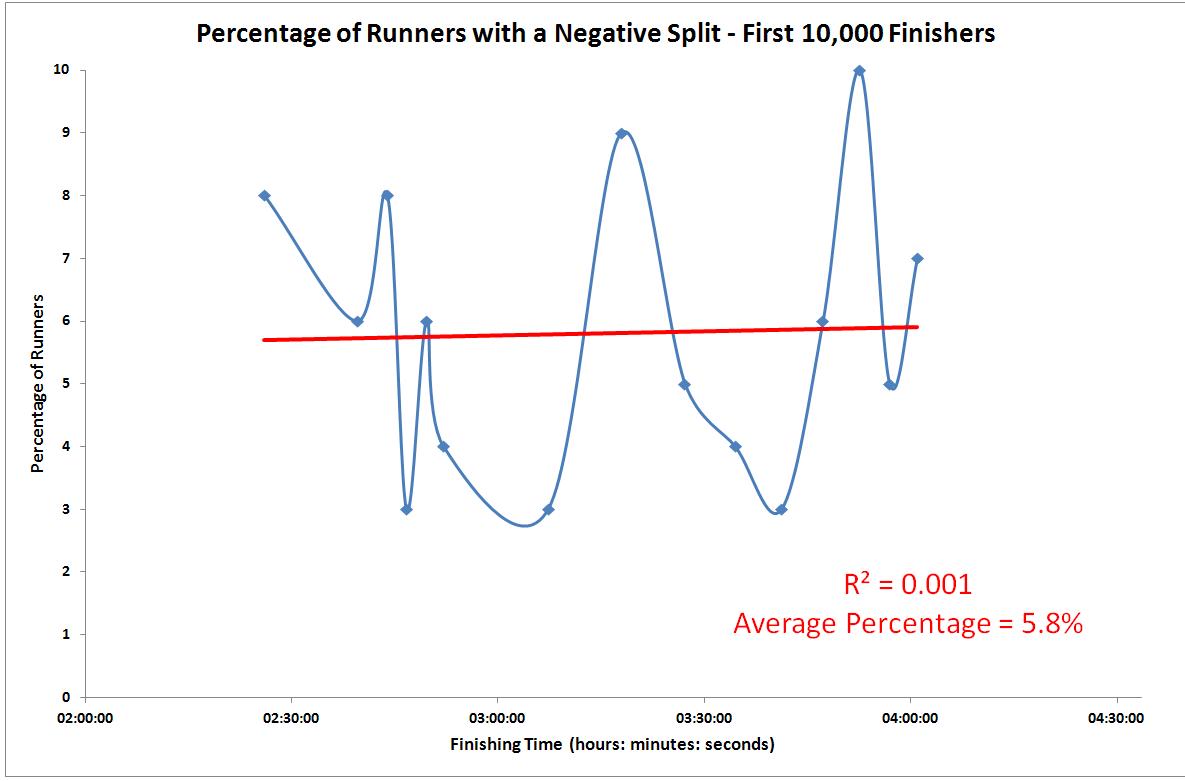
To help provide evidence for the flawed concept of the negative split, back in December 2011 I looked at the results from that year’s Virgin London Marathon. Perhaps as one would expect, based on the status the negative split has, both the male and female winners ran negative splits. So therefore why have I wasted all of this time typing up this blog post, attempting to get you to consider that the negative split isn’t what it is made out to be? But let’s look a little deeper at the results. How many of the other 99 runners in the top 100 in the massed start race also achieved a negative split? Remember these runners are the very best, at the very front of a field of over 35,000 finishers. Surely then one would expect around half of the top 100, or at least a third! No, only seven other runners in the top 100 finishers ran a negative split. This ‘strange’ result could however be because at the front of the race many of the runners went out with the pace makers at nearly world record pace, in the hope of hanging in there to the finish, they therefore were never going to achieve a negative split. So if I look at how many within the next 100 places from 101 – 200 achieved a negative split, this would give perhaps a more true representation of the frequency of the negative split occurring. These runners from 101 – 200 are still top quality runners, and in relation to the overall field, very, very fast runners, with an average finish time of 2 hours 39 minutes. The results show that there were only 6 negative split runners from the 100.


If you look at the graph above, it shows the number of runners that negative split from samples of 100 runners at different time gaps for the first 10,000 finishers, then you will see that there is ABSOLUTELY no relationship at all between the finish time of the runners and the percentage that achieve a negative split. If running a negative split was a quality of being a good runner, of a good performance, then surely one would expect that further towards the front of the field there would be a higher percentage? With a correlation of pretty well zero, one shouldn’t need any more evidence that the negative split is NOT something to aim for, NOT something that indicates that you performed well!


Another key statistic is the percentage of runners within the first 10,000 finishers that actually achieve it, being only 5.8%. With this evidence it therefore still amazes me that there seems to be the message ‘out there’ that the negative split is something all runners should aim for. If we look at a 10% sample, in batches of 100 runners, spread throughout the 23,600 runners that finished within 5 hours at London, then the percentage that achieve a negative split drops even lower to only 4.3% of finishers! The graph above also shows how the positive split slowing down time increases as the finishing time increases.

A real issue that needs attention, is in terms of the potential effect this low percentage of negative splits may have on the marathon finishers, when 95.7% of them do not achieve probably the number one goal that is drummed into them apart from finishing! Remember the message ‘out there’ that the negative split indicates that you ran well, probably even more important than your actual finishing time. So 95.7% of runners are potentially disappointed because they didn’t achieve one of their goals.  No wonder most endurance runners think negatively towards themselves!


The above figures relate to a road marathon, what about some ultra trail race data?  Well I dug out some results and did some analysis.  Hopefully it makes some sense.

Data from the 2012 Montane Lakeland 100:


So, even the widely regarded 'super human' performance by winner Terry, still involved him slowing down during the second half of the race by nine percent!  In comparison to Gancho, who obviously took it really easy during the first half of the race, being over an hour and a quarter behind me at Dalemain.  He still slowed down during the second half of the race by twenty one percent.  Yes, a reduced slowing down rate, in comparison to Paul (and Barry 2nd=, same slowdown as Paul, and also 4th place Ian with 33% slowdown) and me, with a massive 42% decrease in pace!  So only Terry slowed down less than Gancho, but Gancho only finished in 6th place.  Did his attempt to run even pace, cost him second place?  Did he gain back the time he lost during the first half of the race when running purposely slowly, by going faster in the second half of the race.  An interesting question?  I think not!

Just one last example to finish with, this time from the 2011 IAU World Ultra Trail Championships in Connemara, Ireland.  Comparing my slowing down during the second half of the race, with Julian Rendall from GB, who finished one place behind me in sixteenth place.


With regards to the percentage slowdown at the Worlds, it is much smaller than the Lakeland 100, as the first half of the Worlds course involved two very tough steep climbs of Diamond Hill, of around 400 metres climb each time!  Again the question could be asked, did Julian manage to run that much substantially faster during the second half of the race, significantly faster to gain back all of the time he lost during the first half of the race by purposely running slowly?  Again I think not!

Just to conclude "Run as fast as you can, while you can!"  The negative split is a flawed concept!

I hope that the above information has helped provide some evidence for some of the statements I made during my talk.  However, as I mentioned yesterday, the majority of the content of my talk are my views, so it doesn't automatically mean that they are correct.  The main goal from my talk was to get the audience to start questioning their ideas to training and racing.  Is there an alternative approach?

Time to sign off, and I think the words from Tom at Marathon Talk are quite appropriate.
“A large amount of what we achieve is governed by our mental state and how we see ourselves. (It is) a lot about opening the mind to what might be possible when we throw away the self imposed limitations of our mind.” Tom Williams, 2011.
To those of you that attended yesterday's TORQ Trail Team Day, thanks for making the day an enjoyable experience.  To everyone else, hopefully the above information makes some sense, even without the context of my TORQ talk!

I hope to see you all 'positive splitting' in the future,

Stuart